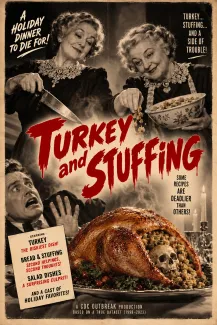
A holiday dinner seems designed to make everyone happy, except perhaps the person responsible for getting a dozen dishes to the table at once. A group of attorneys ranks the “most dangerous” holiday foods, but it tells us less about our chances of getting sick than about how easily an impressive statistic can become a misleading headline.
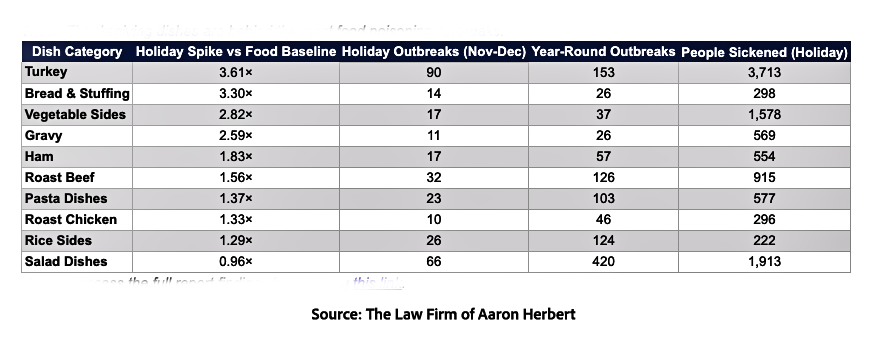
As the medical director at ACSH, I receive a number of unsolicited pitches for articles. This one comes from a Texas personal injury attorney, Aaron Herbert. The dataset comes from the CDC National Outbreak Reporting System (NORS), documenting roughly 25,000 foodborne events from 1998 to 2023, and identifies “Thanksgiving dish families whose recorded foodborne outbreaks are most concentrated in November and December.”
Turkey Is the Riskiest Dish—Or Is It?”
Here is the data sent to me:
The Missing Ingredient: A Denominator
While the math is correct, the epidemiology bears further scrutiny. Specifically:
-
The research confuses seasonal concentration with risk; reported outbreaks of turkey-related foodborne illness are much more concentrated in November and December, but without knowing how many servings of turkey people eat, we cannot determine whether a Thanksgiving turkey dinner is more dangerous than one eaten in July. We have no denominator. A greater-than-threefold concentration of cases is not the same as a threefold risk of getting sick. In fact, because many people eat more servings at Thanksgiving, holiday turkey consumption can carry a lower risk.
-
November and December are being used as proxies for Thanksgiving, one day out of 61 and one holiday out of at least three. At best, the data speak to holiday meals, not Thanksgiving specifically.
-
The researchers construct dish categories by combining meals that appear on a holiday menu, even if they are not equally “risky.” They introduce additional variation into the categories. For example, the vegetable sides category includes an outbreak involving corn in a prison, associated with 880 illnesses and 35 hospitalizations. Is that truly the same category as a serving of green bean casserole with or without soy sauce and crispy fried onions?
- NORS data reporting is voluntary. Combined with foodborne outbreaks representing only a small fraction of foodborne illness, this suggests underreporting. The original NORS dataset of 12,000 or more records was reduced to roughly 10% (1,324 records) that matched the researchers' food categories. So the data may not reflect the broader reality.
The problem isn't necessarily with the numbers themselves, but with the question they're asked to answer. Change the question, and the same data tell a very different story.
Change the Measure, Change the Menu
Using the same data, we get an entirely different ranking when we consider not the increase in reported cases during the holiday interval, but the number of individuals sickened. Turkey remains the leader, both in recorded outbreaks and people sickened. But salads emerge as a major, relatively overlooked category. Bread and stuffing, originally ranked second, fall to eighth by recorded illness burden. I am not arguing that my ranking is more salient, just that how changing the definition of danger changes the story I can tell.
If we dive a bit deeper into salads, another nuance emerges. Salads are hardly the centerpiece of most Thanksgiving dinners (who has a salad for Thanksgiving?), which illustrates another weakness in treating two months of outbreaks as a measure of Thanksgiving risk. Of the 66 holiday outbreaks attributed to salads, 34 were reported to be caused by norovirus and 12 by E. coli. Salads are not a risk from being undercooked like turkey; their disease burden comes from contamination before the ingredients arrive in the kitchen or during handling.
When we factor in the known microbial causes, including norovirus across all categories and Salmonella and C. perfringens in turkey, it becomes clear that foodborne illness at dinner can result from contamination, inadequate cooking, and improper handling during preparation or while waiting to be served.
The CDC data record the site of preparation in about two-thirds of holiday cases. Restaurants and caterers accounted for 171 outbreaks, more than three times the number of cases involving home preparations—so giving Mom the side-eye may not be warranted.
A Recipe for Safety
Whatever the limitations of his rankings, Herbert's practical advice is considerably more persuasive. The data cannot reliably identify the most dangerous holiday dish, but they do remind us of the many ways a meal can become contaminated between preparation and serving:
“When you're cooking for a full house, it's easy to put all your attention on the main course and treat everything else as an afterthought. Germs don't follow those categories. … If you're hosting this year, give every dish the same care you'd give the centerpiece of the meal, from the moment it's made to the moment it's served." – Aaron Herbert
Holiday meals place unusual demands on standard food-safety practices. We prepare larger quantities, serve more people, coordinate dishes that require different cooking temperatures, and often keep food available longer than we would for an ordinary dinner.
Four simple practices can help keep the celebration from becoming a gastrointestinal disaster:
-
Clean: Wash your hands with soap and water for at least 20 seconds, especially after handling raw meat, eggs, or flour. Clean cutting boards, utensils, and countertops between tasks, and rinse fresh produce under running water. Don't wash raw poultry; splashing water can spread bacteria around the kitchen.
-
Separate: Keep raw meat, poultry, and seafood away from ready-to-eat foods, from the grocery cart to the refrigerator to the kitchen counter. Use separate cutting boards and store raw meats in sealed containers to prevent their juices from contaminating other foods.
-
Cook: Appearance isn’t a reliable measure of safety. Use a food thermometer: poultry, stuffing, casseroles, and leftovers should reach 165°F; ground meats, 160°F; and whole cuts of beef, pork, and lamb, 145°F, then rest for 3 minutes.
- Chill: Bacteria multiply rapidly between 40°F and 140°F. Refrigerate perishable foods within two hours of serving, using shallow containers to cool leftovers quickly. Keep refrigerators at or below 40°F, and thaw frozen foods in the refrigerator, cold water, or microwave, never on the countertop.
The attorneys' rankings show how easily numbers can become a frightening headline. Without knowing how often a food is consumed, we cannot determine how dangerous it is from the number of reported outbreaks. But the data do offer a more useful lesson: foodborne illness doesn't distinguish between the turkey at the center of the table and the salad sitting off to the side. Contamination, inadequate cooking, and improper handling can make either a problem. The real holiday safety challenge isn't choosing the right menu. It's managing everything that happens before the food reaches the plate. You can find more details about turkey from the USDA.
Stay curious. Stay informed. Free, independent writing delivered weekly
— no ads, no sponsored fluff.
Join Now
Donate