
Nope, I'm not making this up.
A reader wrote in asking us to investigate something he just read: that polyester underwear can contribute to erectile dysfunction in men (as if we don't get at least one of these every day).
Erectile dysfunction is no laughing matter, especially if you're the one experiencing it. So, despite the almost irresistible temptation to turn this into a festival of adolescent jokes, I'm going to exercise some restraint. Our reader asked a legitimate question, and he deserves a legitimate answer.
Unfortunately, the scientific literature isn't making my job any easier.
Yes, there's a five-page 1996 paper in Archives of Andrology titled "Effect of Different Types of Textiles on Male Sexual Activity." The author, Dr. Ahmed Shafik, an Egyptian surgeon and researcher at Cairo University, writes in a manner that can only be categorized as "descriptive." So don't blame me for the language.
The paper described a study of 50 men, all of whom were "potent and sexually active." The men were divided into five groups of 10—four test and one control. The test groups wore different types of underwear (100% polyester, 50-50 polyester/cotton mix, 100% cotton, or 100% wool), and their sexual performance was evaluated at six and 12 months, and six months after removal (unstated was the assumption that the men removed their underpants at some point during this interval). [1]
Things get interesting fast:
"Behavioral response was rated as potent if the subject's penis became erect, entered the vagina, and ejaculated. The rate of potent intromission (I) to mounts (M) (I/M ratio) was determined."
Oh my.
Disclaimer: At no point during my education or career in chemistry did I ever think about—let alone explain—intromission, mounts, or an I/M ratio, so it is fair to question whether I have a firm grasp of the subject.
Here, you do this
Scientists need to measure stuff, right? How might this be done?
The electrostatic potentials (EP) generated on the penis and scrotum were measured by an electrostatic kilovolt-meter.
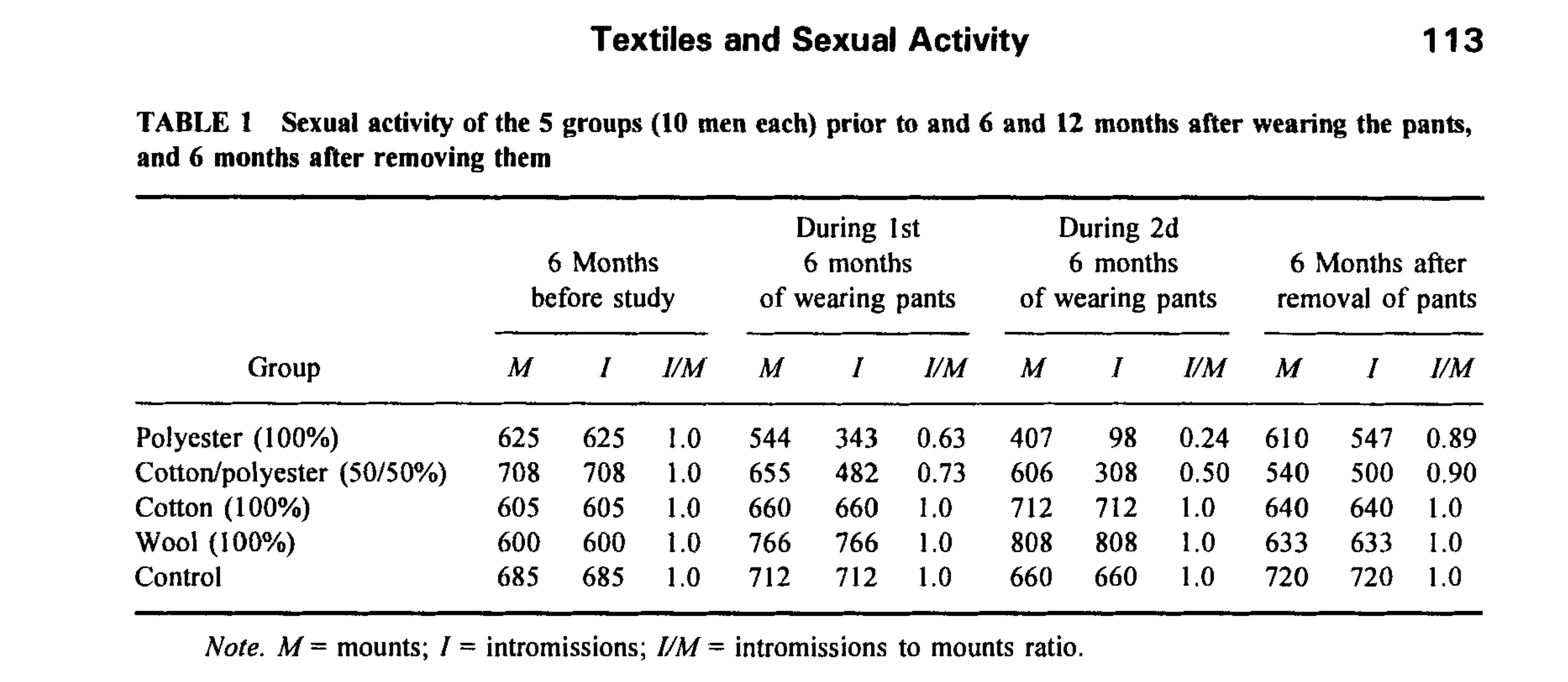
Table 1. Some remarkable numbers. Source: Shafik, A. (1996). “Effect of Different Types of Textiles on Male Sexual Activity.” Archives of Andrology, 37(2), 111–115. Table 1, p. 113.
Mounting evidence
During the six months before the experiment, Shafik reported a combined 3,223 mounting attempts among the 50 men. According to the paper, every single one resulted in successful intercourse. That's 3,223 successes and precisely zero failures. What comic book did these guys come from? Superman?
I don't know about you, but I find this rather difficult to believe. Either these guys were the sexual equivalent of the 1927 Yankees, or something is seriously wrong with the data. And things got even stranger once polyester entered the picture.
Polyester kryptonite
After 12 months of wearing 100% polyester underwear, the ratio of successful intromissions to mounting attempts plummeted to 0.24. In other words, only about one-quarter of the attempts were successful! The polyester/cotton group fared somewhat better, with a ratio of 0.50. Meanwhile, the cotton, wool, and control groups maintained their perfect 1.00 records.
But there's good news for polyester enthusiasts. Six months after the men stopped wearing the offending underwear, their success rates rebounded to nearly 90%.
Which brings us to a rather important question: How did Shafik obtain these numbers? Did the men keep diaries? Did their partners provide progress reports? Were the researchers lurking in the bedroom with clipboards? The paper doesn't say. For a study that depends entirely on counting mounting attempts and successful intromissions, that's a rather glaring omission.
Are we seeing underwear dose response?
Dose-response—the relationship between the amount of exposure to a substance and the magnitude of its biological effect—provides valuable evidence when evaluating cause and effect. Underwear isn't exactly a substance, but let's treat it like one (Table 2).

Table 2. A simplified version of Table 1 showing an apparent dose-response relationship between polyester content and sexual performance.
The results certainly look like a dose-response relationship. More polyester, worse sexual performance. Longer exposure, worse performance. And after the men ditched the polyester, things largely returned to normal. That's the sort of pattern scientists look for when evaluating causation.
Not so fast. Shafik's proposed culprit wasn't polyester itself; it was the electrostatic fields supposedly generated by the fabric. But did he actually demonstrate that these fields interfered with erectile function? Not even close. [2]
What to believe?
On one hand, the results are intriguing. On the other, the study has some serious credibility problems:
- All 3,223 mounting attempts during the six-month baseline period were supposedly successful, an almost unbelievable result.
- The author never explains how these encounters were recorded or verified, and provides only group totals rather than individual data.
- The definition of success required erection, penetration, and ejaculation, so failure didn't necessarily mean erectile dysfunction. Interesting results, but hardly enough to convict polyester of causing flaccidus underpantulus.
Bottom line
So, should men worry about polyester underwear causing erectile dysfunction? Based on this study, there's no convincing reason to. The evidence simply doesn't stand up to scrutiny. Just like the polyester guys. [3]
Since this paper could well be a Seinfeld script, let's conclude with a Cosmo Kramer quote:
I'm out there, Jerry, and I'm lovin' every minute of it!
— Kramer, Seinfeld, “The Chinese Woman.”
NOTES:
[1] I know what you're thinking. Dr. Shafik clears it up: "The 10 volunteers of the fifth group were left without pants and acted as controls."
[2] Shafik measured electrostatic potentials at the surface of the penis and scrotum but never demonstrated that the resulting electric fields penetrated the erectile tissue at sufficient strength to interfere with its function. This is a rather important omission, considering that it's the central hypothesis of the paper.
[3] In terms of evidence, this is pretty much it. I didn't trim off much of anything.

Josh Bloom
Dr. Jonathan (Josh) Bloom, ACSH's Director of Chemical and Pharmaceutical Sciences, earned his Ph.D. at the University of Virginia and completed postdoctoral training at the University of Pennsylvania. During his 20-plus years in drug discovery at Wyeth, his research group discovered the antibiotic Tygacil®, approved in 2005. He holds 25 issued patents and has authored 35 academic papers. Since joining ACSH in 2010, he has written more than 2,000 articles and dozens of op-eds for major newspapers, including The Wall Street Journal and Chicago Tribune.