The definition of PFAS—per- and polyfluoroalkyl substances—lies at the center of a regulatory debate with significant economic and scientific consequences.
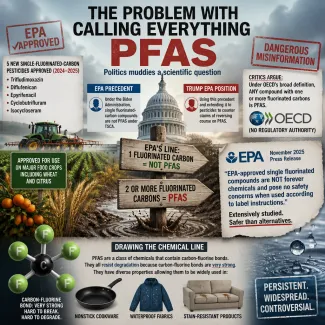
In 2024 and 2025, the EPA approved five new single-fluorinated-carbon pesticides: trifludimoxazin, diflufenican, epyrifenacil, cyclobutrifluram, and isocycloseram. These are now approved for use on major food crops including wheat and citrus. In regulating pesticides, the Trump Administration’s EPA has argued that compounds with a single fluorinated carbon are not PFAS, while those with two or more fluorinated carbons are PFAS.
Under the Biden Administration, the EPA ruled that single fluorinated-carbon compounds are not PFAS under the Toxic Substances Control Act (TSCA). The Trump Administration is using this precedent and extending it to pesticides to counter claims that they have reversed course on PFAS.
Critics claimed that these new pesticides should be considered PFAS under the Organization for Economic Co-operation and Development’s (OECD)—an international organization with no regulatory authority—broad definition, which considers any compound with one or more fluorinated carbons to be PFAS.
In a November 2025 press release, the EPA reacted strongly to “dangerous misinformation” circulating about its recent pesticide approvals, stating that “EPA-approved single fluorinated compounds are NOT forever chemicals and pose no safety concerns when used according to label instructions.” They went on to note that the pesticides have been “extensively studied” and are “safer than alternatives.”
Drawing the Chemical Line
Simply put, PFAS are a class of chemicals that contain carbon-fluorine bonds. They all resist degradation because carbon-fluorine bonds are very strong. They have diverse properties allowing them to be widely used in nonstick cookware, waterproof and stain-resistant fabrics, grease-proof food packaging, firefighting foam, cosmetics, dental floss, and some medical devices.
The regulatory definition of PFAS has shifted since the chemicals were first detected in the environment and remains unsettled. In the early 2000s, they were known as “highly fluorinated compounds” or “perfluorinated organics.” In 2011, a paper formalized the definition of PFAS, including a structural definition covering 268 individual compounds. The OECD greatly expanded this definition in 2021 to include any substance with at least one fully fluorinated carbon atom—a definition covering over 7 million compounds, and a narrower database of about 15,000.
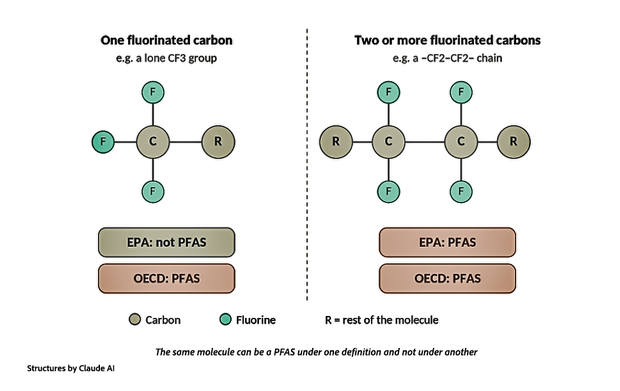
The definition is not about fluorine atoms, but about how many are attached to carbon. The molecule on the left has three fluorine atoms, but they all hang off a single carbon. That is one fluorinated carbon, not three.
I have purposely avoided the term “forever chemicals.” This is a popular journalistic term, not a regulatory or scientific one. It was first used in a 2018 Washington Post editorial by Joseph G. Allen, an assistant professor at the Harvard School of Public Health. "These toxic chemicals are everywhere — even in your body,” he alleged. “And they won't ever go away."
However, PFAS do not last forever. In fact, the half-life (the time needed for a chemical to decrease to half its original amount) of PFOA, one of the most studied PFAS, is about six months in soil and sediment samples and 2.7 years in the human body, measured by its rate of decline in blood samples.
The use of “forever chemicals” was part of a strategy to scare the public and create urgency around a group of chemicals previously known only to technical specialists. This strategy worked very well and resulted in increased research funding, product reformulation, widespread litigation, and public fear.
One Class, Many Chemicals
In one study, a panel of experts was tasked with defining PFAS for human health risk assessment and regulatory decision-making. Most experts agreed that “all PFAS” should not be grouped together and persistence alone was insufficient for grouping PFAS in assessing human health risk, finding that “it is inappropriate to assume equal toxicity/potency across the diverse group of PFAS.”
Alternatively, the European Union has adopted the view that the high environmental persistence of PFAS warrants regulating them as a class of compounds, and that they should all be phased out and replaced with alternatives.
The EPA is required by law to regulate pesticides individually under the Federal Insecticide, Fungicide, and Rodenticide Act (FIFRA). Under FIFRA, EPA must determine whether a pesticide, when used according to widespread and commonly recognized practices, will not generally cause unreasonable adverse effects on the environment.
The EPA carries out a comprehensive human health and environmental assessment to make this determination for each pesticide. Critics who want to ban all PFAS as a class ignore that FIFRA requires assessing pesticides individually, considering their specific health and environmental impacts.
The definition of PFAS is also important at the state level, with more than half the states having passed legislation restricting or banning products that contain PFAS. Of these states, the majority have defined PFAS as having “one fully fluorinated carbon atom.” Maine is the only one enacting a pesticide-specific ban on PFAS pesticides having at least one fully fluorinated carbon atom, although this ban is not effective until 2030.
Other states, such as Minnesota, Colorado, and New York, ban products containing PFAS, but do not include pesticides. California rejected an outright ban on PFAS pesticides but is considering increased oversight, with opponents, including the agricultural industry, arguing that any regulation should be chemical-specific and not based on PFAS as a class. This is a significant issue in California, since an estimated 2.5 million pounds of PFAS pesticides are applied annually.
The Other Side of the Risk Equation
The benefits of PFAS are often ignored. These compounds are essential in medicine, where more than 107 pharmaceuticals meet the OECD definition of PFAS, and fluoropolymers, which fall under the EPA’s definition of PFAS, are critical components of life-saving medical devices, including cardiovascular stents, pacemakers, and vascular grafts.
In agriculture, fluorination increases pesticide stability and allows selective targeting of plants and pests while reducing effects on non-target pests. Many of these single-fluorinated carbon pesticides have reduced risk compared to other pesticides on the market. Currently, the EPA has approved 29 herbicides, 19 insecticides, and 18 fungicides that meet the OECD definition of PFAS and have many uses. These compounds are applied to many domestic crops, including several of the top-producing crops in the U.S., such as corn, soybean, and wheat.
The responsible use of these pesticides has an important public health effect—promoting food security. One study estimated global crop losses to pests at 21.5% for wheat, 30% for rice, 22.5% for maize, 17.2% for potatoes, and 21.4% for soybeans. EPA-approved pesticides undergo extensive health assessments and are critical tools for increasing production and expanding the availability of nutritious food.
Conclusion
Unfortunately, in today’s world, a good catch phrase is often more powerful than sound science. Dr. Allen’s phrase “forever chemicals” has taken on a life of its own. But defining an entire class of chemicals on the basis of the properties of a few well-studied members is not scientifically sound.
The effort by the Biden Administration, and now the Trump Administration, to draw boundaries around what constitutes PFAS seems like the right policy decision. Understanding the health effects of individual chemicals has been the correct approach in the U.S. for decades, and we shouldn’t discard it because of a fear-driven catchphrase.

Susan Goldhaber MPH
Susan Goldhaber, M.P.H., is an environmental toxicologist with over 40 years’ experience working at Federal and State agencies and in the private sector, with an emphasis on issues concerning chemicals in drinking water, air, and hazardous waste. Her current focus is on translating scientific data into usable information for the public.