Healthcare is flooded with good intentions. People drawn to it are often motivated by a desire to help others. I'm no stranger to this, as I suffer from the need to check the “do-gooder” box. But while we’re starting from a good place, good intentions are hardly necessary, and far from sufficient, when it comes to distributing health advice and information. Case in point: Barbara O’Neill.
Much has been said of this Australian septuagenarian who identifies as a health educator, naturopath, nutritionist, and all-around smartypants in health and well-being. In 2019, she was banned from all these activities and all related activities in Australia (more on this later). So, naturally, she took her show on the road. She’s been touring the world with stops in Brazil, Thailand, India, the United Kingdom, Bahrain, Malaysia, Germany, and the United States, among others.
O’Neill has become a flashpoint; some see her as a martyr, others as a dangerous charlatan. Her defenders often repeat some version of “Even if she doesn’t have all of her facts straight, she has good intentions!” or “She cares so much!” They offer these as an explanation for her words and actions, assuming good intentions should excuse any “missteps” or misinformation she doles out. Good intentions seemingly overtake all else.
When Good Intentions Become Credentials
I’ve fervently called for regulation in health coaching for this exact reason. Without regulation, people claiming, both genuinely and disingenuously, to have good intentions flood the field. In these spaces, the thinking goes that having good intentions is a qualification in and of itself. But that’s not true. Good intentions are not enough; in fact, far from it.
Consider how we treat good intentions when a natural disaster strikes, such as a catastrophic earthquake or storm. When it hits the news around the world, millions of people feel sympathy for the afflicted area and people. Some will feel moved to act on that emotion, usually by donating money or items like clothing or sometimes even blood. However, if a person were to feel so moved that they got on a plane to the afflicted area and showed up “just to help” with no resources, know-how, or connections, they would, rightly, be kicked out of the zone as an additional burden that cannot be absorbed during a traumatic time.
As a society, we can agree that it’s not enough to show up to a disaster zone and loudly declare, “I’m here to help!” with no qualifications beyond good intentions. So is that not true in the realm of health and wellness? Why are perceived intentions enough? O’Neill possesses no medical credentials, no completed modern training, and is not subject to a regulatory board enforcing a code of conduct. All she really has is self-promoted branding.
The Business of Caring
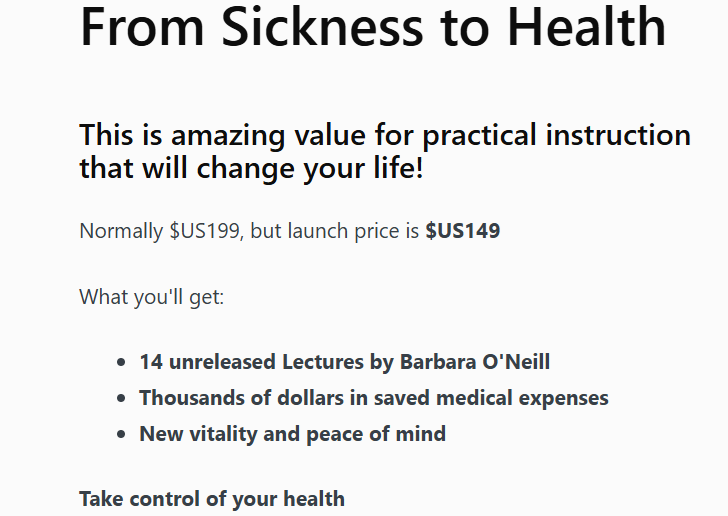
Her husband Michael publicly declared, "I know her heart, and I will keep standing beside you." But assuming O’Neill is motivated solely by good intentions requires ignoring her business model. Her website provides no information about her training or qualifications, presumably because she has none. There’s not even a “Get to know me” section of her website. Instead, there are sections dedicated to the products and courses that she offers. Some courses were developed by her family members, as it seems her brand has become a family business. There is no section dedicated to what she believes. To get that, you have to pay for it. She offers books, events, courses, and retreats.
A Health Watchdog Steps In
In 2019, Australia's health care watchdog, the Health Care Complaints Commission of Australia, banned O'Neill from dispensing any of her advice in Australia. This has been an enormous sticking point for O’Neill because she feels unfairly targeted. However, reviewing the Commission’s decision reveals a solid case:
“The Commission’s investigation found that Mrs O’Neill has limited qualifications in the area of nutrition and dietetics, which she attained more than 10 years ago. Mrs O’Neill has not taken any steps to maintain and enhance her knowledge and skills in her field of practice to deliver a professional service to the community.
Of particular concern to the Commission is that Mrs O’Neill cannot recognise and provide health advice within the limits of her training and experience. Mrs O’Neill considers herself qualified to provide health advice in highly complex and specialised areas such as cancer treatment, use of antibiotics for Strep B and immunisation in circumstances where it is clear her knowledge is limited.”
Intentions Don't Erase Consequences
We ask people to stay in their lane all the time, and it’s not considered rude. However, the moment the assumption of good intentions enters the conversation, it’s as if that matters more than a person's actions. It should be obvious, but good intentions are:
- Not a substitute for training, education, and/or experience,
- Always assumed. However, intentions and motivations are difficult to discern, as they’re internal experiences that are ultimately unknowable to others. The best proxy for understanding a person’s intentions is looking at their actions.
- Should not override harm, both potential and realized.
The wellness space is saturated with people who "just want to help." That desire is human, but in medicine, emotion is not expertise. Medical education is heavily regulated, and legitimate providers are bound by licensure, continuing education, and strict codes of conduct to ensure compassion is backed by competence. Without mandatory standards for education, training, and evidence, "good intentions" are just a euphemism for vibes. In healthcare, relying on vibes is a fast track to preventable harm.
Just as we wouldn't let an untrained volunteer run a surgical tent in a disaster zone simply because "their heart is in the right place," we cannot afford to treat health advice as a playground for uncredentialed goodwill, and Barbara O’Neill is no exception. She is the predictable result of a system that lets intent substitute for impact.

Katie Suleta, DHSc, MPH
Katie Suleta is a regional director of research in graduate medical education for HCA Healthcare. Her background is in public health, health informatics, and infectious diseases. She has an MPH from DePaul University, an MS in Health Informatics from Boston University, and has completed her Doctorate of Health Sciences at George Washington University.