By Susan Goldhaber MPH —
A sensational headline claims that a chemical in tap water is fueling the rise of colon cancer in young adults. But the studies behind that warning tell a far less alarming story: statistical associations, uncertain risks, and the familiar confusion between correlation and causation.
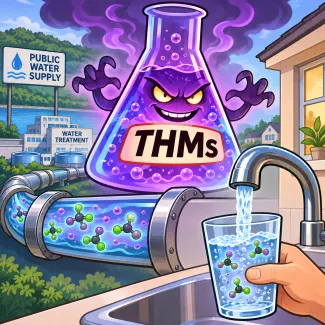
“Colon cancer rising rapidly in young people linked to chemical in tap water consumed by 250 million Americans” — Daily Mail
Both the headline and article distorted the science, misleading the public into believing that their tap water is not safe to drink.
The Daily Mail article did get one thing right: there is an increase in colon cancer in young adults under the age of 50 years by almost 1.4% annually, while there is a gradual annual decline in adults over 50 years of age by almost 3.1%. Colon cancer remains the third leading cause of cancer-related deaths in the U.S. in both males and females. Studies have explored the most likely reasons for the increase in young adults, including:
- Obesity
- Sedentary lifestyle
- Smoking
- Alcohol consumption
- Western diet
- Inflammatory bowel disease
Yet no study cited drinking water as a possible risk factor!
Chlorine: A Public Health Hero with a Chemical Footprint
According to the Daily Mail, “Levels of a common chemical linked to cancer are dangerously high in drinking water in all 50 states…” This chemical is actually a group of chemicals, trihalomethanes (THMs), that I discussed previously regarding the false assertion that they are linked to cancer. THMs are a group of chemicals formed when chlorine, added to the water as a disinfectant, combines with natural organic chemicals present in the water. Chlorine, added for disinfection, drove rapid improvements in public health in the first 40 years of the 20th Century, reducing infant mortality by 75% and childhood mortality from typhoid fever, cholera, and dysentery by roughly 66%.
In 1979, the EPA first set regulations on total THMs in drinking water, for the four THMs most found in water: trichloromethane (TCM), bromodichloromethane (BDCM), dibromochloromethane (DBCM), and tribromomethane (TBM). The regulation was set at 100 micrograms per liter (100 µg/L) based on the sum of the four THMs and reduced to 80 µg/L in 1998.
These chemicals have been extensively studied over the past four decades, and studies have not shown a causal relationship between exposure to drinking water and cancer. The Daily Mail asserts that trihalomethanes in drinking water are associated with both colon cancer and bladder cancer, primarily based on a Swedish study, a meta-analysis [1] of 29 studies assessing 14 different cancers, but only bladder and colon cancer had enough studies to analyze.
Eight Studies Become One Big Headline
The Swedish meta-analysis conducted two types of analysis on eight studies investigating bladder cancer and colon cancer. These were all observational studies that examined data on people’s exposure to THMs and their cancer outcomes. Eight studies are too few to produce accurate meta-analysis results. In comparing the highest category of THM exposure from residential drinking water to the lowest exposed category for both bladder cancer and colon cancer, the results showed that the risk of bladder cancer was 33% higher in the highest exposed groups, while the risk of colon cancer was 15% higher in the highest exposed groups.
Considering the actual doses, the results showed that bladder cancer risks were statistically significant above THM concentrations of 41 µg/L, and the colon cancer association was significant from 19 to 47 µg/L. Both associations were more pronounced in men than women.
The Trouble with Drawing a Line
The authors identified a threshold of 41 µg/L for drinking water THM concentrations, above which they stated that there is a significantly increased risk of bladder cancer. However, in risk assessment, a threshold is a dose, or exposure level, below which a given adverse effect is not expected to occur. The threshold of 41 µg/L was determined based on a non-threshold model that assumes risk at every dose. Based on the bladder cancer threshold, the authors concluded that the U.S. regulatory limit of 80 µg/L and the European Union’s limit of 100 µg/L “may not be sufficient to protect against bladder cancer in the general population.”
There are significant limits to what can be concluded from a meta-analysis, particularly one based on observational studies that indicate association, not causation. Meta-analysis of observational studies provides no additional proof of causation; it is a statistical exercise combining the results of many studies into one overall estimate.
Moreover, the studies selected for the meta-analysis can distort results, either from publication bias when studies that show positive findings are more likely to be published than those with null or negative effects, or selective reporting when researchers only report notable results within a study, or as in this case, having an insufficient number of studies to reach an accurate conclusion.
Meta-analysis only works well when studies are of similar design and adjust for the same confounders, factors that can influence both the exposure and outcome and distort their apparent relationship.
The Daily Mail also discussed a cohort study of approximately 59,000 people in Sweden exposed to THMs in their residential drinking water.
A Closer Look at the Water—and the Numbers
This observational study examined the association between THM levels and colon cancer, linking THM levels from water treatment plants to the cohort's addresses. Participants were divided into three groups: no THM exposure; low exposure (<15 µg/L); and high exposure (>15 µg/L), and hazard ratios (HR) were calculated to compare the risk of one group versus another for both men and women.
The results showed high THM concentrations in drinking water (>15 µg/L) were associated with a 26% increased colon cancer risk (HR = 1.26) in men, compared to individuals without any exposure. There was no association in women. There were several limitations to the study:
- Exposure to THM was based on levels measured at water treatment plants linked to residential addresses and did not measure actual tap water consumption.
- Hazard Ratios do not determine whether one factor caused another. In this study, it is impossible to say that the THMs in drinking water caused the increase in colon cancer.
Cancer Scare That Doesn't Hold Water
The authors of the Daily Mail article distorted the research presented. While the research has significant shortcomings, the authors of the research put qualifiers in their work. For example, in the meta-analysis they stated that:
“[W]e found limited-suggestive evidence that exposure to THMs in drinking water increases the risk of bladder cancer and colorectal cancer.”
Not exactly a ringing endorsement of their findings. Of course, the Daily Mail article doesn't include this qualifier.
The headline of the Daily Mail article is intended to shock and awe and is not based on scientific evidence. The overwhelming evidence has debunked a causal connection between THMs in drinking water and colon and bladder cancer, a conclusion that is ignored by the Daily Mail.
The bottom line? Rising rates of colon cancer in young adults are a big concern, but they're not due to THMs in tap water.
[1] A meta-analysis is a statistical method that combines the results of multiple independent studies on the same question to arrive at one overall estimate.
Category

Susan Goldhaber MPH
Susan Goldhaber, M.P.H., is an environmental toxicologist with over 40 years’ experience working at Federal and State agencies and in the private sector, with an emphasis on issues concerning chemicals in drinking water, air, and hazardous waste. Her current focus is on translating scientific data into usable information for the public.