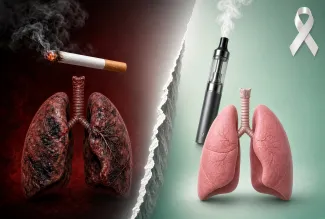
Nicotine is the psychoactive component in cigarettes, but nicotine itself is not responsible for the majority of death and disease from tobacco; instead, it’s the products of combustion that pose the major health risks. Nicotine products exist along a continuum of risk, with cigarettes at the most-harmful end and “medicinal” nicotine products (i.e., nicotine replacement therapy (NRT) products such as patches and gum which are approved for smoking cessation) at the other end:
The biggest distinction in risk is between combusted and noncombusted products, which has led some to describe this as a “risk cliff” rather than a “continuum.” E-cigarettes, sometimes referred to as “electronic nicotine delivery systems (ENDS),” are much closer to medicinal nicotine than they are to cigarettes.
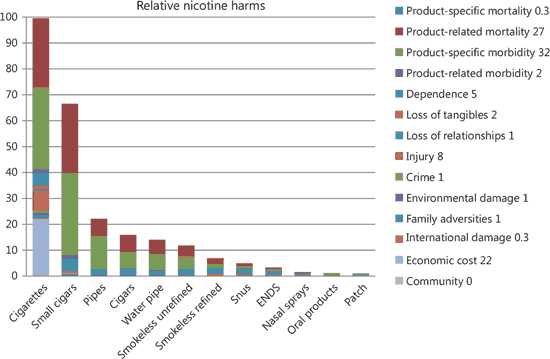
Source: Nutt et al., 2014
Several health authorities (but not all, as discussed later) agree that e-cigarettes are less harmful and that people who smoke cigarettes can reduce their harm by switching completely to e-cigarettes:
-
The UK’s Office of Health Improvement and Disparities (OHID) concluded in their 2022 evidence review that “vaping poses a small fraction of the risks of smoking.”
-
The US Food and Drug Administration (FDA), which regulates consumer nicotine and tobacco products, states that switching completely from cigarettes to e-cigarettes may reduce exposure to many harmful chemicals.”
- Health New Zealand states that “vaping is less harmful than smoking… because smoking burns tobacco and creates many harmful toxins” and that vaping “gives you nicotine in a less harmful way than smoking.”
Not only is there a continuum of risk, but also a continuum of dependence. For example, based on quit rates of different products, it appears much easier to quit smokeless tobacco than cigarettes, and still easier to quit NRT products. This is because smoking a cigarette yields a large and rapid “spike” in nicotine absorption, whereas using most noncombusted products gives a more gradual, flattened nicotine delivery that doesn’t rise to the same levels.
E-Cigarettes are Effective for Smoking Cessation
E-cigarettes are more effective for smoking cessation in head-to-head comparisons against NRT. In fact, evidence from randomized controlled trials (RCTs) is so strong and consistent that the latest Cochrane review grades it “high-certainty,” meaning future studies are unlikely to change that conclusion.
Dr. Nancy Rigotti, Professor of Medicine at Harvard Medical School, argues that evidence has reached a “tipping point” for “the medical community to acknowledge this progress and add e-cigarettes to the smoking-cessation toolkit.” A working group of the Society for Nicotine and Tobacco Research (SRNT)’s the Tobacco Treatment Network published a commentary in JAMA to provide “evidence-based guidance to clinicians regarding use of e-cigarettes for smoking cessation.”
In other words, there is no longer any reasonable doubt that e-cigarettes could benefit adults who smoke and are trying to quit.
It’s Not Just about “Treating” Cigarette Smoking
But what about adults who smoke and are not trying to quit? After all, at any given time, only ~15% of US adults who smoke are planning to quit within a month. Since intending to quit is a prerequisite for obtaining treatment (e.g., e-cigarettes, NRT, or a prescription), the remaining ~85% would not use e-cigarettes for the express purpose of quitting smoking.
The striking thing about e-cigarettes, however, is that they can help people stop smoking even when they are not necessarily trying to; this phenomenon is sometimes dubbed “accidental switching” and has been captured in real-world evidence studies. In a longitudinal JUUL purchaser study, rates of switching away from cigarettes were high (51-59% at the 24-month follow-up) regardless of participants’ quit intentions at baseline. Similar results were found in a naturalistic RCT that provided e-cigarettes to participants who may or may not have initially wanted to quit smoking. An analysis of the longitudinal and naturally-representative Population Assessment of Tobacco and Health (PATH) study found that among adults who initially never wanted to quit smoking, those who used e-cigarettes had 8 times the odds of later doing so.
Since the total impact of a product or intervention is a function of both efficacy and reach, and e-cigarettes are favorable on both accounts, their total impact at the population level has been substantial. In the US, e-cigarettes are by far the most widely-used quit aid by adults who recently stopped smoking in 2022 (~40% vs. <20% for all other single quit aids); England shows nearly identical results.
In fact, it’s even possible that “accidental switching” may be e-cigarettes’ predominant method of action and has a larger population-level impact than the “medical treatment” route (i.e., in pre-planned quit attempts). In a narrative review examining different analyses of the same data from the nationally-representative PATH study, the association between vaping and later stopping smoking was more consistent when including all participants (i.e., regardless of quit intentions) than when including only those who used e-cigarettes with the intention to quit smoking.
Rampant Misinformation and Misperceptions about E-Cigarettes
Despite the critical mass of evidence on e-cigarettes’ lower toxicity compared to cigarettes and their effectiveness at helping people stop smoking, misperceptions are widespread and have worsened over time. In 2022, over 90% of adults who smoked incorrectly believed that e-cigarettes were equally or more harmful than cigarettes.
Several factors have contributed to these worsening misperceptions, such as the 2019 outbreak of EVALI (e-cigarette or vaping associated lung injury) which was initially (and incorrectly) attributed to nicotine e-cigarettes but later traced to an additive (vitamin E acetate) in illicit THC vapes. Misperceptions about e-cigarettes worsened after EVALI and did not fully recover, possibly because US health authorities continue to use the misnomer “EVALI” despite prominent academics urging them to rename the outbreak so as to remove the reference to (nicotine) e-cigarettes.
Additionally, alarmist media coverage about e-cigarettes may have contributed to “increased public confusion regarding the likely relative risks of vaping and smoking.”
Misinformation Relevant to Lung Cancer
Unfortunately, the medical community is not immune to these misperceptions. A recent survey found that 80% of healthcare providers incorrectly believed e-cigarettes were equally or more harmful than cigarettes. When asking specifically whether they believe nicotine causes cancer, responses range from 25% to ~80% across surveys.
Healthcare providers have an additional source of misinformation: medical societies. The American Cancer Society’s page on e-cigarettes incorrectly states that “there is not enough research to show that [e-cigarettes] help people stop using tobacco.” It also implies that e-cigarettes could cause cancer, while implicitly acknowledging that there is no evidence yet (“scientists are still learning”). ACS drew this conclusion about cancer risk because e-cigarette aerosol “can contain harmful chemicals,” while neglecting to mention that the levels of these cancer-causing chemicals are 1-2 orders of magnitude lower than those in cigarettes.
Similarly, the American Lung Association (ALA) does not endorse switching to e-cigarettes as a way to stop smoking, ironically stating that “misinformation about e-cigarettes is rampant” before misleadingly saying that “FDA has not found any e-cigarette to be safe and effective in helping smokers quit.” This statement is technically true but misleading, as it refers to a US regulatory distinction (“safe and effective” in drug regulation vs “appropriate for the protection of public health” in tobacco product regulation)—not a scientific result. The omission of Cochrane’s high-certainty evidence is further misleading as it leaves the false impression that there is no evidence for e-cigarettes’ effectiveness at helping people stop smoking.
What Do We Know about E-Cigarettes and Lung Cancer?
The short answer is, we don’t yet have conclusive long-term data, but short- and medium-term evidence is optimistic. ACS and ALA correctly note that it takes several decades for lung cancer to develop but e-cigarettes have only been around for ~20 years. But the lack of data over a 30-50-year timeline doesn’t mean we know nothing.
We know from decades of toxicological research which constituents in cigarette smoke cause cancer. For example, levels of tobacco-specific nitrosamines (TSNA) are >90% lower in people who switch completely to e-cigarettes than people who continue to smoke. When modeling lung cancer risk based on harmful constituents, one study estimated the risk to be 5 orders of magnitude lower in e-cigarette aerosol than in cigarette smoke.
The studies on human data are not only limited by lack of long-term data, but also by systematic biases. Since the majority of e-cigarette users either currently or formerly smoke, teasing apart the lung cancer risk from smoking vs. vaping is nearly intractable. For example, a recent prospective study found that complete quitters had lower lung cancer risk than switchers, but a methodological criticism pointed out the difference could be due to quit duration: switchers stopped smoking only recently (since e-cigarettes are relatively recent) while many complete quitters had done so decades ago, and would have had more time for their lung cancer risk to decline.
We will need more carefully-conducted studies—that adjust for detailed smoking history and lifetime exposure—to monitor lung cancer risk of e-cigarette use, both in absolute terms (i.e., compared to non-use) and relative to cigarette smoking. Meanwhile, those at the highest risk for lung cancer and other smoking-related diseases may be able to reduce their risks; for example, a recent pilot trial provided e-cigarettes to patients undergoing lung cancer screening, who then significantly reduced their cigarette consumption.
As evidence accumulates, we should take a moment to be grateful for the national decline in lung cancer over the past several decades.

Arielle Selya
Arielle Selya, PhD, is a behavioral scientist whose work focuses on nicotine use, tobacco harm reduction, and the analysis of population-level trends. She earned her doctorate in neuroscience from Rutgers University and has published 85 peer-reviewed papers.