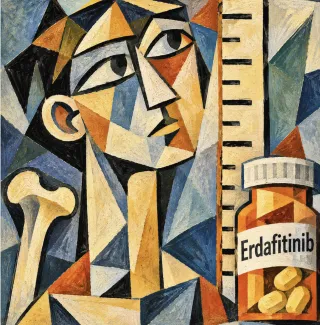
Thanks to websites such as YouTube and TikTok, there is a virtually unlimited collection of video stupidity, much of it aimed at teenagers trying to improve some aspect of themselves—often their appearance.
Some of these schemes are merely ridiculous. Others are downright dangerous. But once in a long while (and you can count these on one toe), an idea comes along that is both dangerous and based on some surprisingly legitimate science.
Welcome to the bizarre world of heightmaxxing, where teenage boys are reportedly taking a prescription cancer drug in the hope of growing taller, as reported in a recent article in the New York Post.
As crazy as this sounds, there's actually a scientific rationale behind it. Unfortunately, there's also a rather substantial difference between understanding how a drug works and deciding that swallowing it is a good idea.
Meet erdafitinib: A cancer drug with an unexpected talent
Before we get started, you may have noticed that the generic names of many advertised drugs end in -mab or -nib. This is no accident. Although the naming convention for monoclonal antibodies (the mabs) changed in 2021, plenty of mabs remain, along with an ever-growing collection of nibs.
Mabs belong to a class of biological drugs known as monoclonal antibodies. Roughly 150 have received FDA approval, and you've probably heard of some of them, such as Humira (adalimumab), Keytruda (pembrolizumab), and Dupixent (dupilumab).
Nibs, on the other hand, are kinase inhibitors—drugs that interfere with enzymes that phosphorylate proteins, a major mechanism of cellular signaling. Most of the roughly 100 FDA-approved kinase inhibitors are pills, not biologics, and about 80 are used to treat cancer.
Why so many? They're part of the targeted therapy boom that has dominated pharmaceutical research for decades. The idea is simple: Instead of attacking cancer cells with drugs that also damage plenty of healthy cells, identify a protein that helps drive the cancer and design a drug to interfere with it. One of the earliest success stories was Gleevec (imatinib), approved in 2001, which transformed the treatment of chronic myeloid leukemia. Unfortunately, targeted doesn't necessarily mean selective, and it certainly doesn't mean harmless.
Although "Nibs and Mabs" sounds like something Willy Wonka might have invented during a nervous breakdown, sadly, it isn't.

One of these nibs is erdafitinib (brand name Balversa), which was approved by the FDA in 2019 to treat certain forms of advanced bladder cancer. In some bladder cancers, mutations cause a protein called fibroblast growth factor receptor 3 (FGFR3) to become excessively active, sending signals that encourage cancer cells to grow and divide. Erdafitinib blocks those signals, slowing the growth of tumors that carry the relevant mutations.
Like other kinase inhibitors, erdafitinib interferes with cellular signaling, the chemical communication system that tells cells when to grow, divide, or perform other functions. Much of this communication depends on a chemical reaction called phosphorylation (Figure 1).
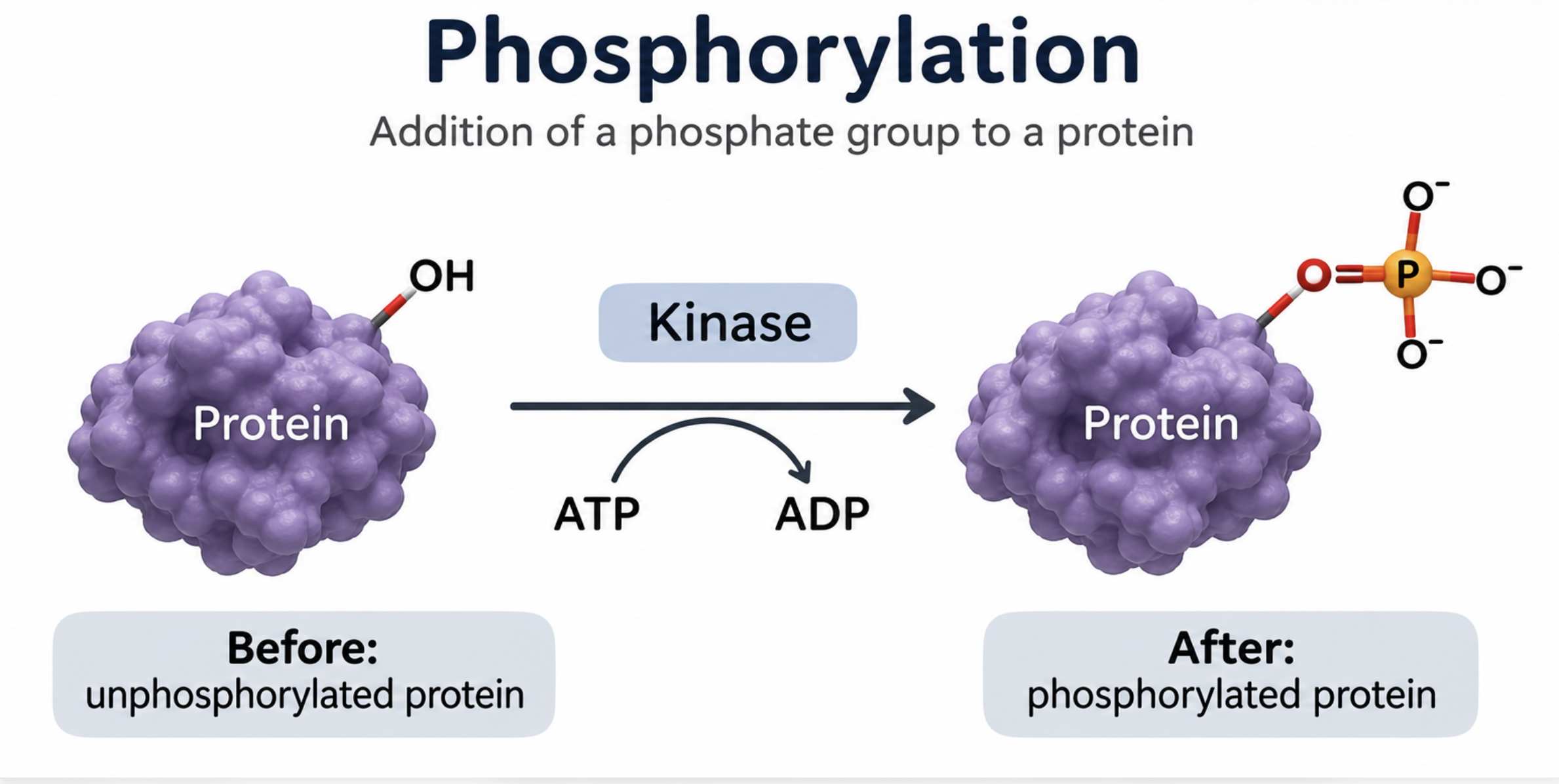
Figure 1. Protein phosphorylation.
A protein kinase is an enzyme that transfers a phosphate group from ATP to a protein, converting ATP to ADP in the process. It might not look like a big deal, but this seemingly trivial chemical modification is anything but. It can dramatically change what a protein does. In the world of cellular signaling, a little phosphate goes a long way.
FGFR3 is one of four fibroblast growth factor receptors, which are involved in numerous biological processes. As it turns out, this particular receptor also plays an important role in regulating bone growth.
And that's where things get interesting. And messed up.
Nibs are not for nibbling
Kinase inhibitors are serious drugs. They interfere with signaling pathways that control fundamental cellular processes, so they can produce remarkable therapeutic effects. But those same pathways also operate in healthy cells, which means the drugs can cause some pretty nasty side effects. And erdafitinib is no exception (Table 1).
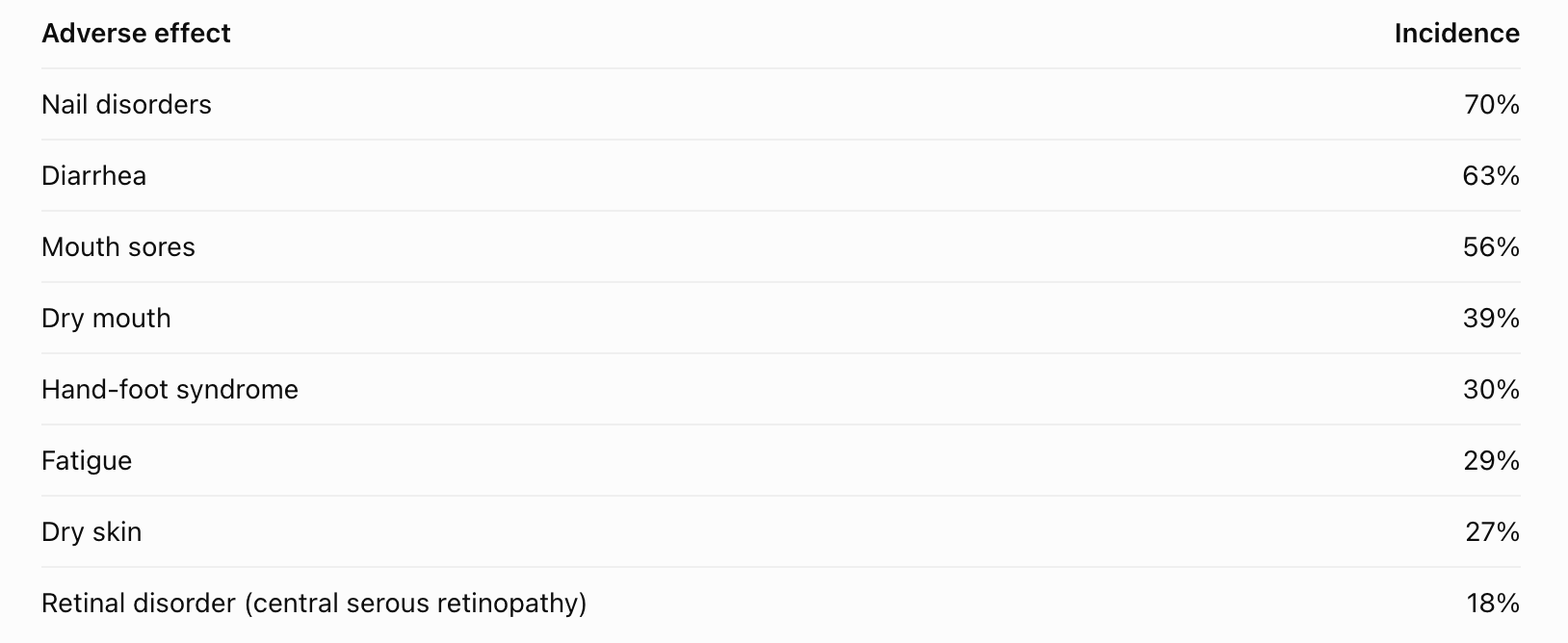
Table 1. Common adverse effects of erdafitinib (Balversa). Data from 135 patients treated with erdafitinib in the Phase III THOR trial (BLC3001). Source: DailyMed
How can a cancer drug make you taller?
To understand why erdafitinib might make someone taller, you need to know a little about how bones grow.
Long bones (those in your arms and legs) grow in length at regions near their ends called growth plates. These contain cartilage cells called chondrocytes. These guys multiply and mature, producing cartilage that is eventually replaced by bone. This process continues throughout childhood and adolescence until the growth plates close. Once that happens, you're pretty much stuck with the height you've got.
This is where FGFR3 comes in. Although its name contains the words growth factor, FGFR3 actually acts as a brake on bone growth. When activated, it slows the multiplication and maturation of chondrocytes, putting the whammy on bone lengthening. This can be demonstrated by examining mutations that make FGFR3 excessively active. The result can be achondroplasia, a form of dwarfism in which the arms and legs are disproportionately short.
In other words, too much FGFR3 signaling inhibits bone growth. So what happens if you inhibit FGFR3 instead? In principle, you release the brake, allowing bones to grow faster. And since erdafitinib inhibits FGFR3, there's a perfectly reasonable scientific basis for thinking that the drug might increase growth in children and teenagers whose growth plates are still open. This isn't just theoretical. But there's a big difference between making bones grow faster and making them grow properly. That is where this idea goes down the toilet.
When growing taller goes horribly wrong
In a 2024 paper, researchers described two children with brain tumors [1] who experienced unexpected growth spurts while receiving erdafitinib. Neither was going through puberty, making the unexpected growth spurts particularly striking. So the drug really did appear to make them grow faster.
Another 2024 case report described a 15-year-old boy being treated with erdafitinib for a brain tumor. Over nine months, he grew 14.3 centimeters (5.6 inches). That's a hell of a growth spurt.
But there was a catch. The rapid growth was accompanied by serious skeletal deformities, including abnormal curvature of the spine and contractures of the hip muscles. He eventually required surgery to correct the spinal deformity.
And he wasn't the only one to experience skeletal problems. Other children receiving FGFR inhibitors have developed slipped capital femoral epiphysis, a condition in which the ball-shaped head of the thighbone slips out of its normal alignment at the growth plate. This is not something you fix by buying longer pants.
An FDA analysis identified five pediatric cases of skeletal growth toxicity associated with erdafitinib. Three required surgery, and treatment was permanently discontinued in all five.
So, is there legitimate science behind heightmaxxing with erdafitinib? Believe it or not, yes. Blocking FGFR3 can accelerate bone growth, and there's evidence that erdafitinib does just that.
But here's the catch, and it's a big one. Does growing faster mean you'll end up taller? Beats me. And apparently, nobody else knows either. The evidence comes from a handful of seriously ill kids being treated for cancer, not healthy teenagers trying to add a few inches to their height.
And let's not forget the drug's other lovely properties, including potentially serious eye damage and screwed-up phosphate metabolism. Not to mention the possibility of growing bones that don't quite end up where they're supposed to.
Erdafitinib is a cancer drug, not a bottle of Miracle-Gro. There's some fascinating science behind this latest teenage craze. There's also a rather impressive amount of stupidity.
The lesson? Knowing just enough science to come up with a "clever idea" doesn't necessarily mean knowing enough to recognize a really crappy one.
NOTE:
[1] Although erdafitinib is approved for certain bladder cancers, some brain tumors also have genetic changes that activate FGFR signaling. This provides a rationale for trying the drug experimentally in patients with those tumors, even though it isn't approved for treating brain cancer.

Josh Bloom
Dr. Jonathan (Josh) Bloom, ACSH's Director of Chemical and Pharmaceutical Sciences, earned his Ph.D. at the University of Virginia and completed postdoctoral training at the University of Pennsylvania. During his 20-plus years in drug discovery at Wyeth, his research group discovered the antibiotic Tygacil®, approved in 2005. He holds 25 issued patents and has authored 35 academic papers. Since joining ACSH in 2010, he has written more than 2,000 articles and dozens of op-eds for major newspapers, including The Wall Street Journal and Chicago Tribune.