An unending war that is being fought all over the world. No bullets are fired, no bombs are dropped, and no peace treaty will ever be signed. This war is being fought between plants on one side and insects and pathogens on the other.
Pathogens, from the Greek "pathos" for "disease" and "gen" for "producer," are biological agents such as bacteria, viruses, fungi, and parasites that can cause disease in a living organism. The war is one of survival. Plants want to grow and reproduce, and so do insects and pathogens. The problem is that both pathogens and insects rely on living systems, such as plants and animals, for the nutrients they need to survive.
Since plants can’t run away from their enemies, they have developed a variety of chemical weapons to fend them off. And as far as plants are concerned, we are enemies as well: Plants did not evolve to serve as our food supply. Luckily, since we are much larger than the insects and the pathogens that confront plants, the dose of chemicals that plants produce to ward off these foes is unlikely to affect us. As we well know, only the dose makes the poison.
Sometimes, though, even a tiny dose can be a problem, which is why we get involved in the warfare. We are also interested in survival, and we want to protect ourselves from plant toxins. Furthermore, given that plants directly or indirectly supply nearly all our food, our survival depends on plants surviving enemy attack. We therefore come to their aid with the use of insecticides and selective breeding methods that we have devised.
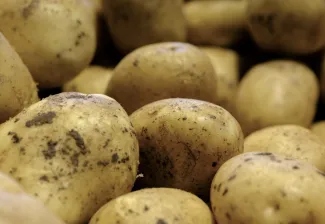
Let’s consider the most widely consumed vegetable in North America: the potato. We love our French fries, our chips and baked tubers. But insects also love the tater.
To protect itself, the potato unleashes two natural insecticides, alpha-solanine and alpha-chaconine, that not only discourage feeding with their bitter taste but also damage the insects’ digestive tract and interfere with the functioning of their nervous system. These 'glycoalkaloids' can damage cell membranes and inhibit acetylcholinesterase, an enzyme responsible for breaking down the neurotransmitter acetylcholine. An excess of acetylcholine causes the nervous system to go haywire, resulting in death.
The potato’s arsenal is the result of evolution. Wild potatoes grew in South America long before humans ever appeared there, and those that by chance produced chemicals that were distasteful to insects were more likely to survive and reproduce. When humans migrated from North America around 14,000 years ago, they encountered the potato and found it to be edible but not always palatable. However, many varieties of potato grew in the wild, and some were less bitter than others.
Early farmers discovered that if a potato were planted, a new potato plant would grow from its sprouts, and they learned to select less bitter tubers for planting. Through such “vegetative reproduction,” meaning reproduction without the need for fertilization by pollen, potatoes containing less solanine and chaconine were domesticated.
Potatoes have worries other than insects. They can be attacked by Phytophthora infestans, a fungus-like microscopic pathogen that results in what is commonly called “potato blight.” Spores land on potato leaves, germinate, and the living pathogen multiplies, penetrates the plant tissue, and destroys it. Phytophthora can then be spread by wind and rain and wipe out an entire crop.
This is what happened in Ireland in 1845, resulting in the Irish Potato Famine. Farmers had relied on one variety of potato, and unfortunately it was susceptible to blight. Since, for many poor people, the potato was their main food, famine ensued.
Eventually, modern breeding practices came to the rescue, starting with the 17th-century discovery of pollen’s role in plant reproduction. Flowers were found to have male structures called stamens and female structures termed pistils. In some cases, they were found on separate male and female plants, and in others, like the potato, flowers contained both male and female structures and were therefore capable of self-fertilization.
By the 18th century, scientists discovered the possibility of taking pollen from one plant to fertilize another. In the case of the potato, the stamen was removed from the flower of one plant to prevent self-fertilization, and the pollen from the flower of another potato plant with a different chemical profile was applied to the pistil. The flower then produced seeds that gave rise to a potato with the genetics of both “parents.” For example, a potato that is low in solanine and chaconine can be crossed with one that resists blight in hopes of producing a new variety that combines both properties. In this fashion, through many crossbreeding experiments, the varieties of potato that do not poison us and that resist pathogens and insect attack have been produced.
But the pathogens and insects do not take this assault on their survival lying down. They fight back. Their weapon is the development of resistance to the plant’s chemical weapons. The Colorado potato beetle, for example, has evolved resistance to the potato's natural chemical defenses. Again, this is evolution at work. Not all beetles have the same susceptibility to the plant’s pesticides, and the ones that are more resistant are more likely to multiply so that eventually the whole population of beetles develops resistance.
This is when scientists joined the battle with the weapon of biotechnology. Back in 1911, in Thuringia, Germany, bacteriologist Ernst Berliner isolated a bacterium from some diseased caterpillars that was later christened Bacillus thuringiensis (Bt). By the 1930s, scientists found that spraying the spores of this bacterium on plants protected them from insect infestation. When susceptible insects consume the bacterial spores and associated toxic proteins, the proteins damage their digestive tract, eventually killing them. In Canada, spraying forests with Bt spores was effective in controlling the devastation caused by the spruce budworm.
Then in the 1980s, researchers managed to identify and clone the bacterial genes that produce the toxic protein and insert these genes into the genome of a plant so that the plant produces the protein. This means that the plant now has a built-in protection system. Bt corn and Bt cotton met with great success.
Monsanto also introduced potatoes that were genetically engineered to produce the Bt toxin to combat the Colorado potato beetle, which had become resistant to the potato’s natural pesticides. The technology worked very well in the field, but not in the marketplace. Alarmists had scared people about genetically modified foods, and potato chip producers, concerned about a consumer backlash, were not interested in buying the engineered potato. It faded from the marketplace. Too bad.
In every war, there are winners and losers.
# Reprinted with permission. Dr. Schwarcz’s original article can be found on the OSS website
May be lightly edited for clarity and accuracy

Joe Schwarcz
Dr. Joe Schwarcz is Director of McGill University's “Office for Science and Society” which has the mission of separating sense from nonsense. He is well known for his informative and entertaining public lectures on topics ranging from the chemistry of food to the connection between the body and the mind.