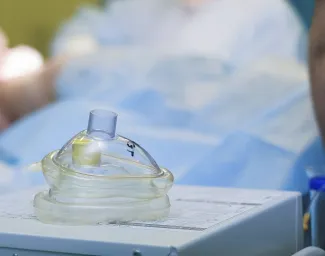
Physicians assembled in an operating room at Boston’s Massachusetts General Hospital on Oct. 16, 1846, to watch chief of surgery John Collins Warren remove a tumor from the neck of young Edward Gilbert Abbott. Dentist William Morton had been experimenting with the sleep-inducing properties of ether and managed to convince Warren to give it a try.
A year earlier, dentist Horace Wells had approached Warren with a proposal. He explained that he had been using nitrous oxide, colloquially known as “laughing gas,” to perform “painless” dentistry and had become convinced of its efficacy after inhaling the gas and gallantly having one of his own teeth extracted.
Now he proposed to extract a tooth from a patient with Warren and his staff watching. The surgeon agreed to the demonstration, but unfortunately it became a fiasco, with the patient yelling in pain and jumping out of the chair. Apparently, in his eagerness to prove that nitrous oxide could dull pain, Wells did not wait long enough for the gas to take effect.
Cries of “humbug” echoed through the room. But the experience with Morton’s ether was different, prompting Warren’s remark of “no humbug.”
There are a couple of footnotes to that epic 1846 moment. Four years earlier, Crawford Long, a country physician in Georgia, had successfully removed a tumor from the neck of James Venable after having him inhale ether fumes. Long then went on to carry out other surgeries with ether, including amputations, but he didn’t publish his results until 1849, which is why Morton gets credit for introducing ether anesthesia into medical practice. It pays to publish.
Long did eventually achieve a certain degree of fame. His statue stands under the rotunda of the U.S. Capitol in Washington with the inscription “discoverer of the use of sulphuric ether as an anesthetic in surgery on March 30, 1842, at Jefferson, Jackson County, Georgia U.S.A.”
That Long practiced in Jackson County is a curious coincidence, given that after Morton’s famous demonstration of ether anesthesia, Dr. Charles Jackson (who had nothing to do with Jackson County, which was named after Revolutionary War general James Jackson) claimed that he was the original discoverer of the anesthetic properties of ether and had described his experiments to Morton when he visited his lab at Harvard.
That was not Morton’s recollection. He claimed he had been experimenting with ether and had sought Jackson’s help to create a device to dispense ether because of Jackson’s expertise in chemistry.
But there is a second footnote to Morton’s and Long’s demonstrations of ether anesthesia. Thirty-eight years before Long’s use of ether, on Oct. 13, 1804, Japanese surgeon Seishu Hanaoka excised a tumor from the breast of a patient under general anesthesia. However, Hanaoka did not use an inhalation anesthetic. He had learned the tenets of ancient Chinese herbal medicine and had his patient drink a potion he had formulated that came to be known as “Mafutsusan,” based on Chinese words for “boil” and “powdered medicine.”
The main ingredients were Datura stramonium, known by the common name “devil’s trumpet”; Aconitum japonicum, also known as “monkshood” or “wolfsbane”; and Angelica dahurica. A total of seven grams of these and four other herbs were boiled in water, the solution shaken and then administered orally. The patient gradually became unconscious and remained so for several hours before recovering uneventfully.
The sleep-inducing chemicals in the herbal mixture were atropine, hyoscyamine and scopolamine, which exert their effects by blocking the action of the neurotransmitter acetylcholine. Angelica serves a different function: It contains compounds that interfere with the activity of enzymes that break down foreign substances and therefore could enhance the activity of the anesthetic components. Each of Mafutsusan’s ingredients already had a long history of folkloric use for various ailments, but Hanaoka gets credit for carrying out systematic experiments on dogs for 10 years to devise his specific formula.
Hanaoka’s fascinating story is told in the 1967 Japanese film The Wife of Seishu Hanaoka, which also reveals how his wife and mother sought to be the first human subjects to try Mafutsusan. The surgeon chose his wife, and while the sedation worked well, she tragically ended up losing her vision. Nevertheless, Hanaoka carried on, and after his pioneering breast-cancer surgery, he went on to perform many other operations using Mafutsusan as a general anesthetic.
Although his contribution has generally been ignored by Western texts, Hanaoka deserves to be recognized for performing the first well-documented surgical operation under general anesthesia.
However, it is Morton’s introduction of ether anesthesia that is celebrated every Oct. 16 on “Ether Day.” The surgical theater where the operation was performed has been preserved as the “Ether Dome,” where a visitor can find the surgical chair in which Abbott sat, replete with stains that are said to be blood from the operation. Morton’s original ether dispensing flask has been lost, but a replica can be seen in Harvard’s Warren Museum of Medicine.
Shortly after Morton’s demonstration, Harvard Medical School professor Oliver Wendell Holmes suggested the term “anesthesia” for the sleep produced by ether, from the Greek “aesthesis,” meaning “perception,” and “an,” meaning “without.”
Wendell Holmes, however, is better known for his cynical quotations about medicine, the best known of which is: “If the whole Materia medica could be sunk to the bottom of the sea, it would be all the better for mankind — and all the worse for the fishes.”
That remark captures his skepticism toward the enormous number of ineffective remedies used in 19th-century medicine. But Wendell Holmes did recognize that anesthesia was not one of them.
# Reprinted with permission. Dr. Schwarcz’s original article can be found on the OSS website
May be lightly edited for clarity and accuracy

Joe Schwarcz
Dr. Joe Schwarcz is Director of McGill University's “Office for Science and Society” which has the mission of separating sense from nonsense. He is well known for his informative and entertaining public lectures on topics ranging from the chemistry of food to the connection between the body and the mind.