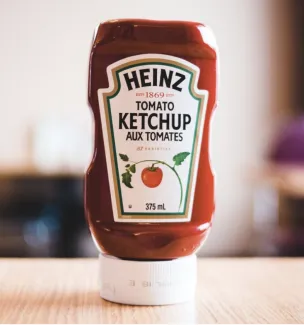
You turn the ketchup bottle upside down, and nothing comes out. Frustrated, you start banging on the bottom of the bottle and all of a sudden there is a burst of red slush. You have just experienced the behavior of a non-Newtonian fluid, one whose viscosity changes on the application of a force.
In contrast, Newtonian fluids, like water or oil, maintain a constant viscosity regardless of how vigorously they are stirred or shaken. Ketchup’s odd behavior has to do with the pectin and cellulose leaching out of tomato cell walls, mixing with microscopic particles of tomato pulp to form an interconnected structure that traps water. When shaken, the structure is dismantled, the water is released, and the ketchup flows. Of course, Isaac Newton did not have ketchup in mind when he wrote his classic treatise on fluid dynamics. Tomato ketchup would not appear on the scene for another one hundred years.
Ketchup is best described as a condiment, a substance added to food to enhance, complement, or change its flavor.
The first condiment was probably a fermented fish sauce that in an ancient Chinese dialect sounded like “ke-tsiap.” When fish is fermented, naturally occurring microbes present in fish release enzymes that break proteins into smaller peptides and amino acids, one of which is glutamic acid, which stimulates a taste known as “umami.” Today, purified monosodium glutamate (MSG) is widely used as a flavoring agent.
Sometime during the 17th century, British merchants encountered fermented fish sauce on their travels to China and introduced this condiment to the British palate. Cooks then began tailoring the sauce to please local taste buds by adding mushrooms, walnuts, spices, and vinegar. Tomatoes did not enter the picture until 1812, when Philadelphia physician James Mease replaced fermented fish with tomato pulp, spiced shallots and brandy. Tomatoes turned out to be an excellent substitute for fish because they naturally contain glutamic acid, which also explains why pizza has become a global favorite.
It wasn’t long before food producers realized the appeal of tomato “katsup,” as it was then called. By the latter part of the 19th century, Henry Heinz began to market the tomato-based condiment. However, there was a problem. Sometimes the ketchup would spoil due to the growth of bacteria, yeasts and molds. Heinz found that adding vinegar, sugar, and salt reduced the problem, as did ensuring that the cooking equipment and bottles were scrupulously clean.
Some producers took a different approach and added sodium benzoate to ketchup to give it an even longer shelf life. That did not sit well with Dr. Harvey Washington Wiley, the U.S. Department of Agriculture’s chief chemist. Wiley was a great advocate for food safety at a time when food production was essentially unregulated. He believed that something had to be done and organized a series of experiments in which a dozen healthy, young male volunteers would consume meals that included substances Wiley believed could potentially be dangerous.
The men, who became known as the “Poison Squad,” ate meals with added borax, salicylic acid, sulfites, formaldehyde, and sodium benzoate, all of which were being used at the time as food preservatives in an unregulated fashion. The doses of these chemicals in the meals were far greater than what was normally added to food. The theory was that this would mimic what could happen with the consumption of small doses over a long time. Any symptoms the men experienced were duly documented.
Formaldehyde, borax, and sulfites caused various adverse reactions. Sodium benzoate seemed to cause digestive problems in some of the men, but the results were inconclusive. Wiley’s experiments were controversial.
Still, the publicity given to the Poison Squad resulted in manufacturers voluntarily removing some of the chemicals, especially formaldehyde, salicylic acid and borax, from the food supply. Sodium benzoate, however, had been established as an effective preservative and Wiley’s experiments did not furnish sufficient evidence for producers to eliminate its use. Indeed, sodium benzoate was subjected to several subsequent evaluations and is now an approved food additive.
Heinz capitalized on Wiley’s condemnation of sodium benzoate and launched an advertising campaign with the slogan “Good Ketchup Needs No Drugs” and referenced a U.S. Department of Agriculture Bulletin documenting that ketchup can be prepared and kept without artificial preservatives. That is true, and Heinz ketchup to this day is made without added preservatives such as sodium benzoate. It does, though, contain four grams of sugar per tablespoon. Curiously, Heinz built a reputation for purity and a “preservative-free” product, but in 2000, it didn’t see a problem with introducing ketchup coloured green with synthetic dyes, hoping that children would have fun squirting the green goo on their fries.
Initial sales were hot and soon “Funky Purple, Passion Pink and Awesome Orange” ketchup appeared on store shelves. Mercifully, the fad soon faded, probably to the dismay of laundry detergent producers.
Tinkering with ketchup is still with us as producers pay attention to the public’s quest for “functional foods” that claim to provide health benefits beyond supplying basic nutrients. Russian scientists have their eyes on fortifying ketchup with protein to take advantage of the craze to increase protein consumption. Chlorella vulgaris is a microscopic organism in the family of algae that is found in freshwater ponds, from where it can be collected and then cultivated in tanks. Chlorella is rich in protein that can be extracted from the algae and then added to foods. The researchers found that adding Chlorella isolate up to five per cent of the total weight of the ketchup does not change the product’s taste or color. Above that, it develops a greenish tinge and an off flavor.
At the five-per-cent level, one tablespoon of ketchup contains a third of a gram of protein. Adults generally need about 0.8 grams of protein per kilogram of body weight daily, although individual needs vary, so any contribution from ketchup fortified with Chlorella protein isolate would be insignificant. Advertising such ketchup as “protein fortified” would be technically correct, but totally misleading. So far, no manufacturer has gone that route, but LaFontanella Foods does make “Protein ketchup” with the added protein extracted from cattle hide. It contains three grams of protein per tablespoon, still insignificant in the context of the overall diet, so that “protein ketchup” amounts to no more than an advertising gimmick.
I won’t be banging on that bottle to make it come out.
# Reprinted with permission. Dr. Schwarcz’s original article can be found on the OSS website
May be lightly edited for clarity and accuracy

Joe Schwarcz
Dr. Joe Schwarcz is Director of McGill University's “Office for Science and Society” which has the mission of separating sense from nonsense. He is well known for his informative and entertaining public lectures on topics ranging from the chemistry of food to the connection between the body and the mind.