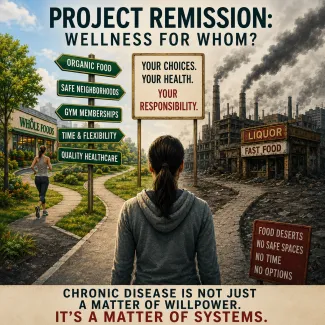
The American College of Lifestyle Medicine (ACLM) recently launched Project Remission, which is dedicated to the idea that chronic diseases, such as hypertension, type 2 diabetes, and obesity, are not inevitably progressive and can be brought into remission through Lifestyle Medicine. As usual, wellness jargon and individual-level solutions abound in this marketing ploy dressed as medicine.
The ACLM has been making moves. They have a journal, position papers, and now Project Remission, a new initiative geared toward reversing chronic disease. According to the press release, “Grounded in scientific evidence and real-world clinical practice,” it “challenges the assumption that chronic disease should be treated as lifelong and progressive by demonstrating that addressing the root causes of disease through lifestyle interventions can lead to meaningful improvements in health outcomes.”
Project Remission claims that “Lifestyle medicine gives the patient agency,” but as I have written previously, the people who can afford Lifestyle Medicine physicians are often not the ones who need them most. While everyone benefits from better health habits, individual choices are nested inside complex, often unyielding environments. ACLM notes that 90% of the nation's $5.3 trillion in healthcare spending goes to chronic disease, yet they treat this systemic crisis as a failure of individual habit.
The Illusion of Choice in a Sick Environment
The lifestyle changes being lauded are ones that everyone can, in theory, make. But it’s impossible to discuss these specific diseases without also considering other contributing factors, including "privilege." Not everyone lives in a neighborhood where it is safe to walk around. Not everyone can afford a gym membership. Not everyone has access to a grocery store.
ACLM co-opts the wellness terminology of "root causes," but ironically ignores the socioeconomic underpinnings of lifestyle diseases. Telling someone living in a food desert to eat fresh, organic whole foods isn't medicine; it's an absurd privilege test and one that I will continue to highlight.
What I don’t see in Project Remission is a push for policy to address these contributing factors. If we really do want to address the root causes of chronic diseases, especially hypertension, type 2 diabetes, and obesity, socioeconomic change has to figure into the conversation. Project Remission claims it is "designing care around the possibility of restoring health." But asking physicians to design care" around habits without asking lawmakers to design environments where those habits are possible is pure theater. It’s lip service, once again, placing the responsibility solely on the individual and ignoring broader societal factors.
Co-opting "Root Causes": The ACLM and MAHA Alignment
The ACLM has been flirting with the wellness industry since day one. The use of the phrase “root causes” is no accident, but rather a dog whistle to the wellness industry and a leadership coalition within the Make America Healthy Again (MAHA) movement that preaches health autonomy while actively undermining public health infrastructure. They are playing for the same team.
If we’re worried about the root causes of disease, why isn't the ACLM issuing position statements on what’s happening with the childhood vaccine schedule? If ACLM is genuinely dedicated to prevention at the population level, their silence on core public health pillars, like childhood immunization schedules, is deafening. Vaccines represent the ultimate way to address root causes by preventing disease before it starts.
Further, ACLM has articles on its website where they and their delegates have appeared. One of the recent articles highlights MAHA specifically and their dedication to “prevention” and is best summed up by “This is why the most important question raised by the MAHA movement is not whether prevention works. It does. The more important question is whether healthcare leaders are prepared to build organizations around that reality.”
ACLM’s decision to feature commentary praising the MAHA movement's focus on "prevention" highlights a significant misalignment in strategy. True public health prevention relies on protecting core infrastructure, like safeguarding vaccine programs, supporting nutrition access initiatives like SNAP, and strengthening funding for school meals, rather than endorsing the dismantling of established agencies like the CDC and FDA.
By aligning with this rhetoric, ACLM risks adopting a construct of prevention that overlooks systemic realities. Programs like Project Remission place the onus of chronic disease management primarily on individual choices while leaving broader structural, economic, and social determinants unaddressed. Rather than reshaping healthcare delivery, this approach risks framing wellness as a matter of individual responsibility rather than pursuing the broader policy reforms necessary to make health accessible to all communities.
Project Remission sounds promising on paper, but in practice, it represents a dangerous shift away from real public health. By reducing complex chronic conditions to individual habits while ignoring structural and economic issues, all the while cheering on the gutting of institutions like the CDC, ACLM offers an illusion of care. Real prevention is built in policy, not elite lifestyle clinics. Until ACLM advocates for the structural environments that make healthy choices possible, Project Remission isn't medicine; it's virtue-signaling privilege.

Katie Suleta, DHSc, MPH
Katie Suleta is a regional director of research in graduate medical education for HCA Healthcare. Her background is in public health, health informatics, and infectious diseases. She has an MPH from DePaul University, an MS in Health Informatics from Boston University, and has completed her Doctorate of Health Sciences at George Washington University.