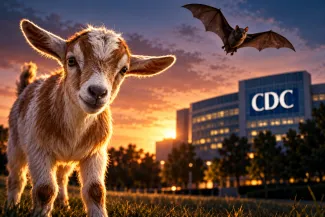
In February 2025, I wrote about the possibility of rabies making a comeback because of anti-vaccine rhetoric. Eighteen months later, we’ve shifted from a hypothetical warning to an active Health Alert Network advisory from the Centers for Disease Control and Prevention (CDC).
“From July through August 2026, CDC received 17% more rabies-related inquiries than during the same period in 2025, including reports of mass exposure events, involving more than one person. During this time frame, CDC also received reports from at least eight state health departments of increased rabies PEP [post-exposure prophylaxis] use, PEP administration errors, or both.”
The CDC also tracks rabies vaccine and human rabies immune globulin (HRIG) use. The vaccines are used with HRIG because HRIG acts faster than the vaccine and can bind to the virus quickly. The vaccine then builds longer-term immunity before the virus reaches your nervous system. Similar to the rabies inquiries, the use of the rabies vaccine and HRIG was also tallied for the same time this year as last year. Both also saw sharp increases.
This naturally leads to some questions:
- Are more people being exposed to rabies?
- Is rabies a bigger problem now than it was this time last year?
Rabies Exposure
This summer, a mass exposure event in North Carolina involved baby goats at a petting zoo. The goats were part of a traveling petting zoo that made ten stops over a few weeks. This led to a recommendation that hundreds of people receive PEP.
Each year, about 100,000 people receive the rabies vaccine. According to the Health Alert Network, vaccinations and HRIG use are up 33% and 76% over the same period last year. Could that be completely due to the rabid baby goats? Probably not.
The Health Alert Network also reported rabies inquiries from eight states. For example, there were rabid beaver attacks in Maryland; rabid bats have popped up in Florida several times this year; and rabid raccoons were reported in South Carolina. While animal vectors were clearly active this summer, another major factor driving the spike in rabies PEP treatment wasn't lurking in the woods; it was happening inside CDC laboratories.
Rabies Testing
To answer whether rabies is actually spreading or if we’re just seeing a surge in defensive treatments, we first have to look at a massive blind spot created by federal testing interruptions. The CDC keeps a running list of tests in its laboratory, including unavailable tests.
In early April 2026, the CDC paused testing for several infectious diseases, including rabies. At the time, the pause was reported as temporary and for quality control purposes. No official word came down on when the tests would be available again, but the implication was that it would be soon. The word “weeks” was thrown around.
Four months later, rabies testing became available again, although several other infectious diseases remain on the list. But for four months, the CDC, the agency specifically designed to combat and surveil diseases, couldn’t test for rabies, one of the deadliest infectious diseases.
About a month after testing returned, the CDC issued a rabies alert. A 4-month testing hiatus creates a blind spot. When state and local public health departments can't get federal confirmation on suspected cases, clinicians default to defensive medicine, administering expensive PEP "just in case."
The testing being unavailable for so long could absolutely have been due to routine maintenance and/or quality control issues. However, this pause is also part of a broader pattern of diminished agency capacity and public erosion of trust under current HHS leadership. This administration has not done itself any favors. Secretary Kennedy, the current HHS secretary, while running for president in 2023, stated, “We’re going to give infectious disease a break for about eight years.”
Rabies Vaccines
It’s ironic that the health alert also includes the following guidance on rabies.
“Although there is currently no shortage of human rabies vaccine or human rabies immunoglobulin in the United States, it is important for clinicians to administer PEP appropriately because errors in rabies risk assessment and PEP administration could result in unnecessary treatment (e.g., additional doses of vaccine or HRIG), potential adverse effects, and avoidable costs. A typical course of PEP can cost between $11,000 and $14,000 per person. Following rabies PEP administration guidance helps ensure that lifesaving vaccines are available for persons who need it and extraneous costs are avoided.”
The press release also states that “CDC urges clinicians to conduct careful, evidence-based rabies risk assessments and follow current ACIP [Advisory Committee on Immunization Practices] recommendations when post-exposure vaccination or treatment is indicated.”
ACIP guidance hasn’t meaningfully changed since Secretary Kennedy has been at the helm; an important consideration given how much ACIP has changed, with members suddenly ousted, new replacements with questionable credentials, and a notable lack of meetings around fall vaccine recommendations. The question of “would they change the guidance around rabies vaccination recommendations?” is not out of scope here.
Rabies is public health 101. Unlike novel viruses or contested chronic illnesses, the course of rabies is absolute: if you become symptomatic, you die. But if you get PEP on time, you live. No middle ground or political debate exists on the biology. Microbes do not take sabbaticals for political cycles. Infectious diseases don't pause because leadership wants to shift attention to wellness trends or alter vaccine schedules. The "break" from infectious disease didn't stop animal vectors or rabid petting zoo goats. It just broke the surveillance infrastructure designed to protect us from them.
Rabies is a harbinger. If the public health apparatus is fumbling risk assessment, surveillance, and basic clinical administration on a disease that is 100% fatal yet completely preventable, it signals a breakdown in our core public health infrastructure. If rabid baby goats aren’t enough to make you reconsider your stance on the importance of vaccines and infectious diseases, likely nothing will.

Katie Suleta, DHSc, MPH
Katie Suleta is a regional director of research in graduate medical education for HCA Healthcare. Her background is in public health, health informatics, and infectious diseases. She has an MPH from DePaul University, an MS in Health Informatics from Boston University, and has completed her Doctorate of Health Sciences at George Washington University.