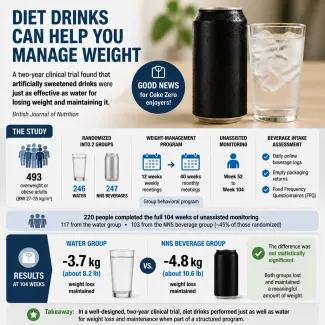
Good news for the Coke Zero enjoyers among us: in a two-year weight-management program, artificially sweetened drinks were just as effective as water in helping people lose weight and maintain it. So says a team of researchers writing in the British Journal of Nutrition. Unlike much of the low-grade dietary research that makes headlines, this study was a reasonably well designed prospective clinical trial that ran long enough to generate some useful data—results that may even inform your eating habits, though a few qualifications are in order. Let’s take a closer look.
The researchers analyzed the weight-loss impacts of non-nutritive-sweetened (NNS) beverages and water in 493 overweight or obese people (BMI 27–35 kg/m2) over the course of a year-long assisted weight-management program. They then followed participants for a second, unassisted year. Body weight was the primary outcome; metabolic markers were secondary.
Participants were evenly split between two groups; 246 adults who regularly consumed cold beverages were randomized to water, 247 to NNS beverages. They joined a group behavioral weight-management program with weekly meetings during a 12-week weight-loss phase and monthly meetings during a 40-week weight-maintenance phase. Unassisted monitoring began at week 52 and ended at week 104.
Some 220 people participated in the year-long unassisted monitoring phase: 117 from the water control group and 103 from the beverage group—about 45 percent of those randomized. The researchers focused on weight change from the beginning of the study to reach their conclusion. Beverage intake was assessed by “daily online beverage logs; empty packaging returns; completed Food Frequency Questionnaires (FFQ)...”
The water group maintained weight loss of 3.7 kg (about 8.2 pounds) over 104 weeks, and the diet drink group 4.8 kg (about 10.6 pounds), a noticeable but statistically insignificant difference. Both groups saw comparable reductions in waist and hip circumference and fat mass. Total cholesterol rose slightly with diet drinks and fell slightly with water. HbA1c and diastolic blood pressure improved more in the water group. The authors judged none of these differences clinically meaningful, and the samples were small, roughly 14 to 16 people per group (see table 3). The researchers’ conclusion:
“There was no significant difference in weight loss between NNS beverages or water groups. Importantly, both groups maintained significant weight loss up to week 104. Both NNS beverages and water improved anthropometric [physical measurements of the human body] and other outcomes over the 2-year period.”
Aside from the headline finding, several other conclusions stand out.
Diet soda won’t make you fat
The results in themselves aren’t especially remarkable. Fewer calories in your diet, whether in solid or liquid form, will result in weight loss. But as a challenge to constant popular mythology surrounding sugar-free drinks, the study is quite helpful.
In particular, the authors highlighted the so-called Cephalic Phase Insulin Response (CPIR). The claim is that the sweetness of these drinks tricks your pancreas into producing a shot of insulin in anticipation of the glucose it “thinks” is coming. Since the glucose never arrives, the insulin spike causes hunger (and thus more eating) or switches your metabolism into fat-storage mode.
It’s a plausible hypothesis—some research shows a minimal increase in insulin from diet drinks—but it hasn’t been borne out by well-designed clinical studies. As the authors of the new trial explained:
“... [R]andomised controlled trials have suggested beneficial or neutral effects of NNS beverages on body weight depending on whether the comparator was sugar-sweetened beverages or water, respectively.”
In other words, multiple clinical studies (they cite five) show that diet drinks aid weight loss compared to sugary beverages and show no difference compared to water. There’s also a sizable collection of epidemiological studies cited in support of CPIR. But as the authors noted, many of these papers “suffer from reverse causality and residual confounding and typically do not include repeated intake measures …”
Epidemiologic studies sometimes identify a tight correlation between obesity and diet drink consumption, but fail to account for the possibility that overweight people drink more sugar-free beverages because they contain no calories. The drinks don’t make people obese; people drink them because they're obese and trying to slim down. It’s also easy to drink diet soda and gain weight even if the beverages aren’t to blame.
Importantly, this trial didn't measure insulin or the cephalic-phase response itself. Hunger rose slightly in both groups, with a significant increase only in the diet-drink group, but no significant difference between the groups. Bottom line: whatever insulogenic effect artificial sweeteners trigger is probably tiny, at least in the doses we consume from diet drinks.
Some answers, more questions
While the weight-loss difference between groups was insignificant by study’s end, the diet drink group lost slightly more weight and more quickly than the control group. People in the water group hit their lowest weight at 44 weeks, while the test group hit their lightest weight at 36 weeks. Both groups regained some of the lost weight as the trial progressed, though the control group did so sooner.
The study does not offer an explanation. However, one possibility is that the palatability of sugar-free drinks improves adherence to a diet. We know that’s generally true: weight-loss regimens tailored to individual preferences tend to yield better results. Diet drinks, because they come in an array of enjoyable flavors, may discourage people from reaching for something sugary to satisfy a craving, on top of the liquid calories they displace.
This is only a possibility based on the data in this study—sugar intake was a bit lower in the diet-drink group, but not statistically significant—though it’s an intriguing one.
Yes, but
As I said, a few caveats are in order. Although this study was better than much of what passes for science today, the researchers still had to rely on participants to accurately record what they drank. Daily surveys and regular support probably helped minimize misreporting, though we can never be certain. The trial was also relatively small and limited to one site in the UK; we don’t all live there, nor are we all British. Our varied environments and genetics almost certainly influence the dietary habits we pick up. Attrition was also substantial: only 220 of 493 randomized participants had weight data at week 104. [1]
Conclusion
We often conclude episodes of our Science Dispatch podcast by reminding everyone that “nobody gets out alive.” Despite the phony miracle cures that pollute your social media feed, there’s rarely a magic pill to cure your ailment—just practical measures that help preserve or improve your health while you’re here. [2] The good news is that diet soda appears to be one of those measures, if it replaces some sugar in your diet.
[1] The study was also funded by the beverage industry. That doesn’t mean the results are inherently flawed. But it’s always wise to consider the incentives of those who fund research.
[2] GLP-1s are the closest we've come to a miracle cure for obesity. They're remarkably effective, but still not one-and-done solutions.

Cameron English
Executive Vice President
Cameron English is a writer, editor and co-host of the Science Facts and Fallacies Podcast. Before joining ACSH, he was managing editor at the Genetic Literacy Project.