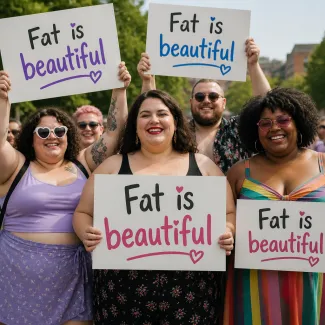
Four years ago, the “body positivity” movement was a cultural force to be reckoned with. Riding on the coattails of the broader social justice movement, advocates of body positivity and fat acceptance proudly denied the established connection between weight and health and slandered doctors as defenders of “thin privilege.” So prominent was this inane ideology that we actually challenged it on the Dr. Phil show in 2022.
Then came the GLP-1s. These drugs—Ozempic, Wegovy, among others—are the closest thing to a cure for obesity we’ve ever had. It's now possible for many millions of people to control their hunger with relative ease and shed significant weight along the way. That’s an enormous win for public health—but a crippling defeat for a movement built on the myth that BMI was designed to oppress obese people.
The fat acceptance crusade appears to be on life support as a result, but it’s being sustained by the very institutions that should be fighting it. On September 30, Harvard Medical School hosted a panel titled “Against the Pathology of Unruly Bodies.” It featured three speakers, an artist-in-residence at the school, a self-described "queer and trans afropessimist and anarcho-communist" and a full-time body positivity activist. Apparently there were no doctors on campus that day. Brad Polumbo reported on the festivities for the Free Press on October 21. Judging by the topics covered, they were predictably unserious:
“Obesity isn’t unhealthy. Medical paperwork is violence. We’re living under fascism for fat people."
Other insights shared during the panel included the claims that GLP-1s represent a “genocide” against fat people, and that obesity isn't a disease but an identity. Polumbo did a fine job of deconstructing these erroneous assertions, so I won’t repeat the task. But there is more to say about this event, because the problem isn’t just a few kooky activists on a panel.
The deeper issue is that universities continue to amplify these dangerous ideas and far too many people use them to excuse their harmful choices. Both need to stop immediately.
It’s not your doctor’s fault
One of the core tenets of fat acceptance is blame shifting: you’re not overweight because you make poor dietary choices; it’s actually your physician’s fault. How exactly? Well, you see, doctors have superimposed a subjective standard of health on you from a bygone era of racism (yes, they really argue this way). In essence, we only think obesity is harmful because the medical establishment told us so.
As someone who has worked hard to lose weight, I’m here to tell you this is utter nonsense. Obesity can kill you; the evidence is undeniable. We know from individual studies that changing what you eat results in weight loss and improved health. It’s an experiment you can do on your own. We also have population-level data showing that entire ethnic groups gain weight and get sicker when they replace their traditional eating patterns with sugar-laden diets. When they switch back, the trend reverses: they lose weight and experience improved metabolic health.
Anyone who dismisses this evidence with slogans about “body fascism” and lectures doctors for weighing their patients deserves your skepticism. They’re attempting to rob you of your agency for the sake of their political agenda. Believe them at your peril.
That doesn't mean obesity is a moral failure dictated exclusively by personal choice. That’s not the point. Your genetics profoundly influence your behavior (including your eating habits) and how your body metabolizes the foods you consume. The same could be said of culture; you learn from those around you. You can’t help it, and it’s not your fault you were born into that context.
But proper nutrition can counteract the obesogenic influence of your DNA, and unhealthy behaviors can be unlearned. This is precisely why we discourage alcoholism and smoking as a society. We know they have genetic and cultural components, but we don’t use those facts as an excuse to enable these two very destructive behaviors—both of which have plummeted in recent years. The same logic applies to poor eating habits.
What is Harvard thinking?
If there’s one institution in the world that shouldn’t be trafficking in “fat acceptance,” it’s a medical school. As Polumbo rightly noted, “... a core responsibility of a doctor is to advocate for your health, even if that means telling you something you don’t want to hear.” If that’s true of individual physicians, it’s certainly true of the schools that train doctors. They absolutely must tell the truth about the risks posed by obesity, and every other health condition for that matter. If they won’t, what purpose do they serve?
That leads to a final point. Certain segments of the medical establishment have tied themselves in a contradictory knot, and their affinity for body positivity is my star witness. [1] When a leading medical school attacks its own profession as a racist ploy to oppress obese people, it’s telling the public that science can be ignored when you don’t like its conclusions.
Yet when parents flout the pediatrician’s advice to vaccinate their kids, every medical organization on the planet—including Harvard Medical School—cries foul. They complain about ordinary people rejecting expertise in favor of ideology, while they themselves reject expertise in favor of ideology.
You can’t have it both ways. You can accept all the evidence on every topic, and encourage the public to do so as well. But you can’t selectively mix science and politics and expect everyone to treat you as serious medical authorities—because you aren’t.
[1] The American Academy of Pediatrics has been a notable exception in recent years, calling for renewed focus on preventing obesity in children.

Cameron English
Executive Vice President
Cameron English is a writer, editor and co-host of the Science Facts and Fallacies Podcast. Before joining ACSH, he was managing editor at the Genetic Literacy Project.