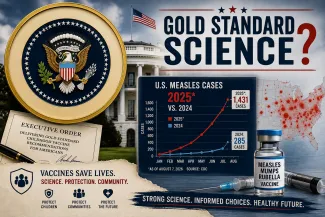
The White House unveiled another in a line of executive orders (EO) on the childhood vaccine schedule. In December of 2025, an EO was issued to align the childhood vaccine schedule in the United States with that of other “peer” countries. In May of 2026, there was a follow-up call for the Advisory Committee on Immunization Practices (ACIP) to review data on vaccines. It specifically stated that “ACIP’s review should consider ways to provide maximum flexibility to parents and doctors through recommendations for timing and sequencing of the administration of routine immunizations.”
ACIP, a once seemingly uncontroversial body, has become another flashpoint in the conversation about vaccines. In June of 2025, RFK Jr. dismissed all 17 members of the committee. This was followed by a January 2026 memo from the Department of Health and Human Services proposing an overhaul of the vaccine schedule. RFK Jr. also attempted to appoint new members to ACIP. This resulted in a lawsuit led by the American Academy of Pediatrics and was joined by other medical organizations about the changes to ACIP. ACIP has become the battle ground upon which we fight about vaccines, but it doesn’t stop there.
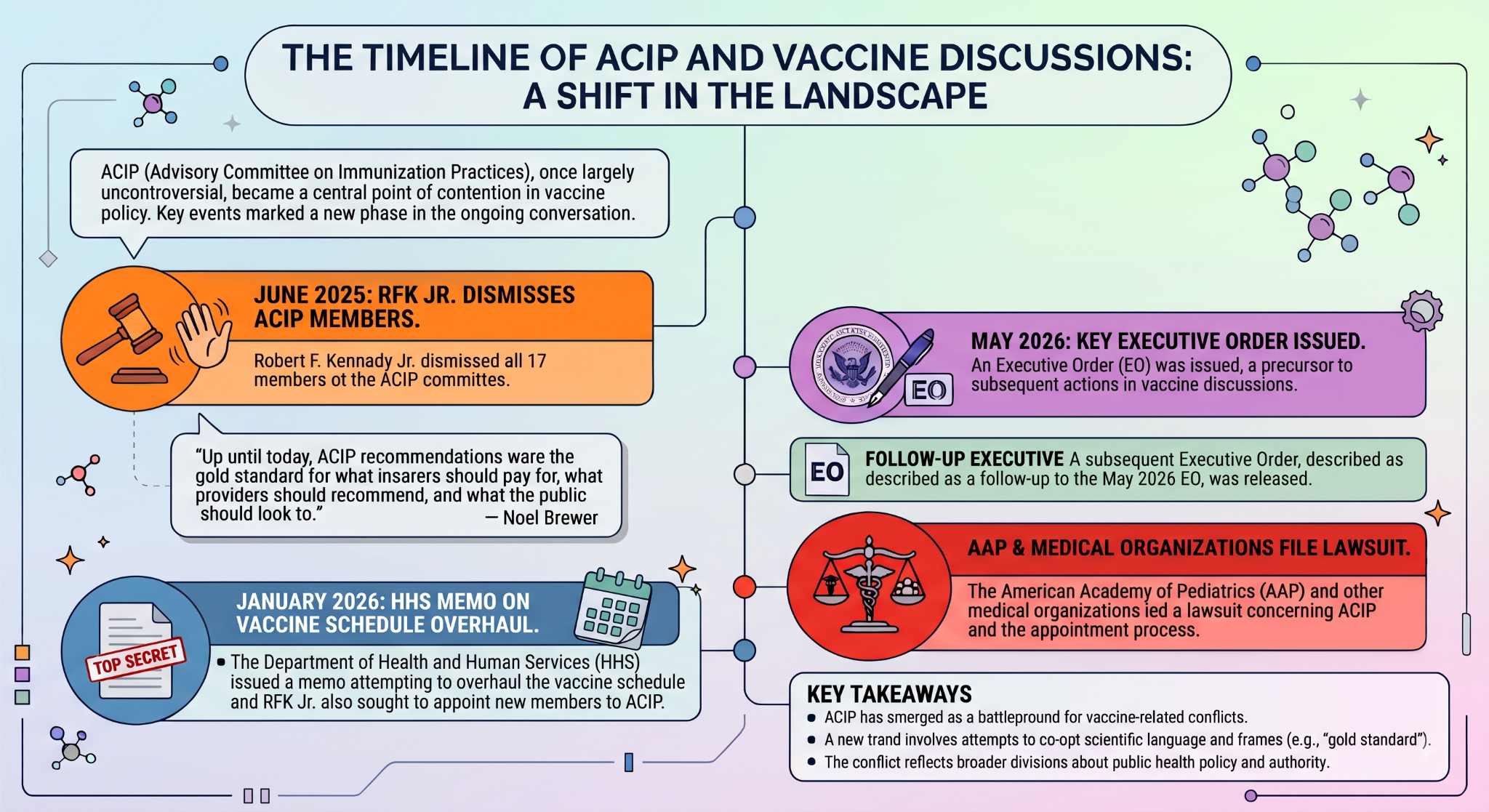
When RFK Jr. removed all of the ACIP members, Noel Brewer, one of the removed, said,
"Up until today, ACIP recommendations were the gold standard for what insurers should pay for, what providers should recommend, and what the public should look to."
There’s that phrase again: gold standard. This is yet another skirmish in the vaccine wars, with the co-opting of scientific language as a weapon.
August 2026 Executive Order
The most recent EO is a natural follow-up to the previous EOs focusing on the ACIP review and “gold standard” science. The language of the current EO demonstrates how rhetoric around 'parental choice' is being used to dismantle public health guidelines
“The Department of Health and Human Services (HHS) completed a scientific assessment…and found that the United States currently recommends more childhood vaccines than any peer nation…[I]nstead of implementing vaccination mandates, most peer nations maintain high childhood vaccination rates through public trust and education. In the United States, by contrast, individual States set mandatory vaccination requirements….
Further, it is the policy of my Administration that Federal programs and funding should support maximal parental choice over childhood vaccines...."
“Peer countries” is doing some heavy lifting. While European countries are often considered our peers, there are important infrastructure differences, such as universal health insurance, centralized tracking for vaccines and other preventive procedures, and school-based health centers that maintain high uptake without mandates. Additionally, these “peer countries” have different epidemiological risks with differing rates of endemic diseases, travel patterns, and healthcare access.
The EO categorizes vaccines into three buckets: those recommended for all children, those for high-risk groups, and those left to parental discretion. Those left up to parents include vaccines against hepatitis A, hepatitis B, meningitis, rotavirus, flu, and COVID.
Under the Affordable Care Act (ACA), private insurers are required to cover vaccines recommended by ACIP for routine use without co-pays. Shifting vaccines to "discretionary" buckets gives insurance companies legal grounds to stop covering them entirely. Similarly, low-income families who rely on the Vaccines for Children (VFC) program could lose access to these vaccines if the federal schedule strips their “routine” status. So, why is that a problem?
Influenza provides a good example of why this vaccine is important for kids. While pediatric flu deaths are relatively rare, they are almost entirely preventable. According to the CDC, of those children who died during the 2024-2025 flu season, the overwhelming majority (89%) were not vaccinated. This is an obvious case for vaccines. Fewer kids dying of this infectious disease is good! It’s a public health and medical win! Fewer deaths from infectious diseases are why vaccines were developed in the first place.
Anti-Vaccine Misinformation
The shift embodied in the President's EO raises a fundamental question: why refuel a debate over settled public health measures? Historically, the anti-vaccine movement relied on pseudoscience (e.g., debunked autism claims). When scientific consensus repeatedly defeated those claims, the movement shifted from science-based to rights-based arguments. The Make America Health Again (MAHA) movement, Secretary Kennedy, and the Trump Administration have gone all in on health freedom — the idea that parents know what’s best for their children and society. This is framed as reclaiming individual liberty from medicine’s paternalistic narrative.
However, what it actually does is make it more difficult to get vaccinated, creates more doubt around these specific vaccines, and vaccines in general. Our all-too-human psychology naturally views an action that causes harm now, such as a rare vaccine side effect, as far worse than inaction that results in harm, such as catching a preventable disease later.
By splitting vaccines into "mandatory" vs. "discretionary" buckets, the EO creates a false hierarchy. It signals to the public that vaccines for Hepatitis B, Rotavirus, or Flu are "optional luxuries" rather than essential protection, implicitly casting doubt on their necessity if not safety.
It allows the bombardment of vaccine mis- and disinformation to persuade just enough so that people are confused and default to the seemingly “safe” decision of fewer vaccines. But that’s not actually the safe decision.
The anti-vaccine movement has stacked the deck. They’ve been distributing propaganda for years. The COVID-19 pandemic added fuel to the fire, and they finally found a powerful speaker and talking point that allowed their rhetoric to really take off: health freedom. They’ve successfully co-opted jargon (“gold standard science”) and use it to talk about their policies as though they are based on what that phrase means in a scientific context, when it’s not.
For years, those of us involved in science communication have discussed the dangers of the anti-vaccine movement. For a while, the popular position was that anti-vaccine beliefs were fringe, easily ignored. Except, here we are. The number of measles cases continues to rise; we are losing our elimination status. Whooping cough is a problem, as is Mumps. The list goes on.
And this is just the beginning. These headlines will only get worse. As the vaccine schedule continues to be muddied by EOs, RFK Jr., and anti-vaccine rhetoric and propaganda, people will only feel more confused. We had a vaccine schedule based on actual gold-standard science, which considered the best available data and evidence, not just cherry-picked evidence to promote a specific cause.
Ultimately, this executive order does not reflect evolving science. It manufactures doubt. By reframing established medical consensus as a debate, it signals to the public either that vaccine science has shifted or that it was never trustworthy to begin with. Preventing the resurgence of infectious diseases requires high, sustained community immunity; eroding trust in the childhood schedule puts every vulnerable person at risk.

Katie Suleta, DHSc, MPH
Katie Suleta is a regional director of research in graduate medical education for HCA Healthcare. Her background is in public health, health informatics, and infectious diseases. She has an MPH from DePaul University, an MS in Health Informatics from Boston University, and has completed her Doctorate of Health Sciences at George Washington University.