
I recently wrote about a nonsensical study claiming that artificially sweetened drinks contribute to cognitive decline. It was nonsense.
Now there's a new study about sugary drinks and stomach cancer that's making the rounds. Is this one legit? Let's turn the ACSH eyeball on it.
Hint: It's not nonsense. But its headline finding, that frequent sugary-drink consumers are about 2.5 times more likely to develop stomach cancer, didn't sit quite right with me. Call it a gut feeling.
Yes, high-volume consumers had a hazard ratio (HR) of 2.45. And, predictably, the news media ran with it. One headline announced that a daily habit “more than doubles your odds of stomach cancer.”
But the bitter details of these numbers are found in the paper, and when they're examined, there's plenty of reason to be skeptical.
Oddity #1
The prospective study divided participants into five groups based on consumption (Table 1). Note that a serving size was defined as eight ounces.
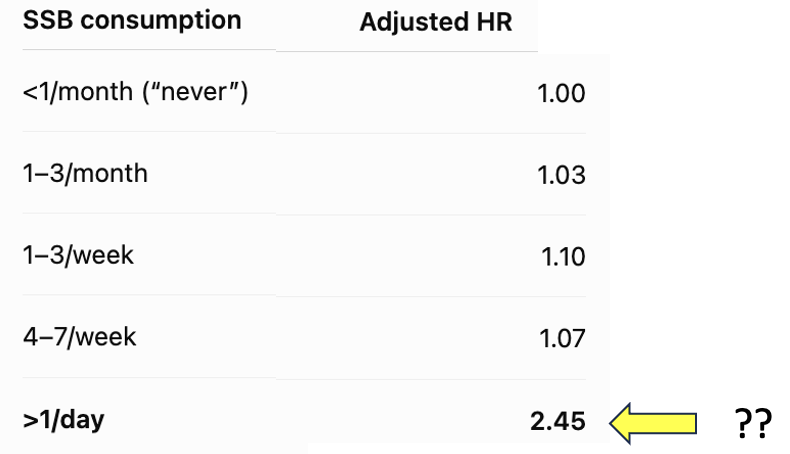
Table 1. The number of sugar-sweetened beverages as a function of stomach cancer. Source: Author’s table based on data from Gweon T-G et al. “Association between sugar-sweetened and artificially sweetened beverage intake and gastric cancer incidence.” Gastroenterology. 2026.
What absolutely jumps off the page is that last number (yellow arrow) for two reasons.
First, people consuming anywhere from essentially zero to as many as seven sugary drinks per week had virtually no increase in stomach cancer risk. The hazard ratios were 1.00, 1.03, 1.10, and 1.07. Then, suddenly, in the >1-per-day group, the HR jumped to 2.45.
That's far from an obvious dose-response pattern, where increasing exposure is accompanied by increasing risk, something that helps make a causal relationship more convincing. Instead, the risk is basically flat and then shoots up in the final group.
Second, what does >1/day mean? Does it mean 1.2 servings per day or 15? There's no way to tell from the reported categories because >1/day is open-ended. Worse, this poorly defined category is precisely where the entire effect suddenly appears.
This is probably the paper's biggest weakness. The headline result depends on a single open-ended category, yet we have no idea how much the people in that category were actually drinking. And with no obvious increase in risk through seven servings per week, that missing information matters. A lot.
But it's not the only problem.
Oddity #2: Not many cancers behind that scary number
A hazard ratio of 2.45 certainly sounds scary. It's a husky HR. But, as in any study, there's an important distinction between relative and absolute risk.
Relative risk tells you how much greater the risk is in one group compared with another. Absolute risk tells you how often the event actually occurred. And in this study, stomach cancer was quite rare.
Among 112,284 participants, only 278 cases of stomach cancer were recorded during more than 3.2 million person-years of follow-up. More importantly, just 31 cases occurred in the >1-serving-per-day (8 ounces per serving) group, the group responsible for the headline HR of 2.45.
While the result is statistically significant, the small number of cases makes it difficult to know how large the effect really is. When the absolute number of events is small, a handful of cases can have a disproportionate influence on the estimated HR. That's reflected in the rather wide 95% confidence interval (CI) around that 2.45: 1.49–4.04. In other words, the study's best estimate is a 2.45-fold increase, but the data are compatible with an increase ranging from about 1.5-fold to fourfold. A narrower CI would provide more confidence in the size of the effect.
Now combine this with Oddity #1. The scary 2.45 HR comes from just 31 cancers in the single consumption category where the risk suddenly shoots up. And because that category is open-ended, we don't even know how much those people were actually drinking.
None of this makes the 2.45 wrong. But it gives me plenty of reason to wonder what, exactly, that number is measuring.
Oddity #3: Is there an obesity confounder?
Obesity is associated with an increased risk of a number of cancers. And high consumption of sugary beverages can contribute to weight gain. So an obvious question arises: Could obesity, rather than the sugary drinks themselves, account for some of the increased stomach cancer risk?
The authors address this obvious confounder, but do so in a manner similar to how drink frequency was reported—with an open-ended category. This is shown in Table 2.
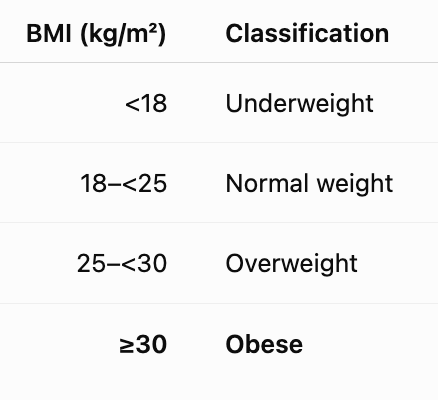
Table 2. Weight categories used in the study.
The problem here should be obvious, and it's essentially the same one shown in Table 1. Everyone with a BMI of 30 or greater was lumped into a single category. That could mean a BMI of 30.1 or 50; as far as this adjustment is concerned, they're in the same bucket. As such, it's reasonable to question whether the analysis adequately controlled for the degree of obesity, especially if the heaviest sugary-drink consumers also tended to have higher BMIs.
The study doesn't tell us whether that actually happened. But if the heaviest sugary-drink consumers were also substantially heavier, lumping everyone with a BMI ≥30 together could mask that difference. In that case, some of that 2.45 HR could be due to obesity rather than the drinks themselves. There is simply no way to tell.
Bottom (or waist) line
So, is the study nonsense?
No. Unlike the artificially sweetened beverage study I wrote about earlier, this is a serious prospective study, and the authors found a statistically significant association that shouldn't simply be dismissed.
But “statistically significant” isn't the same thing as “case closed.” The 2.45 HR comes entirely from one open-ended consumption category, is based on only 31 cancers, and may not have been adequately separated from differences in obesity. All of which makes the claim that ‘sugary drinks more than double your risk of stomach cancer’ considerably less convincing
Maybe they do. Maybe they don't. But this study doesn't convince me either way.
My gut feeling remains intact.

Josh Bloom
Director of Chemical and Pharmaceutical Science
Dr. Josh Bloom, the Director of Chemical and Pharmaceutical Science, comes from the world of drug discovery, where he did research for more than 20 years. He holds a Ph.D. in chemistry.