Almost every week, reports appear in the local news describing how police officers, exposed to fentanyl in the air or by contact, lose consciousness and need reviving with the opioid overdose antidote naloxone. Their coworkers take them to a nearby emergency room, where they are evaluated and released.
This unscientific hysteria reached a new level when police near Wilmington, North Carolina, added assault charges to a suspect they arrested and charged with possessing and trafficking heroin, marijuana, and drug paraphernalia. Police added the assault charges because the suspect tossed the drugs out of the car, “exposing two detectives and a deputy, causing the detective to lose consciousness.” The detective was administered naloxone, and all three were taken to an emergency room and were later released.
According to a 2017 report from the American College of Medical Toxicology (ACMT) and the American Academy of Clinical Toxicology (AACT),
At the highest airborne concentration encountered by workers, an unprotected individual would require nearly 200 minutes of exposure to reach a dose of 100 mcg of fentanyl. The vapor pressure of fentanyl is very low…suggesting that evaporation of standing product into a gaseous phase is not a practical concern.
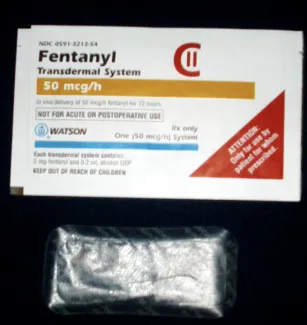
The urban myth persists that even minimal skin contact with fentanyl or an analog can cause a drug overdose. Because fentanyl is not easily absorbed through the skin, it took years of research before pharmaceutical companies finally devised a means to deliver fentanyl trans-dermally using a skin patch, now one of the most common ways it is prescribed in the outpatient setting. In their position paper, the ACMT and AACT affirm that even extreme skin exposure to fentanyl “cannot rapidly deliver a high dose” of fentanyl.
Many reported cases of police officers and first responders being rushed to the emergency room for overdose symptoms due to fentanyl exposure are probably cases of the nocebo effect, an exquisite example of the power of suggestion that has a neurochemical explanation. Frightening warnings from the Drug Enforcement Administration that “A 3‑milligram dose of fentanyl—a few grains of the substance—is enough to kill an average adult male,” while the Centers for Disease Control and Prevention encourages first responders to “wear respiratory protection if powdered illicit drugs are visible or suspected” help to fuel these fears.
DEA and CDC fearmongering and misinformation harm first responders by causing them to panic. Now it’s harming criminal justice by causing law enforcement to view exposing people to illicit drugs as tantamount to assault.
#Reprinted with permission. The original article from the Cato Institute website can be found here.

Jeffrey Singer
Jeffrey A. Singer is a senior fellow at the Reason Foundation, where he focuses on health care policy and drug policy. He is President Emeritus and founder of Valley Surgical Clinics, Ltd., Arizona's oldest and largest private group surgical practice. From 2017 to 2026, he served as a senior fellow in the Cato Institute's Department of Health Policy Studies and as a Visiting Fellow at the Goldwater Institute. Singer is a member of the Board of Scientific Advisors of the American Council on Science and Health and serves on the expert panel for Doctors for Drug Policy Reform. From 1994 to 2016, he was a regular contributor to Arizona Medicine, the journal of the Arizona Medical Association. He served on the Advisory Board Council of the Center for Political Thought and Leadership at Arizona State University from 2014 to 2018. His writings have appeared in peer-reviewed medical and scientific journals, as well as in publications such as the Wall Street Journal, Washington Post, USA Today, The Hill, and National Review. He has been a guest on national and local television and radio. Singer received his BA from Brooklyn College (City University of New York) and his MD from New York Medical College. He is a Fellow of the American College of Surgeons.