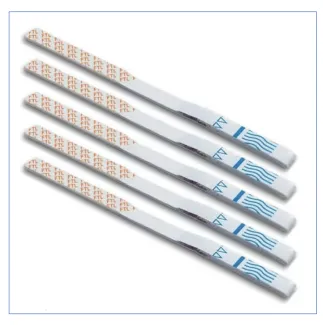
Today’s Wall Street Journal reports that recreational drug users at parties and nightclubs increasingly use fentanyl test strips before engaging in drug use. Singer-songwriter Kalie Shorr, who has lost a sister and childhood friend to drug overdoses, keeps them with her in her purse and offers them to partiers and nightclub goers:
Just dissolve the cocaine in a small amount of water, she tells them. Then dip in the test strip, and wait a few minutes to see if one line (positive) or two lines (negative) appear. “You can put it up your nose if you feel so inclined,” she said. “But please do this.”
The article points out that, in many cases, when people use cocaine, MDMA (“ecstasy,” “molly”), or other non-opioid drugs obtained on the black market, the drugs are either counterfeit and/or contaminated with fentanyl.
While the Centers for Disease Control and Prevention and most public health agencies endorse distributing fentanyl test strips to people who use drugs, the practice is illegal in 42 states and the District of Columbia. As Sophia Heimowitz and I explain in a policy analysis we published last June and as I explain in a Cato Daily Podcast released earlier this week, every state except Alaska prohibits the possession, manufacture, sale, or distribution of drug paraphernalia.
The Food and Drug Administration approves fentanyl test strips for urine testing, and emergency rooms and urgent care facilities have used them for years when treating suspected drug overdose victims. Harm reduction advocates learned several years ago that drug users could use the test strips on the drugs they are about to consume and began handing them out to people. Testing the drug rather than the urine is using the device “off‐label.”
State drug paraphernalia laws vary, as do their definitions of drug paraphernalia. For example, Arizona prohibits the possession, “with intent to use, drug paraphernalia to plant, propagate, cultivate, grow, harvest, manufacture, compound, convert, produce, process, prepare, test, analyze, pack, repack, store, contain, conceal, inject, ingest, inhale or otherwise introduce into the human body a drug in violation of this chapter.” Illinois law specifies as prohibited paraphernalia “testing equipment intended to be used unlawfully in a private home for identifying or in analyzing the strength, effectiveness, or purity of controlled substances.”
Forty‐two states and the District of Columbia consider fentanyl test strips drug paraphernalia because drug users use them to test or analyze illicit drugs. Arizona removed fentanyl test strips from its list of forbidden paraphernalia in 2021. Tennessee did so in early 2022. And on January 3, 2023, fentanyl test strips became legal in Ohio.
The Wall Street Journal article states, “In 2021, fatal overdoses involving synthetic opioids increased 22% compared with the year prior.” If policymakers continue to wage war on drugs, we can expect this trend to continue. The best way to reduce overdose deaths and other harms from illicit drug use is to end drug prohibition and make the drugs legal and regulated, as when the U.S. repealed alcohol prohibition. Until that happens, states should emulate Alaska and repeal their drug paraphernalia laws, removing the barriers those laws place on harm reduction organizations working to save lives. At a minimum, state lawmakers should make it legal for people to distribute and use fentanyl test strips.

Jeffrey Singer
Jeffrey A. Singer is a senior fellow at the Reason Foundation, where he focuses on health care policy and drug policy. He is President Emeritus and founder of Valley Surgical Clinics, Ltd., Arizona's oldest and largest private group surgical practice. From 2017 to 2026, he served as a senior fellow in the Cato Institute's Department of Health Policy Studies and as a Visiting Fellow at the Goldwater Institute. Singer is a member of the Board of Scientific Advisors of the American Council on Science and Health and serves on the expert panel for Doctors for Drug Policy Reform. From 1994 to 2016, he was a regular contributor to Arizona Medicine, the journal of the Arizona Medical Association. He served on the Advisory Board Council of the Center for Political Thought and Leadership at Arizona State University from 2014 to 2018. His writings have appeared in peer-reviewed medical and scientific journals, as well as in publications such as the Wall Street Journal, Washington Post, USA Today, The Hill, and National Review. He has been a guest on national and local television and radio. Singer received his BA from Brooklyn College (City University of New York) and his MD from New York Medical College. He is a Fellow of the American College of Surgeons.