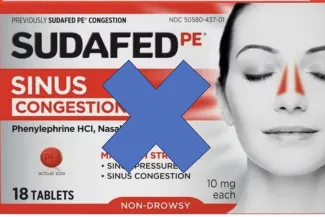
Just before cold and flu season is set to kick off, the Food and Drug Administration's advisory panel last month reported that an oral decongestant Americans have relied on for nearly 20 years is no better than a placebo.
This ingredient found in popular versions of Sudafed, Dayquil and other medications has gained popularity since Congress made it difficult for people to obtain an effective oral decongestant. Now, lawmakers can correct that mistake before the winter cold and flu season arrives in full force.
In an effort to shut down homegrown meth labs in which people converted oral decongestants containing pseudoephedrine into methamphetamine, Congress 18 years ago passed the Combat Methamphetamine Epidemic Act. Under the CMEA, the Drug Enforcement Administration ordered all pseudoephedrine-containing products moved “behind the counter” and required pharmacists to register and track people who purchased them.
#Reprinted with permission of USA Today. Dr. Singer's entire article can be read here.

Jeffrey Singer
Jeffrey A. Singer is a senior fellow at the Reason Foundation, where he focuses on health care policy and drug policy. He is President Emeritus and founder of Valley Surgical Clinics, Ltd., Arizona's oldest and largest private group surgical practice. From 2017 to 2026, he served as a senior fellow in the Cato Institute's Department of Health Policy Studies and as a Visiting Fellow at the Goldwater Institute. Singer is a member of the Board of Scientific Advisors of the American Council on Science and Health and serves on the expert panel for Doctors for Drug Policy Reform. From 1994 to 2016, he was a regular contributor to Arizona Medicine, the journal of the Arizona Medical Association. He served on the Advisory Board Council of the Center for Political Thought and Leadership at Arizona State University from 2014 to 2018. His writings have appeared in peer-reviewed medical and scientific journals, as well as in publications such as the Wall Street Journal, Washington Post, USA Today, The Hill, and National Review. He has been a guest on national and local television and radio. Singer received his BA from Brooklyn College (City University of New York) and his MD from New York Medical College. He is a Fellow of the American College of Surgeons.