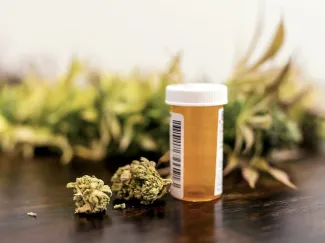
The Washington Post reports that President Trump plans to issue an executive order that would have the Drug Enforcement Administration (DEA) reclassify cannabis from its current Schedule I status, which means “no currently accepted medical use and high potential for abuse,” to Schedule III, indicating a “moderate to low potential for physical and psychological dependence.”
Schedule I drugs include heroin, LSD, and MDMA (“ecstasy” or “Molly”). Schedule III drugs include Tylenol with codeine, ketamine, anabolic steroids, and testosterone.
Although federally illegal, recreational cannabis is currently legal in 24 states, and medical cannabis is legal in 40 states. Six states permit individuals to use cannabidiol (CBD) containing small amounts of THC (the psychoactive component of cannabis), while four states—Idaho, Wyoming, Kansas, and South Carolina—ban cannabis entirely.
While many in the press might see this as a major step toward legalization, little will actually change.
Rescheduling cannabis to Schedule III means that, only if the FDA approves a drug application for cannabis, people will be able to get it with a doctor’s prescription. It will still be illegal to buy or sell recreationally. The 40 states where cannabis is currently legal for medical or recreational use will still be ignoring federal law.
Once the DEA reschedules cannabis to Schedule III, a pharmaceutical company would need to submit a New Drug Application (NDA) to the FDA, outlining the condition(s) the drug is intended to treat. Since cannabis is not patented, the company would likely develop a patented formulation of a cannabis-derived product. Subsequently, it would have to undergo safety and efficacy trials. Then, after many years, individuals can ask their clinicians to prescribe it for the condition the FDA permits to be included on the drug’s label, or off-label if the clinician decides it is appropriate.
Even then, FDA-approved cannabis-based drugs will only be available at state-licensed pharmacies. State-licensed cannabis dispensaries will ignore federal law.
Years ago, Solvay Pharmaceuticals created dronabinol (brand name Marinol), a Schedule III drug now marketed by AbbVie as a synthetic form of THC used to treat nausea. Most clinicians haven’t been impressed with its effectiveness and prescribe other medications for nausea.
Reclassifying cannabis as Schedule III will allow state-licensed businesses to deduct ordinary business expenses on their federal income tax returns, which they are currently unable to do. It might also make banks and financial institutions more willing to work with cannabis dispensaries.
It will also make research on the drug easier for pharmaceutical companies and academic institutions. Getting DEA approval to research a Schedule I drug is challenging and lengthy, with researchers needing to overcome many hurdles and meet strict requirements.
Rescheduling cannabis doesn’t end prohibition; it only rearranges it. The true reform would be for Congress to completely remove cannabis from the Controlled Substances Act and let states regulate it openly, without forcing patients, clinicians, researchers, and businesses to deal with a legal illusion.
# Reprinted with permission. Dr. Singer's original article can be read on the Cato Institute website

Jeffrey Singer
Jeffrey A. Singer is a senior fellow at the Reason Foundation, where he focuses on health care policy and drug policy. He is President Emeritus and founder of Valley Surgical Clinics, Ltd., Arizona's oldest and largest private group surgical practice. From 2017 to 2026, he served as a senior fellow in the Cato Institute's Department of Health Policy Studies and as a Visiting Fellow at the Goldwater Institute. Singer is a member of the Board of Scientific Advisors of the American Council on Science and Health and serves on the expert panel for Doctors for Drug Policy Reform. From 1994 to 2016, he was a regular contributor to Arizona Medicine, the journal of the Arizona Medical Association. He served on the Advisory Board Council of the Center for Political Thought and Leadership at Arizona State University from 2014 to 2018. His writings have appeared in peer-reviewed medical and scientific journals, as well as in publications such as the Wall Street Journal, Washington Post, USA Today, The Hill, and National Review. He has been a guest on national and local television and radio. Singer received his BA from Brooklyn College (City University of New York) and his MD from New York Medical College. He is a Fellow of the American College of Surgeons.