
Here’s a discovery I wish had been around when I was younger: a silver-based cavity killer called silver diamine fluoride (SDF). A dentist paints the liquid onto a cavity and, boom, the decay stops.
The cavity isn’t actually gone. The damaged part of the tooth remains, and it turns black (more on this later). But in many cases, the treatment can stop the decay without a drill, an injection, or a filling.
I can still hear and feel the drill wielded far too often by my dentist father when I was a kid. Even with Novocain, the damn thing hurt plenty. Eventually, the amalgam [1] fillings would fail, followed by something even lovelier: a bunch of root canals.
More canals than Venice. Then more crowns than the British monarchy.
It wasn't entirely my fault; genetics may explain as much as 60% of the variation in people’s cavity experience. Perhaps I can blame my dad twice!
What is silver diamine fluoride?
It's a rather simple complex of silver, two ammonia molecules, and one fluoride, with the formula [Ag(NH3)2]F, and is available as a 38% solution in water.
Each component of the solution has a specific job. Ammonia binds to the silver ion, forming a soluble complex and keeping the silver in solution until the liquid reaches the cavity [2]. The silver then interferes with the bacteria and sticky biofilm, better known as plaque, that cause decay. Fluoride does what fluoride does: it returns minerals to the damaged tooth and makes it more resistant to further acid attack. SDF also blocks enzymes that break down collagen, the protein framework supporting the dentin beneath the enamel. Applied properly, it arrests decay without harming the pulp or causing fluorosis.
Great stuff, but not for every cavity
Let’s get back to that business about turning the tooth black.
SDF does not normally blacken healthy enamel. Silver accumulates in the decayed portion of the tooth, where it forms metallic silver and several silver-containing compounds. These deposits darken the damaged tissue, and exposure to light may darken it further. The result can range from a small black spot to something that looks as though the patient has been chewing a pencil.
Figure 1 illustrates the related photosensitivity of silver chloride. Fresh silver chloride is white, but exposure to light gradually turns it purple and eventually gray as tiny particles of metallic silver form. This is not precisely the reaction occurring in an SDF-treated tooth, but it demonstrates the light sensitivity characteristic of many silver compounds. The same general chemistry gave rise to silver-halide photography.
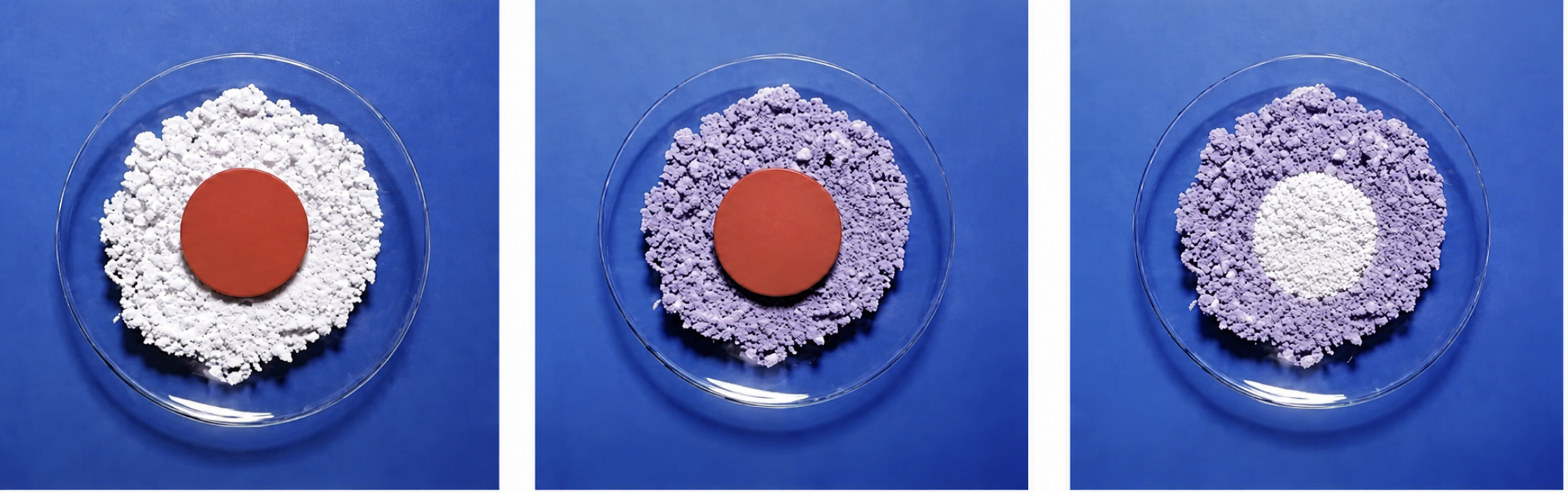
Figure 1. Silver chloride changes color when exposed to light. (Left) Fresh white silver chloride is partially covered by an opaque plastic disc. (Middle) The exposed powder turns light purple while the disc blocks the light beneath it. (Right) Removing the disc reveals a circular patch of unchanged white silver chloride.
That may be an acceptable trade when the cavity is in a back tooth. It is a harder sell when the tooth is front and center in every smile.
SDF stops decay, but it does not rebuild the tooth. If a cavity has left a large hole or really screwed up the tooth, a filling or crown may still be needed. The dentist must continue to monitor the cavity, and additional applications may be necessary.
Other medical uses for silver
SDF is not medicine’s only silver compound. Silver, which has known antimicrobial properties, was used to treat infections long before antibiotics arrived, and a few of its uses remain.
Silver nitrate also comes in sticks that look a little like matches. Applied to a wart, overgrown healing tissue, or a stubborn bleeding site, the tip chemically burns the spot without using heat. Doctors use it around wounds and feeding-tube openings, as well as to stop nosebleeds. Before antibiotics, silver nitrate drops were also placed in newborns' eyes to prevent blindness caused by gonorrhea.
There's a prescription drug called silver sulfadiazine, which combines silver with a sulfa antibiotic. Sold under names such as Silvadene, the cream is applied to serious burns to suppress bacteria and help prevent wound infection. It was once a mainstay of burn treatment, although newer dressings are now often preferred because silver sulfadiazine can slow healing in some burns.
Silver also turns up in antimicrobial wound dressings and coatings on medical equipment. (Strictly speaking, many of these are medical devices rather than drugs.) But their purpose is the same: release silver in a limited area where bacteria are likely to grow.
Notice the pattern. These treatments keep silver confined to a particular site. Silver is applied topically or incorporated into a surface. It is not supposed to be swallowed.
Except people swallow it anyway.
Enter colloidal silver.
Colloidal silver: For the clueless and the conned
The silver drugs I have discussed are for topical use, not internal. Just because something has antibacterial properties does not mean you should swallow it. Drain openers also kill bacteria, but no one markets it for immune support. Yet. Amazon nevertheless sells more than 100 different "supplements" made up of colloidal (very fine particles) silver. Because ya never know when you might not get enough silver in your daily diet. Duh.
Here are some of the descriptions listed:
- Vegan
- Nanoions
- Immune support (show me a supplement that doesn't)
- Electrolyte concentrate
- Plant-derived (kill me)
- Pure monatomic silver water
- Preservative-free Silver is sometimes used as a preservative WTF???
- Alkaline-structured
- Organic (This is impossible)
And these doozies are all found on one page!
A visit to crazyville!
Can someone please explain this?
The Vitamin Shoppe sells its own colloidal silver at a fairly high concentration of 30 parts per million. The same retailer sells Arsenicum album 30X, a homeopathic remedy made by diluting an arsenic preparation by a factor of 1030, well beyond the point at which a single molecule of the original material would be expected to remain.
This calls for a letter.
Dear Vitamin Shoppe:
I am extremely health-conscious but on a limited budget. Could you kindly tell me which product would benefit me more: concentrated silver or zero molecules of arsenic?
Regards,
An eternally confused consumer
Bottom line
Silver diamine fluoride represents a breakthrough in dentistry, and the silver is what kills the decay-causing bacteria. But this does not mean you should be gulping down silver.
Like this guy did.
And whose career might have been preordained had he lived near the Astor Place Theatre in the early 1990s. Timing is everything. So is marketing.

Figure 2. (Left) Paul Karason, a long-time colloidal silver consumer, developed argyria from the stuff. He is shown in an appearance on Oprah in 2008. (Image: Wikipedia) (Right) Had Karason learned to catch marshmallows in his mouth while drumming, who knows where he would've ended up? (Image: Wikimedia Commons)
NOTES:
[1] Ironically, the old dental amalgam contained both mercury and silver. Mercury is gone, but silver is back.
[2] I've written about the chemistry of silver, including a Dreaded Chemistry Lesson From HellTM here.

Josh Bloom
Dr. Jonathan (Josh) Bloom, ACSH's Director of Chemical and Pharmaceutical Sciences, earned his Ph.D. at the University of Virginia and completed postdoctoral training at the University of Pennsylvania. During his 20-plus years in drug discovery at Wyeth, his research group discovered the antibiotic Tygacil®, approved in 2005. He holds 25 issued patents and has authored 35 academic papers. Since joining ACSH in 2010, he has written more than 2,000 articles and dozens of op-eds for major newspapers, including The Wall Street Journal and Chicago Tribune.