
Anyone passing by a gas station lately may have noticed that diesel is considerably more expensive than gasoline. It wasn't always that way. This seems a little strange. Both fuels come from the same barrel of crude oil. So what happened? Did diesel suddenly become more valuable? Did oil companies discover another way to squeeze money out of motorists?
Nope. Economics may call the shots when it comes to fuel prices, but chemistry lurks in the background. And one element is particularly expensive to deal with: stinky sulfur.
Same crude oil, different chemistry
Crude oil is a complex mixture of thousands of chemicals, mostly hydrocarbons (composed of carbon and hydrogen). Gasoline and diesel are both derived from crude oil, but their chemical compositions and (especially) boiling points are quite different.
Gasoline consists primarily of relatively small (low-molecular-weight) hydrocarbons, typically containing about 4–12 carbon atoms. Diesel contains larger molecules, generally in the C10–C20 range. Larger molecules almost always have higher boiling points than smaller ones, making them less volatile and requiring more heat to distill. Refiners separate these compounds by taking advantage of their different boiling points, using a process called fractional distillation.
Crude oil is heated and introduced into a tall distillation tower (Fig. 1). The lighter, more volatile components rise toward the top, while heavier components condense lower in the tower. Different petroleum fractions are collected through outlets at various heights, depending on their boiling points. Diesel belongs to a group of petroleum products known as middle distillates, which also include heating oil and kerosene. But distillation alone doesn't produce fuel that's ready for your tank. There's still some schmutz to get rid of.
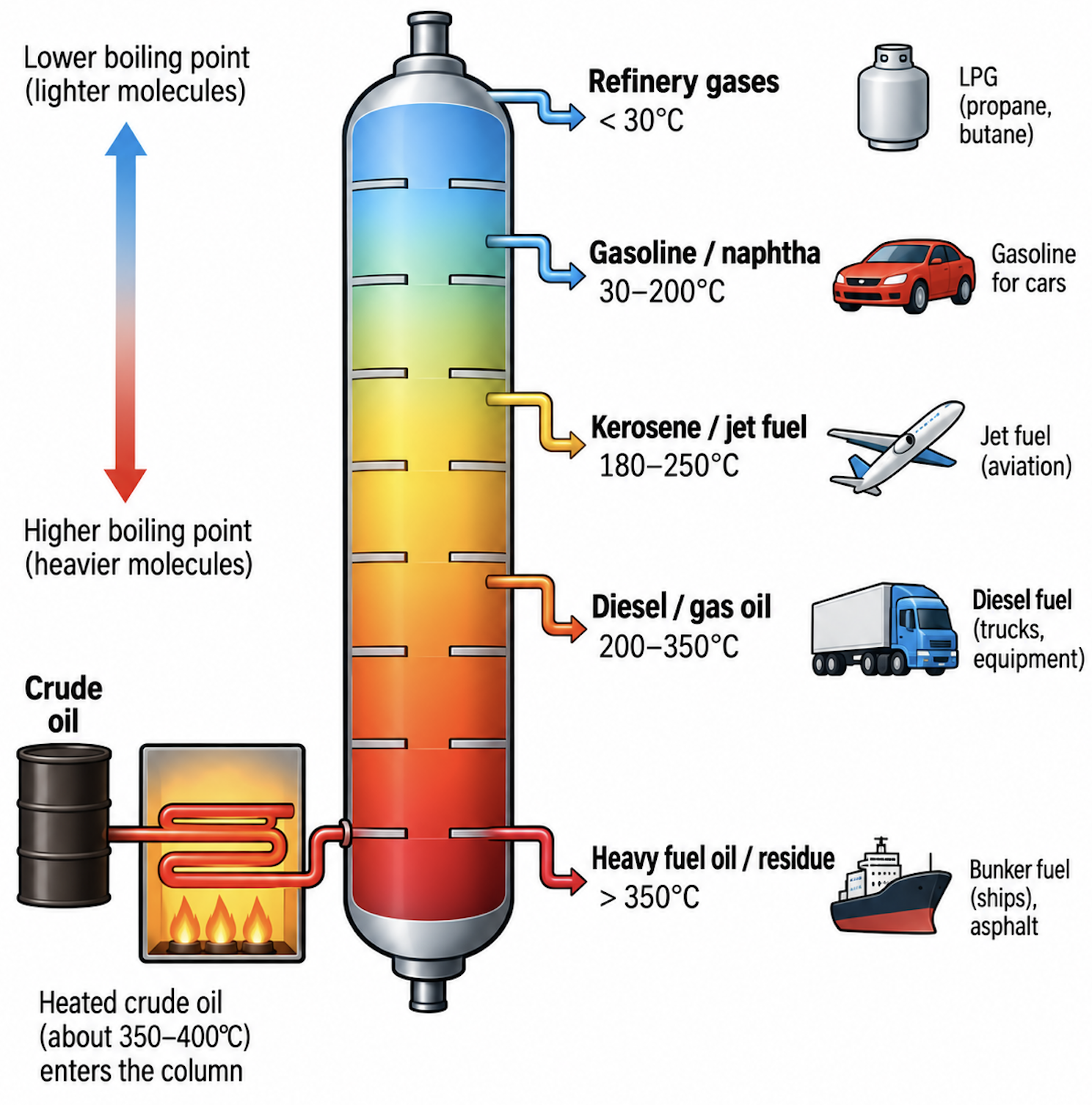
Figure 1. A crude oil distillation tower. Different petroleum fractions are collected at different heights according to their boiling points. Heavier fractions tend to contain more complex hydrocarbons and troublesome impurities, including sulfur compounds.
Sulfur screws things up
Crude oil contains sulfur, sometimes several percent by weight. But we're not talking about little chunks of yellow sulfur floating around in the oil. Much of it is chemically incorporated into organic molecules, appropriately called organosulfur compounds. Why does this matter? When sulfur-containing fuels burn, they produce sulfur dioxide (SO₂), which contributes to air pollution, acid rain, and the formation of fine particulate matter.
To reduce these emissions, the EPA progressively tightened sulfur limits in diesel fuel. Beginning in 2006, the United States began transitioning to ultra-low-sulfur diesel (ULSD), which contains no more than 15 parts per million (ppm) sulfur. That's an extraordinarily low concentration, especially considering that some crude oils contain 30,000–50,000 ppm sulfur. Getting down to 15 ppm requires some serious chemistry, none of which you will be especially eager to read about.
Bummer.
Hydrodesulfurization removes sulfur. This may or may not be easy.
Refineries remove sulfur using a process called hydrodesulfurization (HDS). Diesel fuel is treated with hydrogen gas at elevated temperatures and pressures in the presence of catalysts, commonly based on cobalt-molybdenum or nickel-molybdenum compounds. Many metals have a thing for sulfur, a property that comes in handy here.
The basic idea is straightforward. Hydrogen reacts with organosulfur compounds, breaking carbon-sulfur bonds and converting the sulfur into hydrogen sulfide (H₂S), which can then be separated from the fuel. Here's the equation in simplified form:
Organosulfur compound + hydrogen → hydrocarbon + H₂S
Sounds easy enough. Unfortunately, it isn't.
All this takes plenty of hydrogen, energy, and expensive equipment. And the hydrogen sulfide produced in the process? It's highly toxic, so refiners have to deal with that, too. And, of course, in organic chemistry there's usually an annoying exception.
Simple thiols are relatively easy to desulfurize. Others are remarkably stubborn. One example is a pain in the ass called 4,6-dimethyldibenzothiophene, a name that was no doubt on the tip of your tongue. Its two methyl groups help shield the sulfur atom, making it harder for the molecule to interact with the catalyst. Chemists call this steric hindrance (Fig. 2).
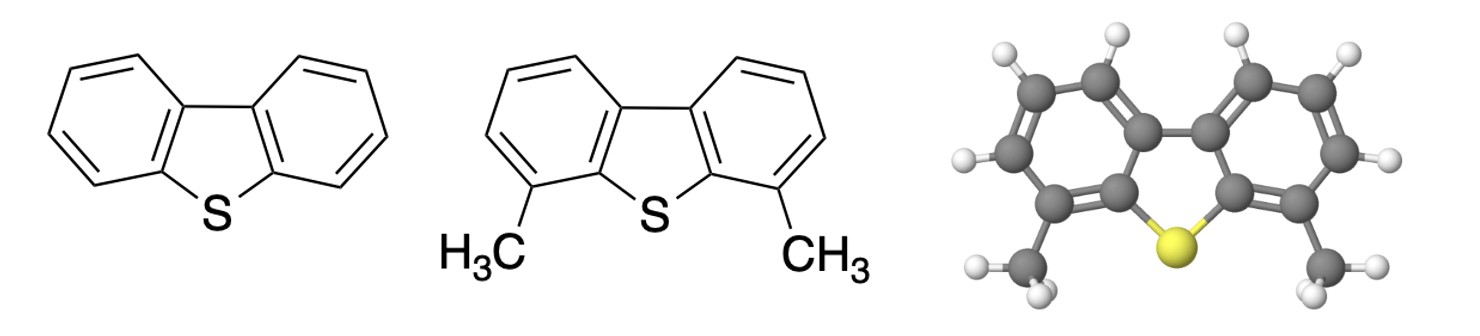
Figure 2. A little molecular obstruction goes a long way. Dibenzothiophene (left) is relatively easy to desulfurize. Add two methyl groups (center), and sulfur removal becomes considerably more difficult. The 3D ball-and-stick model (right) illustrates how the methyl groups crowd the region around the sulfur atom (yellow), a phenomenon called steric hindrance.
Sulfur has another dirty trick
Sulfur pollution isn't the only concern. Sulfur also interferes with diesel exhaust treatment systems, including catalysts designed to reduce harmful emissions. It has an annoying tendency to bind to catalytic surfaces, where it isn't wanted.
Without ultra-low-sulfur diesel, modern exhaust treatment systems wouldn't work nearly as well. So, cleaner air. Good. More expensive refining. Not so good.
Chemistry isn't the whole story
If sulfur removal were the only consideration, diesel would generally be more expensive than gasoline. But it isn't.
Supply and demand also have a say. Trucks, tractors, construction equipment, and factories consume enormous quantities of diesel. Heating oil and jet fuel compete for related refinery products, and refineries can't simply crank out more diesel whenever demand increases. Also, the federal tax on diesel is currently 24.4 cents per gallon, compared with 18.4 cents for gasoline. Another six cents, courtesy of Washington.
Diesel does have one advantage. It contains roughly 10–15% more energy per gallon than gasoline, and diesel engines are generally more efficient. But when diesel costs so much more per gallon, that "advantage" doesn't come close to making up the difference.
The bottom line
Now, assuming you've stayed awake, you at least have some idea why diesel is so expensive. Removing sulfur is a chemical pain in the buttocks. There's also supply, demand, taxes, and other stuff I don't understand.
If I put you to sleep, there are a variety of fine products available at truck stops. Some are even legal.

Josh Bloom
Dr. Jonathan (Josh) Bloom, ACSH's Director of Chemical and Pharmaceutical Sciences, earned his Ph.D. at the University of Virginia and completed postdoctoral training at the University of Pennsylvania. During his 20-plus years in drug discovery at Wyeth, his research group discovered the antibiotic Tygacil®, approved in 2005. He holds 25 issued patents and has authored 35 academic papers. Since joining ACSH in 2010, he has written more than 2,000 articles and dozens of op-eds for major newspapers, including The Wall Street Journal and Chicago Tribune.