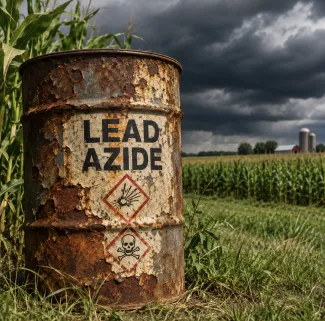
Two words that make chemists pay attention are "lead" and "azide," especially the latter.
Lead is, well, lead, and most people have a pretty good idea that it should generally be avoided. But for all its drawbacks, at least it won't blow your head off. The same cannot be said for azides. Many of them can, including silver azide, copper azide, mercury azide, and, ironically, lead azide.
So, while it's wise to avoid lead azide when trying not to blow your head off, the stuff comes in mighty handy when you're trying to blow someone else's head off.
Hence, the use of the chemical for military purposes makes perfect sense. Lead azide is a primary explosive — something used to detonate less sensitive (secondary) explosives, such as TNT, which requires a kick in the pants to get going.
One particularly useful property of a primary explosive is its sensitivity to mechanical shock.
Which brings us to Middletown, Iowa, where the Army had been sitting on 9,700 pounds of lead azide. Some of the stuff dates back to the 1940s, making it even older than ACSH writers. (The Department of Defense was aware of the stockpile's deterioration as early as 2004.) Whatever was bad back then is 22 years worse now.
As if things weren't bad enough...
Polymorphism — the ability of a compound to exist in more than one crystal structure — may have made the problem worse. Lead azide is known to exist in four crystal forms called alpha, beta, gamma, and delta, and there are differences in physical properties among these forms (Table 1).

Table 1. The four crystalline forms (polymorphs) of lead azide. Source: Biegańska, J. Materials 2021, 14(11), 2818. doi:10.3390/ma14112818
The Army observed both needle- and plate-shaped crystals on the outside of the barrels. Although crystal shape alone doesn't establish which polymorphs were present, the sight of these crystals couldn't have been comforting.
Verdict: Uh oh.
Bad choices abound
The people of Middletown, Iowa, weren't terribly enthusiastic about babysitting 9,700 pounds of an explosive lead compound sitting within a few cornfields of their town, and I don't blame them. But getting rid of the stuff was no easy task. Consider the Army's options.
1. Chemically neutralize it
As recently as April 2026, the preferred plan for dealing with this mess was to chemically neutralize the lead azide. The proposed treatment was intended to eliminate the explosive hazard and reduce the environmental risks posed by the lead.
This would seem to be a perfectly sensible solution, except for one big problem: the condition of the 68 old barrels, some of which had crystalline lead azide on their exterior.
Opening an old barrel coated with a shock-sensitive explosive is a task that belongs squarely in the "you do it" pile.
2. Move it
Moving the barrels alone would have been risky enough. Even loading them onto a truck would seem like a suicide mission. And burying the stuff elsewhere would not have eliminated either its explosive properties or its toxicity. It would simply have relocated the problem.
3. Blow it up
Ultimately, this was the option the Army chose. [1] But the detonation addressed one problem while raising concerns about another: the potential for a big cloud of lead.
How much lead are we talking about? It's an easy chemistry calculation: 9,700 pounds of pure lead azide contains 6,900 pounds of lead. The explosion destroyed the azide, but not the lead.
How much of it became airborne, and how far did it travel? What happened to the rest of it? And how much will need to be cleaned up?
The answers to these questions will help determine whether the Army made the right choice — or simply the least bad one.
[1] To its credit, the Army did not simply blow up the stuff and hope for the best. Measures to minimize the dispersal of lead included physical barriers, foam, and water sprays. The Army and EPA also planned extensive air, soil, and water testing, with the government covering the cost of cleanup where lead contamination exceeds specified limits. Whether these measures were sufficient remains to be seen. (See the Army's November 24 announcement.)

Josh Bloom
Dr. Jonathan (Josh) Bloom, ACSH's Director of Chemical and Pharmaceutical Sciences, earned his Ph.D. at the University of Virginia and completed postdoctoral training at the University of Pennsylvania. During his 20-plus years in drug discovery at Wyeth, his research group discovered the antibiotic Tygacil®, approved in 2005. He holds 25 issued patents and has authored 35 academic papers. Since joining ACSH in 2010, he has written more than 2,000 articles and dozens of op-eds for major newspapers, including The Wall Street Journal and Chicago Tribune.