
My kids like to play with anything they can get their hands on, especially things they’re not supposed to play with—cell phones, iPads, wallets, keys and even expensive dishware. If you’re a parent, you know exactly what I mean, and you know how expensive and destructive your little ones can be. It’s this indisputable fact about toddlers that makes squishy toys so helpful.
You very likely own at least one, or you’ve probably seen them online. For the uninitiated, squishes are “soft, squeezable toys designed to be pressed, stretched or fidgeted with,” UC Davis explains. “They come in many shapes, sizes and textures, from food-shaped toys and animals to stress balls and tactile fidgets.” My favorite is the NeeDoh Nice Cube; it’s damn fun to fidget with; I see why my kids like them so much.
That’s why squishy toys seem like an ideal solution to an inevitable problem. But the internet can’t let anything be that simple. Nope. Instead of low-cost, low-risk baubles that keep your children occupied, many across social media now view them as meaningful health threats. Here’s a typical (and viral) example from Instagram:
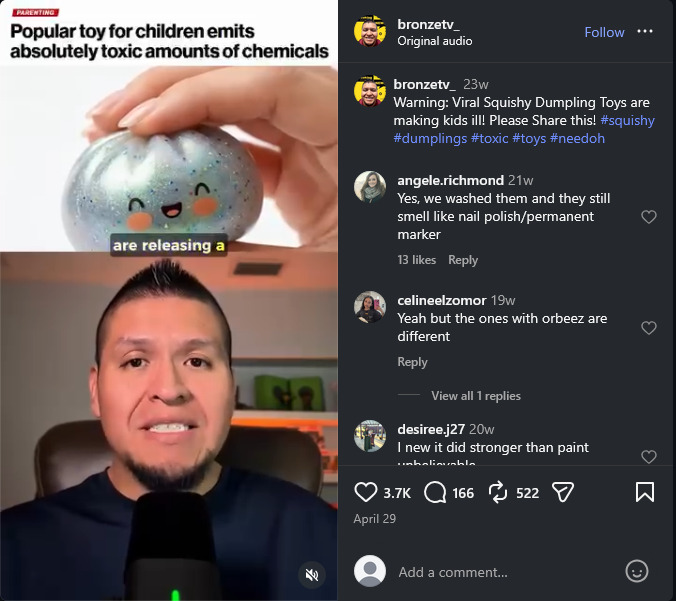
The claim here is that these toys, when first unboxed, expose the user to more volatile organic compounds (VOCs) “than a can of paint” through a process known as “offgassing.” You may also see other social media influencers claiming they contain high levels of chemicals that can be harmful if ingested or inhaled during routine use. As usual, very serious diseases like cancer are casually thrown around by people more interested in engagement than accuracy.
So what’s truth and what’s myth? With a few qualifications (see below), the online concern around squishy toys is mostly baseless. Here’s a brief guide for the perplexed.
Spoiler alert
To ruin the scare story right away, squishy toys are generally very safe. As UC Davis concluded in the expert-reviewed piece linked above:
“Squishy toys aren’t necessarily unsafe, but certain types and situations can pose risks. Be aware of damaged toys, toys containing water beads or small parts, counterfeit products and toys exposed to heat.
Squishy toys can be a fun way for children to explore textures and sensory play. Choosing age-appropriate toys from reputable sellers, checking toys for damage and keeping them away from heat can help reduce potential risks.”
As always, apply a little common sense and you’ll be in good shape. Don’t let your young children play with toys that could pose a choking or ingestion hazard (water beads can expand in the stomach and cause serious injuries); don't puncture or paint squishies with nail varnish, both of which degrade the surface and release their contents. Buy your toys from a reputable retailer, and—whatever you do—please don’t microwave a plastic toy filled with any sort of chemical gel. This may seem like an unnecessary warning, but that silly experiment is popular enough that CBS Mornings did a segment discouraging it. The Consumer Product Safety Commission (CPSC) also issued a news release with similar guidance in August.
Examining the hype
As with many social media scares, the problem here begins when a bit of truth is morphed into a five-alarm panic lacking the context parents need to make informed decisions. For example, problems with counterfeit products—which are serious enough that US Customs and Border Protection has seized more than 350,000 toys—become concerns about the product category itself. “Do Not Buy These Toys,” the Instagram post above warns—without defining “these toys” or “high levels” of VOCs, or even "VOCs." Dr. Josh Bloom, our director of chemical and pharmaceutical sciences, adds several important details about the exposure to paint chemicals. It might be a valid comparison, but not for the reason Instagram influencers think:
"This may be true, since almost all paint sold now is water-based with less volatile matter. They don't specify which kind of paint; also, no more lead in paint or gasoline, much less air pollution from cars, no more chloroform or methylene chloride solvents, no more arsenic in pressure-treated wood...I could go on.
As if kids are going to be snorting vapors from toys 12 hours/day for 10 years. Even if there are solvent residues in the toys, it's not going to hurt anyone. Even toy chewers."
It’s a critical qualification because there are strict federal standards governing toy manufacturing, generally enforced by the CPSC. These cover products ranging from bicycles to model aircraft and inflatables, and they outline standards for flammability, material quality and toxicology, among several other expansive categories. There’s literally an entire subchapter in the federal code dedicated just to water bead toys.
There are federal rules prohibiting the use of certain chemical additives in toys; tight limits on lead in construction materials; and regulations governing mechanical integrity, which mitigate the likelihood of toys becoming choking hazards.
There are even migration and solubility limits for hazardous heavy metals (e.g., arsenic, chromium, lead and mercury). These limits are set based on experiments using simulated stomach acid to determine how easily a compound leaches out of a toy if sucked or chewed on. This prevents children from ingesting toxic doses of heavy metals if they decide to use their squishy as a snack.
Importantly, these rules are not self-enforced standards. Manufacturers have to submit (see p. 4) their products to CPSC-approved laboratories for testing before they are marketed. But it doesn’t stop there. Once a toy hits the shelf, the product and its packaging must feature permanent, distinguishing marks that allow consumers and regulators to trace the manufacturer, date and place of production, as well as the batch number. This is to say nothing of the voluminous labeling rules that apply to essentially every category of toy.
Conclusion: a word about responsibility
Ultimately, the solution lies in responsible parenting. Many people bristle at such admonitions, but it’s a reality of the world we live in. Yes, there are rules and regulations that will help you protect your kids. Those are good and necessary safeguards. But no regulator can stop your child from microwaving a NeeDoh or limit their screen time—you can. Bottom line: don’t panic. Toys off the shelf aren’t going to harm your kids if they’re used as they’re designed to be used. Take precautions as necessary—along with a deep breath—and your kids will make it through this latest social media panic.

Cameron English
Executive Vice President
Cameron English is a writer, editor and co-host of the Science Facts and Fallacies Podcast. Before joining ACSH, he was managing editor at the Genetic Literacy Project.