“Pope Leo said in his initial announcement of the impending surgery after praying the Angelus October 11 that doctors ‘found a small, localized nodule in my lung. It was detected at a very early stage and is well-localized.’”
Discovery of a small nodule in the right lower lobe of the lung allowed a surgical team led by Dr. Stefano Margaritora at Rome’s Catholic University of the Sacred Heart to surgically remove the cancer. The resection of the pope’s right lower lobe was accomplished using a minimally invasive method termed video-assisted thoracotomy (VATS), which uses a small camera and specialized instruments inserted through small incisions in the chest wall to diagnose or in the case of the Pope, treat conditions involving the lungs, avoiding the need for a traditional open thoracotomy. The operation was designated as “radical,” implying that dissection of hilar and mediastinal lymph nodes was performed. Pope Leo is reported to be recovering satisfactorily. What’s up next in his treatment plan?
What Happens Next Depends on What the Pathologist Finds
That answer will depend on the size of the lung cancer, which has yet to be reported, its composition—whether entirely solid, non-solid, or a mixture of the two—and whether pathological examination reveals spread to the lymph nodes. Because the cancer was a “nodule.”’ i.e., less than 3 cm in diameter, odds are that the lymph nodes will prove negative, without evidence of lung cancer’s spread, and no post-operative radiation therapy, chemotherapy, or immunotherapy will be required.
The Survival Advantage of Finding Cancer Early
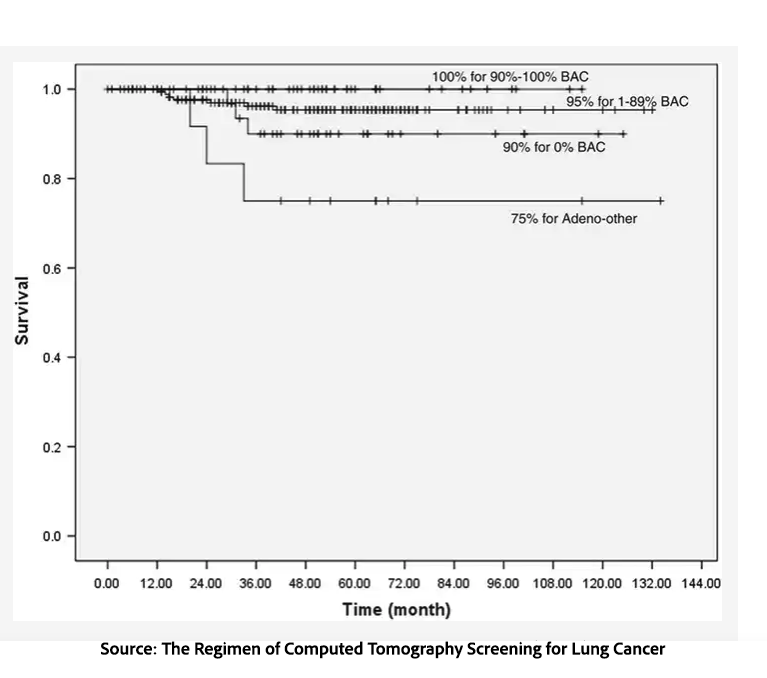
The Early Lung Cancer Action Project (ELCAP), whose early results were reported in The Lancet nearly two decades ago, was designed to evaluate low-dose computed tomography (low-dose CT) screening in people at high risk of lung cancer. In the study, more than 80% of patients were diagnosed at the early Stage 1. After detection by screening, in more extended research, those with adenocarcinoma, like Pope Leo, experienced very high 20-year actuarial survival, as the survival graphic demonstrates. [1]
 This is very good news for both the Pope and for people at risk in the U.S. and Italy.
What the Headlines Miss
Gina Kolata, the science reporter for the NY Times, acknowledges that annual mortality for lung cancer has gradually fallen to 40,000 fewer annual deaths since the 1990s “because fewer people smoke but also because newly developed treatments are working.” Her summary of newer, less invasive, more effective therapies completely ignores, from my perspective, the real reason that Pope Leo and millions of others will be cured of lung cancer in coming years—low-dose, non-contrast spiral CT screening.
Although experts quoted by Kolata emphasize encouraging developments in drug treatment of lung cancer, unfortunately, in the case of those with metastases, the new drug treatments extend duration of survival, but most often do not cure. They are enormously expensive and frequently have adverse effects.
The article fails to mention major advances in the surgical treatment of lung cancer. When lung cancers are detected at small size and early stage, most can be safely removed by thoracic surgeons using VATS or robotic techniques, performed through tiny incisions, rather than long incisions with the ribs spread apart (thoracotomy). These less invasive surgical treatments have achieved equivalent survival rates, with lower complication and perioperative death rates, shorter hospital stays, and faster recovery. The striking advance in surgical methods is largely due to the slow but steady increase in early-stage detection by low-dose CT screening of at-risk patients, which can detect lung cancer at the earliest Stage 1 in up to 80% of cases. In contrast, only 15% of patients with symptomatic lung cancers are diagnosed in Stage 1.
Who Gets Screened and Who Gets Left Out
Fortunately for Times readers, Nina Agrawal offered a more accurate, far more nuanced discussion of the problem posed by current Medicare coverage, which excludes population screening for “light” and never smokers in the U.S. from coverage. This appears to be the case for people, as with the Pope, who is currently believed to be a non-smoker.
Currently, approximately 17,000 American never-smokers die of lung cancer each year. In 2013, the United States Preventive Services Task Force (USPSTF) and the American Cancer Society recommended low-dose CT screening for high-risk adults, a service now covered without a copay for Medicare recipients. [2] Today, only 1 in 5 at-risk, eligible patients take advantage of this screening.
The lesson from the pope's experience should reach well beyond the Vatican. Those with a significant smoking history should speak with their healthcare providers about whether they qualify for annual low-dose CT screening. Clinicians and healthcare systems should make those conversations routine, while researchers and policymakers work to better identify high-risk individuals who fall outside current screening recommendations.
We should celebrate the medicines that help patients live longer with lung cancer. But we should be equally committed to finding cancers early enough that patients may never need those medicines at all.
[1] Among patients with lung cancers that appeared non-solid or partly solid on CT scans, survival was closely related to how the cancer cells grew. We do not know the Pontiff’s complete histologic (cell) description. Patients whose tumors consisted almost entirely of (90–100%) a lepidic growth pattern (BAC)—meaning cancer cells spread along the lining of the lung’s tiny air sacs rather than invading deeper into lung tissue—had a reported 100% survival rate during the study’s follow-up period.
[2] Medicare currently covers annual low-dose CT screening for qualifying asymptomatic adults ages 50–77 with at least 20 pack-years of smoking who currently smoke or quit within 15 years. The American Cancer Society's 2023 recommendations extend eligibility to people with that smoking exposure regardless of when they quit, but neither recommends routine population screening for never-smokers.