Almost without exception, when a new drug is approved and subsequently widely used, adverse effects that went undetected during clinical trials will begin to emerge. Math and clinical trial design explain why.
A typical Phase 3 trial (the final phase before approval or rejection) is the largest and by far the most expensive part of the drug-approval process. Several thousand people (perhaps 3,000) are enrolled in a typical Phase 3 trial, and this gives regulators a pretty good (but not perfect) idea of the incidence of side effects. But when millions of people try the drug, all bets are off. Adverse events that occur once in 5,000 people will probably be missed, and those that occur once in 50,000 people will almost certainly be missed.
This same reasoning can be applied to marijuana; as more people use it, more negative effects are pretty much inevitable.
However, there's one obvious difference. Unlike prescription drugs, marijuana never had to pass through the rigorous clinical trials required for FDA approval before becoming widely available. As a result, much of what we know about its potential adverse effects comes from observational studies, which, as usual, make it difficult or impossible to distinguish causation from coincidence.
The study says...
A new study in BMJ Open examining the relationship between marijuana legalization and cardiovascular disease illustrates this problem rather nicely. The researchers reviewed more than 50 million hospital discharges between 2012 and 2018, looking for a relationship between recreational marijuana legalization and cardiovascular disease.
The obvious way to study marijuana's effects on the heart would be to compare people who use it with those who don't (duh). Simple enough, except for one problem. Marijuana users may also smoke cigarettes, drink more alcohol, or use other drugs, all of which can screw up cardiovascular health. So, if marijuana users have more heart attacks, how do we know whether marijuana is the culprit?
To address this, the researchers tried a different approach, and it's not necessarily obvious. They treated the entire Western United States as a region with legal recreational marijuana sales beginning in 2014, even though sales remained illegal in several Western states throughout the study. If heart-related hospitalizations increased more rapidly in the West than elsewhere, perhaps marijuana legalization had something to do with it.
Clever idea. But does it work?
The results are in. Sort of.
There may be something going on here (Table 1).
Compared with trends elsewhere in the country, each additional year of legal recreational sales was associated with relative increases in hospitalization rates for heart failure (3.7%), heart attacks (3.1%), and atrial fibrillation (2.3%). These three findings were statistically significant, but the increases for stroke and two other cardiovascular conditions were not.
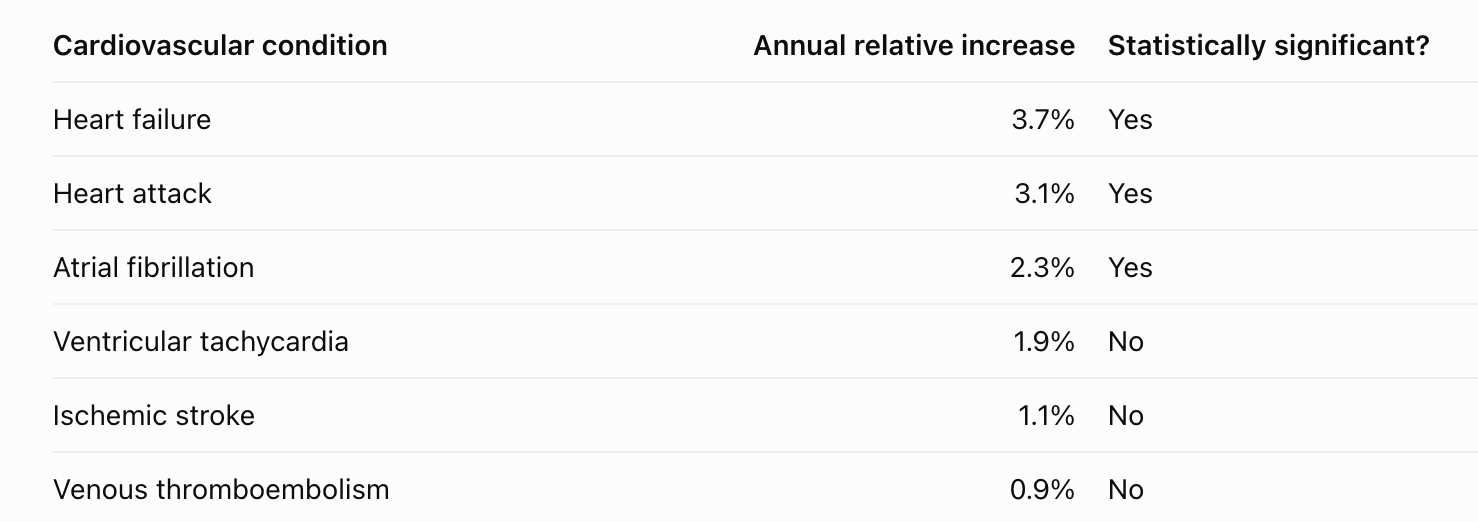
Table 1. Annual relative changes in cardiovascular hospitalization rates associated with recreational marijuana legalization, 2012–2018. Statistically significant increases were found for three of the six conditions studied. Source: Slavin et al., BMJ Open (2026).
So, does legalizing marijuana cause heart disease? Not necessarily. And here's where things get interesting.
A few problems...
For starters, the researchers had no idea whether the patients hospitalized for cardiovascular problems actually used marijuana. None. They were studying the effects of legalization, not marijuana consumption itself. That's a pretty important distinction.
There's more. The researchers classified the entire Western United States as exposed to legal marijuana sales beginning in 2014, even though recreational sales remained illegal in several Western states throughout the study. Idaho, Utah, and Wyoming, for example, were lumped together with Colorado and Washington, where legal sales had already begun.
The authors acknowledge this limitation and argue that including states without legal sales would probably make any real effect harder to detect. Fair enough. But it doesn't change the fact that legalization was being used as a substitute for actual marijuana exposure.
And there's still the usual problem with observational studies: other stuff happens while you're busy studying one particular thing. Changes in smoking rates, obesity, diabetes, healthcare access, or hospital admission practices could also influence cardiovascular hospitalization rates. The researchers adjusted for several demographic factors, but they couldn't account for all the other variables that might influence the results. Welcome to epidemiology.
As another check, the researchers examined hospitalizations for kidney stones and opioid-related conditions as negative controls. Why? If hospitalizations were increasing across the board for reasons unrelated to marijuana, these conditions might show similar trends. They didn't. Neither showed a statistically significant association with legalization. That lends some credibility to the cardiovascular findings, but it still doesn't tell us whether marijuana was responsible for anything.
In other words, the study found that cardiovascular hospitalizations increased relative to trends elsewhere following marijuana legalization. What it didn't establish is that marijuana was responsible.
The bottom line
So, what did this study actually tell us?
- What it found: Following recreational marijuana legalization, hospitalization rates for heart failure, heart attacks, and atrial fibrillation increased relative to trends elsewhere in the country. The differences were small, but statistically significant.
- What it didn't find: Convincing statistical evidence of increased hospitalizations for strokes, dangerous heart rhythm disturbances, or blood clots.
- What it couldn't tell us: Whether the hospitalized patients actually used marijuana, how much they used, or how they consumed it.
- What it didn't (nor could it) prove: That marijuana caused any of the observed increases in cardiovascular hospitalizations.
None of this means marijuana is harmless. The findings raise some concerns about cardiovascular risks, but nothing worth having a heart attack over. Marijuana may be guilty, but this study isn't enough to convict it.

Josh Bloom
Dr. Jonathan (Josh) Bloom, ACSH's Director of Chemical and Pharmaceutical Sciences, earned his Ph.D. at the University of Virginia and completed postdoctoral training at the University of Pennsylvania. During his 20-plus years in drug discovery at Wyeth, his research group discovered the antibiotic Tygacil®, approved in 2005. He holds 25 issued patents and has authored 35 academic papers. Since joining ACSH in 2010, he has written more than 2,000 articles and dozens of op-eds for major newspapers, including The Wall Street Journal and Chicago Tribune.