There were several events on my agenda as we planned a family trip to London in 1989. We were going to see Miss Saigon with Lea Salonga and Jonathan Pryce; we would visit 221B Baker St., a thrill for any Sherlockian; and we would explore the Chelsea Physic Garden, where medicinal plants had been cultivated since 1673.
I had been eager to see some of the plants I had so often discussed in lectures, such as mandrake, belladonna, Pacific yew and the white willow. I was especially keen to see a cinchona tree, which has played a major role in the history of chemistry, thanks to the quinine found in its bark. The fourth visit planned was to the National Portrait Gallery. Unfortunately, that proved to be disappointing.
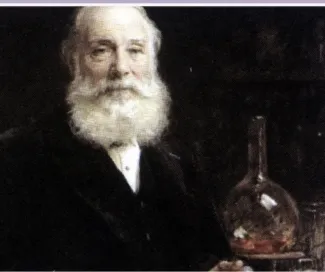
To be sure, the gallery is fantastic, and I was thrilled to stand next to the portraits of Isaac Newton, Robert Boyle, Charles Darwin, Humphry Davy and Michael Faraday that I had so often seen in books. But the portrait I had really come to see was of William Henry Perkin, the chemist I think I have spoken about more over the years than any other.
I knew about the famous portrait painted in 1906 by Sir Arthur Stockdale Cope to commemorate the 50th anniversary of Perkin’s discovery of the world’s first synthetic dye and could hardly wait to see it. I hunted around for it, in vain as it turned out. When I asked, I was informed that the portraits were rotated and Perkin’s was temporarily in storage. Auggh.
Perkin was an 18-year-old student when he came under the guidance of famed chemist August Wilhelm von Hofmann, who had been imported from Germany by Queen Victoria’s husband, Prince Albert, to be the first director of the Royal College of Chemistry in London. In 1856, Hofmann gave Perkin the task of trying to synthesize quinine from aniline found in coal tar.
At the time, quinine was in great demand for the treatment of malaria, and its only source was the bark of the Peruvian cinchona tree, which I did manage to see at the Physic Garden. Perkin’s task to synthesize the substance in the lab was, in retrospect, impossible, and he just kept coming up with gummy residues in his glassware.
One day, faced with a particularly insoluble residue, he tried rinsing his flask with alcohol. To his astonishment, the solution turned into a purple color that was more stunning than any purple ever produced from a natural source. Young Perkin had accidentally made the world’s first synthetic dye.
Eventually named mauve, that dye would have an impact far greater than just setting a fashion trend. It would revolutionize chemistry. Perkin himself went on to synthesize a number of other dyes and inspired chemists to follow in his footsteps. German companies such as BASF, Bayer, Hoechst and Agfa soon dominated the global synthetic dye market, but they went farther.
If dyes could be produced in the lab from coal tar, why not other substances? The companies that began as dye producers were soon manufacturing aspirin, heroin, and the fever-reducing antipyrine.
What’s more, the discovery of the first antibacterials is also strongly connected to Perkin’s breakthrough. As early as the 17th century, self-taught Dutch scientist Antonie van Leeuwenhoek developed a microscope lens that allowed him to see what he described as little “animalcules” cavorting around in samples of water, saliva and sperm. In 1828, Christian Ehrenberg coined the term “bacteria” for the little creatures, from the Greek for “little rod” because of their shape. However, it was only after Louis Pasteur proposed his germ theory of disease in the mid-19th century that interest in bacteria skyrocketed.
The search was now on to see whether diseases could be traced to the presence of bacteria in the body. But there was a problem.
Although the general shape of bacteria could be seen through a microscope, details could not be distinguished because the bacteria were nearly transparent. In 1875, German physicians Carl Weigert and Robert Koch had the idea of using the newly discovered synthetic dyes to visualize bacteria in tissue samples. That worked, and suggested to Paul Ehrlich the possibility of using chemicals to selectively kill bacteria without harming the patient. This eventually led to the development of Salvarsan, an arsenic-containing compound introduced in 1910 to treat syphilis.
Back in 1884, Danish physician Hans Christian Gram had been studying lung tissue from patients who had died of pneumonia, but he had trouble visualizing the microbes he thought must be present. Drawing inspiration from Weigert and Koch, he experimented with different dyes, and when he treated his sample with iodine and gentian violet, a coal-tar dye, some bacteria — but not others — were made visible. His experiment gave rise to the terms 'Gram-positive' and 'Gram-negative' for bacteria that do or do not retain the violet stain after a decolorizing step.
Later, Weigert would develop safranin, another coal tar dye, as a “counterstain” that would color Gram-negative bacteria red. These variances are more than academic. The different responses to stains are due to the bacteria having differently structured cell walls that also determine the cells’ sensitivity to various antibiotics.
A patient presenting with a severe infection requires immediate antibiotic treatment, but the selection of the antibiotic depends on identifying the bacteria that are causing the infection. For specific identification, bacteria have to be cultured, and that can take 24-48 hours, which may be too long to wait before starting treatment. A rapid Gram stain can be done in 15 minutes, narrow down the class of bacteria, and allow for more informed initial antibiotic treatment.
Gram's intent was not to identify different classes of bacteria. In the report of his experiment, he modestly stated: “I have published the method, although I am aware that as yet it is very defective and imperfect; but it is hoped that also in the hands of other investigators it will turn out to be useful.” He was sure right about that.
Perhaps now you can understand why I was so keen to see the portrait of the chemist who seized an accidental discovery and ended up laying the cornerstone for both the dye and pharmaceutical industries.
In 1998, on another visit to London, this time to see Andrew Lloyd Webber’s musical Whistle Down the Wind, I went back to the Portrait Gallery hoping that Perkin’s turn had come. Indeed, it had. Not only do I now have a picture of myself with the famous painting, but I also bought a beautiful print of it that now hangs in my office and brightens my day.
# Reprinted with permission. Dr. Schwarcz’s original article can be found on the OSS website
May be lightly edited for clarity and accuracy
Joe Schwarcz
Dr. Joe Schwarcz is Director of McGill University's “Office for Science and Society” which has the mission of separating sense from nonsense. He is well known for his informative and entertaining public lectures on topics ranging from the chemistry of food to the connection between the body and the mind.