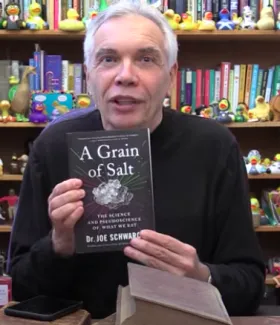
This week "Dr. Joe" Schwarcz takes a look (a sniff, really) at the chemistry of why books have their distinctive smell. The answer is (of course) that books of different eras were made from different materials. Long ago books were made from materials containing cellulose, which, with time, broke down to form small amounts of furfural, which has an almond-like scent.
As paper materials changes so did the scent of the books. New books now have a distinctive fresh odor because of bleaching agents used to make the paper. And Kindles don't smell at all, but you can buy a spray that (supposedly) be reminiscent of old books while you're reading a bunch of electrons on a plastic screen.
Here's a link to the video.

Josh Bloom
Dr. Jonathan (Josh) Bloom, ACSH's Director of Chemical and Pharmaceutical Sciences, earned his Ph.D. at the University of Virginia and completed postdoctoral training at the University of Pennsylvania. During his 20-plus years in drug discovery at Wyeth, his research group discovered the antibiotic Tygacil®, approved in 2005. He holds 25 issued patents and has authored 35 academic papers. Since joining ACSH in 2010, he has written more than 2,000 articles and dozens of op-eds for major newspapers, including The Wall Street Journal and Chicago Tribune.