Versed may very well be the second-coolest drug out there. Some might even consider it #1, but we chemists (like wine connoisseurs) can be pretty snooty too. According to my highly refined (and snooty) palate, the prize for the coolest drug goes to propofol - hands down.
But one should not dismiss the awesomeness of Versed (generic name midazolam) simply because propofol eats its lunch. It's still pretty great stuff. Once that bad boy hits your blood, life is good, and you simply won't care about whatever misfortune you may be facing at the moment.
Just like I didn't when I was given Versed during my recent ocular procedure (which could be described in culinary terms as "filet of eyeball") (1). It is truly impossible to worry about anything once you get a nice jolt of the stuff, as depicted in Figure 1.
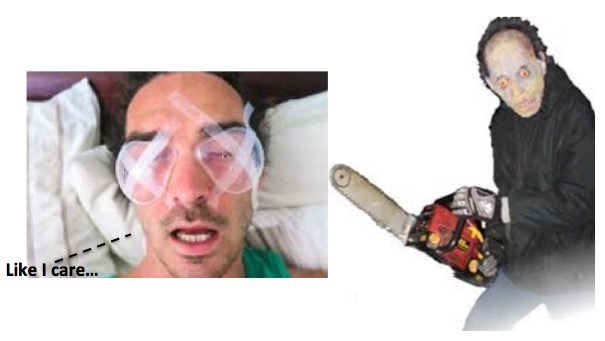
Figure 1: Cares just melt away.
Versed may be a wonderful sedative (a drug that treats anxiety) and hypnotic (a drug that induces sleep), but it is NOT a general anesthetic (induces unconsciousness)—something that the idiots in an Oklahoma prison learned at the expense of a convicted murderer, who they were trying to execute with the wrong drugs. Except their pharmacology wasn't quite up to snuff. Lethal injection involves 1) Induction of unconsciousness, 2) administration of a drug to stop breathing, and finally 3) potassium chloride to stop the heart.
What they (really) should have known is that Versed can't do #1 well enough, as evidenced by the prisoner writhing and screaming for 43 minutes before the other drugs finally killed him (See: Chemistry, Politics, And The Death Penalty). Propofol would have done the job, but it was unavailable because drug makers have stopped selling it to prisons as a protest against capital punishment.
The chemistry of Versed is both interesting and unusual. Most small-molecule drugs (2) are single entities containing one medicine that does (hopefully) what it's supposed to do. There are some exceptions to this (see note 3). Following administration, almost all small-molecule drugs are chemically altered (metabolized), mostly by the liver, and converted to inactive compounds (4) , which are then excreted. Once this conversion happens, the molecule doesn't get put back together again (5), but Versed does just that. Versed is a Jekyll/Hyde drug— it has two personalities, only one of which is good (6), as shown in Figure 2.
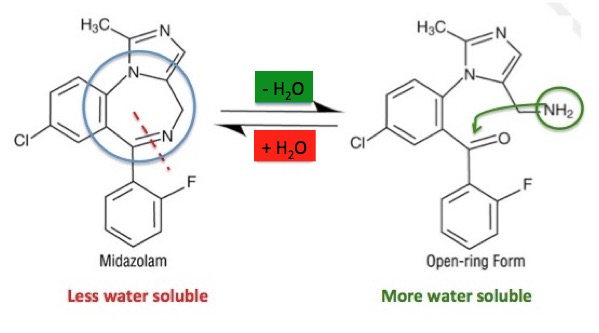
Figure 2: The two forms of Versed are interconverted by the loss or addition of water. The pH dependence of the two forms of Versed is unusual among drugs.
Versed's ability to come back together is due to a reversible opening of the benzodiazepine ring (blue circle). The closed (left) and open (right) forms of Versed are in equilibrium with one another, depending on pH. The open form is much more water-soluble due to the presence of the polar primary amine group (green circle), making it easier to dissolve the drug in water at about pH 4, where a significant portion is in the open form (7). The red hatched bond breaks to give the open form. The green arrow shows the same two atoms that will react to give the closed form.
For those of you I have not put into a coma, there is some chance that this article was anxiety-producing because it was a little heavy on the chemistry. Fortunately, there is an answer:
Relax!
Notes:
(1) OK, this may be somewhat melodramatic. It was a (yawn) lens implant. Was it unpleasant? Damned if I know...
(2) Small-molecule drugs are usually of low molecular weight and given as pills or capsules. Biologics - large, complex biomolecules, such as vaccines, antibodies, and proteins, must be given by injection, since they cannot withstand the digestive processes in the stomach and would not be absorbed. Biologics, which are harder to manufacture, are almost always much more expensive than pills.
(3) There are a variety of (mostly older) drugs that have multiple components. One such example is the HRT drug Premarin. It contains about a dozen similar estrogenic hormones.
(4) Drug metabolites may be the active species, in which case, the drug is called a pro-drug. One such example is the antidepressant Effexor. It is converted by the liver by oxidative demethylation to Pristiq - the active species. In other cases, especially opioids, metabolites may have a lesser potency than the parent drug but still bind well enough to block the pain response.
(5) Other members of the benzodiazepine class of drugs undergo a similar ring opening-closure, but not as readily.
(6) Some papers have shown that both the open and closed forms of Versed have some sedative properties. I don't buy it.
(7) At or above pH 5, most of the drug is in the closed (less soluble) form.

Josh Bloom
Dr. Jonathan (Josh) Bloom, ACSH's Director of Chemical and Pharmaceutical Sciences, earned his Ph.D. at the University of Virginia and completed postdoctoral training at the University of Pennsylvania. During his 20-plus years in drug discovery at Wyeth, his research group discovered the antibiotic Tygacil®, approved in 2005. He holds 25 issued patents and has authored 35 academic papers. Since joining ACSH in 2010, he has written more than 2,000 articles and dozens of op-eds for major newspapers, including The Wall Street Journal and Chicago Tribune.