By Mauro Proença —
The magic mirror has traded its enchantment for an algorithm, and its verdict now comes with personalized recommendations for improvement. Artificial intelligence is reshaping how we see our faces, what we expect from cosmetic surgery, and even what physicians might learn about our health from a photograph. But is AI helping us see ourselves more clearly, or creating a more convincing distortion?
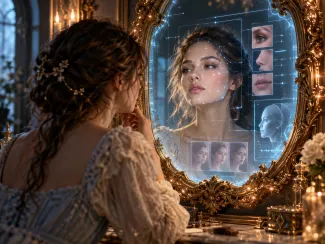
Let’s begin with updating Snow White.
“Mirror, mirror on the wall. Am I the fairest in the land?”“You possess a unique beauty, my dear. However, I see a few areas that could use improvement. You might benefit from some adjustments to your nose. It’s quite flat. Your jawline lacks a sense of strength; it’s too rounded. And, of course, there’s some thinning in that fine head of hair. Perhaps an implant, supplements, or medication would be worth considering. Would you like to know which options might be best for you?”
From Magic Mirror to AI Face
This seemingly lighthearted opening shows how artificial intelligence is replacing the magic mirror. It highlights an emerging trend in plastic surgery clinics. Patients, including young people, are requesting physical alterations based on AI-generated images, some depicting results that surgery can achieve only with difficulty, if at all.
We may be witnessing an evolution from “Instagram Face” to “AI Face.”
According to Joshi, patients “very frequently” bring AI-generated images of themselves to consultations to demonstrate the look they wish to achieve.
Meanwhile, specialized facial analysis tools promise to evaluate users’ appearances, score individual features, and suggest changes to supposedly “optimize” their looks. Examples include LooksMax AI and UMAX, both of which have surpassed 10 million downloads on Google Play. Another tool, Qoves, offers aesthetic assessments, recommendations for altering one’s appearance, and AI-generated images that simulate potential outcomes.
These developments bring AI to an age-old problem: dissatisfaction with one’s appearance and distorted body-image perceptions. Are these tools necessarily harmful, or could they also serve beneficial purposes, particularly in medicine?
The Cost of Comparison
One’s body image is currently understood as a multidimensional belief that encompasses perceptions of physical appearance, as well as attitudes, thoughts, feelings, and behaviors toward one’s body. In this field, traditional and digital media play an important role.
A meta-analysis published in 2002 in the International Journal of Eating Disorders examined 25 experimental studies involving 2,292 participants. The authors concluded that women’s body satisfaction decreased significantly after exposure to media images of thin bodies.
Another meta-analysis in Psychological Bulletin synthesized 77 studies and found associations between media exposure, lower body satisfaction, and greater internalization of the thin ideal. A review of experimental studies published that same year also found a small increase in body dissatisfaction among men after exposure to images of idealized muscular bodies.
Researchers have investigated social comparison, or the tendency to compare oneself with others, as one factor explaining these responses. In the digital environment, a 2025 systematic review and meta-analysis published in Body Image included 83 studies involving 55,440 participants. The authors found associations between greater social comparison on social media, increased body image concerns, and symptoms of eating disorders.
While these findings come primarily from observational studies of weight and body shape and do not establish causal relationships, taken together, they suggest that exposure to idealized body images can reduce body satisfaction in the short term. That comparison on social media is associated with greater appearance concerns. Do similar effects occur with facial features?
From bodies to faces
A 2003 study in BMC Psychology explored how photo editing relates to self-esteem, perceived attractiveness, comparisons with others, and self-objectification—the tendency to see and judge one’s own body through others' eyes, primarily in terms of physical appearance.
The researchers recruited 403 participants, most of whom were women and psychology students. The results showed a small negative correlation between photo editing and perceived attractiveness, and positive correlations between photo editing, self-objectification, and comparisons of physical appearance.
The authors proposed that frequent editing might create an idealized virtual self-image, widening the gap between one’s actual and ideal self. Although this study does not establish a causal link between photo editing and dissatisfaction with one’s face, other research has directly investigated the effects of exposure to idealized facial images.
An article in the Journal of Orthodontics examined the effects of exposure to idealized smiles. The researchers recruited 132 students and divided them into two groups. One group viewed images of smiles posted on Instagram, while the control group viewed images of nature.
After five minutes of exposure, facial satisfaction decreased significantly among participants who viewed the idealized smiles. Unlike the previous study, this experiment supports a more specific causal inference. Under the conditions tested, brief exposure to idealized smiles reduced facial satisfaction in the short term.
However, a single five-minute session does not replicate repeated exposure to idealized images over months or years. Furthermore, neither study directly investigated facial images generated by artificial intelligence. Smiles can help us understand how appearance idealization affects perceptions of one’s face, but we cannot conclude that AI-generated images produce similar effects.
When Virtual Perfection Meets Real Anatomy
At first glance, an AI-powered application might seem like a useful resource for visualizing what a treatment can achieve, especially when a qualified professional isn't available. After all, these tools have access to vast amounts of data. However, this reasoning overlooks a problem documented in the literature.
A study from Orthodontics & Craniofacial Research compared actual orthodontic outcomes with AI-generated images. In an online survey of 288 Brazilians, participants rated the AI-generated images significantly more attractive than the actual photographs. One possible explanation is that the AI optimized features such as symmetry and balanced facial proportions. Among 426 participants, in a study published in Aesthetic Plastic Surgery, the use of AI-based visual enhancement tools led to significantly higher expectations for the outcomes of plastic surgery.
Unlike reality, AI-generated images do not account for an individual patient’s anatomical, skeletal, periodontal, or functional limitations. This does not mean that AI in these emerging tools is inherently harmful. AI-powered simulation tools used in clinical consultations can facilitate communication between patients and surgeons, help them discuss desired outcomes, and support patient education about aesthetic procedures. These potential benefits, however, should not be confused with proven clinical effects.
When the Face Becomes a Medical Biomarker
Beyond aesthetics, recent research suggests that AI systems can also extract information about aging and clinical prognosis from facial photographs.
Trained on more than 40 million facial images, the FAHR-Face model was evaluated in a cohort of cancer patients. In the American cohort, individuals whose estimated facial age was at least five years greater than their chronological age had an approximately 21% higher risk of dying; those whose facial age was at least five years lower than their chronological age had a 17% lower risk.
These findings suggest that facial photographs may contain mortality-associated markers, but they cannot predict an individual’s survival. Because the researchers studied cancer patients, primarily in the context of radiotherapy, they must evaluate these models in other populations before determining their broader clinical utility.
Snow White’s magic mirror offered certainty. Today’s AI offers something potentially more seductive: the ability to show us not merely who we are, but who we might become. In cosmetic applications, that imagined perfection can create expectations that medicine cannot fulfill. In clinical medicine, however, the same technology may reveal patterns of disease and aging that the human eye cannot detect.
The distinction is not between good AI and bad AI, but between what the technology can demonstrate, what the evidence supports, and what we choose to believe. An attractive simulation is not a surgical promise, any more than a statistical prediction is an individual prognosis. Both require informed interpretation and an appreciation of uncertainty.
Perhaps the question we should be asking our digital mirror is no longer, “Am I the fairest of them all?” but “Is what you are showing me actually true?"
Category

Mauro Proença
Mauro Proença is a nutrition graduate student with a postgraduate degree in Clinical Nutrition from the University of São Paulo (USP), Brazil.