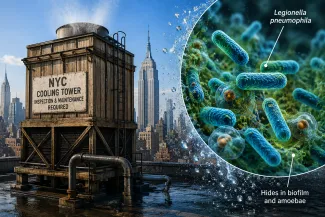
As I previously wrote, Legionnaires’ Disease was first identified in 1976 at a hotel in Philadelphia where members of the Philadelphia State American Legion were staying. About 200 Legionnaires were struck with what appeared to be severe cold symptoms, and 29 ultimately died. The bacteria, Legionella pneumophila, was identified as the causative agent and determined to have spread from the hotel’s air conditioning system. The CDC published “Legionnaires’ Disease” as the official name of the disease.
Legionnaires’ Disease is a type of pneumonia with symptoms including fevers, chills, muscle aches, and coughs. It is contracted by inhaling water droplets containing Legionella bacteria. Legionnaires’ Disease occurs more often in older adults and people with weakened immune systems. It does not spread from person to person or by drinking water, only by inhaling mist from water.
Legionella are typically found in freshwater, such as rivers and lakes, but they multiply and can pose a human health hazard in warm, stagnant water, including plumbing systems, cooling towers, heating, ventilation, and air conditioning (HVAC) systems, humidifiers, and hot tubs. They multiply and hide in the biofilms that form within pipes, where they are dispersed through tiny water droplets. Legionella can be difficult to control because they not only hide in biofilms but within microorganisms in the water, such as amoebae, which are not killed by disinfection.
Controlling Legionella involves regular cleaning and disinfection of cooling towers. This requires acid cleaning to remove scale and rust, disinfection with chlorine, chlorine dioxide, or ozone, and stripping of biofilm and loosening of deposits. It is recommended at least once a year and costs approximately $10,000.
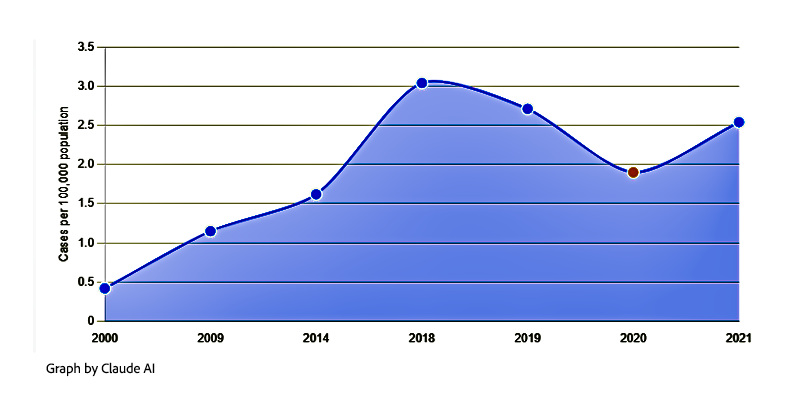
Legionnaires’ Disease Cases
The number of cases of Legionnaires’ Disease has been increasing since the early 2000s, with a peak in 2018, a drop during the pandemic, and a subsequent rise since 2020.[1]
Recent outbreaks
New York City (2026): On July 2, 2026, an outbreak of Legionnaires’ Disease occurred in the Upper East Side, with 90 reported cases, 65 people hospitalized and released, and six deaths (as of July 28, 2026). The cause was determined to be contaminated cooling towers. Officials tested 183 cooling towers at 160 buildings and found 77 positive for Legionella. All the cooling towers were cleaned and disinfected, and officials “are confident the source of the Legionella bacteria has been eliminated.”
Hamilton, Ontario, Canada (2026): Between May 4 and May 26, 2026, 22 cases of Legionnaires’ Disease were reported, with no confirmed source identified.
New York City (2025): From July – August 2025, 118 cases of Legionnaires’ Disease, with seven deaths, were reported in Harlem. Forty-three cooling towers were sampled, and two were positive for Legionella and determined to be responsible for the outbreak.
Grand Rapids, Minnesota (2023 and 2024): Fourteen cases of Legionnaires’ Disease were reported, with the source determined to be the municipal water supply, which was not chlorinated because it drew its water from groundwater. [2] Legionella-contaminated water mist from showers or faucets was the most likely source of exposure.
Regulations
In 1989, the EPA enacted the Surface Water Treatment Rule, which requires public water systems to filter and disinfect most water supplies to control Legionella and other microorganisms. This approach works well for most microbial contaminants that can be reduced by filtration, inactivated by disinfection, and do not multiply in plumbing systems. However, it does not work for Legionella, which can grow in pipes after treatment. Even a few cells can enter the water distribution system and multiply rapidly under the right conditions.
The EPA has proposed adding Legionella as a water contaminant under the Safe Drinking Water Act, but there are limits to controlling Legionella once water leaves the treatment plant because of its unique ability to evade detection and control measures.
Hospitals must follow strict rules for Legionella control, requiring facilities to develop a water management plan, map the building’s water systems, identify control points, i.e., cooling towers and hot water tanks, and establish standards for temperature and disinfection.
Unlike hospitals, office or apartment buildings are not subject to federal laws for Legionella control. There are also local and state regulations that attempt to control Legionella in buildings, cooling towers, and other sources. New York City enacted among the most rigorous and protective laws in the country to reduce the risk of Legionnaires’ Disease from cooling towers after the 2025 Harlem outbreak, but even these strict rules did not prevent the recent outbreak.
Additionally, for offices and apartment buildings, industry standards outline what a water management plan should include, such as identifying aerosol–generating equipment (e.g., cooling towers), setting temperature and disinfection control limits, and establishing monitoring schedules.
Why Traditional Water Regulations Fall Short
Legionnaires' disease illustrates an important lesson in environmental health: not every public health problem can be solved by regulating water at the treatment plant. Once water enters buildings, responsibility shifts to thousands of individual owners and facility managers, where maintenance practices—not municipal treatment—often determine whether Legionella can multiply.
While the EPA may issue additional regulations that categorize Legionella as a contaminant, a more practical solution, particularly for large cities, is to develop financial incentives for small building owners to comply with industry-accepted standards, as well as a visible educational campaign about the risk of Legionella. Financial incentives are particularly important in this era of cost constraints; incentivizing owners to ensure proper maintenance of their plumbing and cooling towers. Continued public education raises awareness and may pressure building owners to action. In the case of Legionnaires' disease, the challenge is less a lack of rules than the practical difficulty of controlling bacteria where they actually live.
[1] Precise incidence rates are not available from 2022-2025 and thus could not be included in the graph.
[2] The EPA requires municipalities to chlorinate their drinking water, irrespective of source, unless they can demonstrate no risk of contamination, such as in a deep, well-protected aquifer.

Susan Goldhaber MPH
Susan Goldhaber, M.P.H., is an environmental toxicologist with over 40 years’ experience working at Federal and State agencies and in the private sector, with an emphasis on issues concerning chemicals in drinking water, air, and hazardous waste. Her current focus is on translating scientific data into usable information for the public.