By Susan Goldhaber MPH —
How safe is safe enough? For a decade, EPA has struggled with that deceptively simple question under the Toxic Substances Control Act. A landmark Fifth Circuit decision on methylene chloride now draws a clearer line: Congress required EPA to regulate “unreasonable risk,” not eliminate risk.
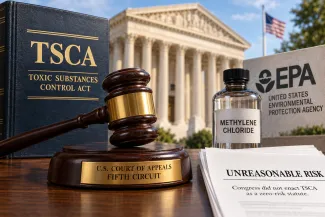
This year marks the 10th anniversary of the passage of the amended Toxic Substances Control Act (TSCA). The ten years have been marked by bitter disagreements between different administrations over the interpretation of “unreasonable risk,” culminating in an important September 2026 decision from the U.S. Court of Appeals for the Fifth Circuit on methylene chloride.
The Court not only vacated EPA’s entire methylene chloride rule, but in a stunning rebuke of the Biden EPA’s approach to chemical regulations, stated that “Congress did not enact TSCA as a zero -risk statute” and that “Unreasonable risk is not a factual finding but a prudential baseline set by the statute.” This means that EPA must set standards for chemicals under the amended TSCA that permit some residual risk.
This decision is significant because it's the first time the court has provided substantial guidance on what constitutes an “unreasonable risk.”
The History of TSCA
When EPA amended TSCA in 2016, it aimed to “strengthen EPA’s regulatory authority and establish clear processes and timelines for identifying, assessing, and managing chemicals in commerce that present unreasonable risks.” The amended TSCA laid out a three-step process for regulating existing chemicals:
- Prioritization of chemicals of concern as low- or high-priority
- EPA risk determination of whether the chemical presents an unreasonable risk of injury to health or the environment under the conditions of use. [1]
- Risk management regulations to eliminate those risks found to be unreasonable.
However, as I have discussed, Congress failed to define “unreasonable risk,” the phrase at the heart of the regulation, which the recent Fifth Circuit decision on methylene chloride clarified.
Methylene Chloride Rule
Methylene chloride has commercial and industrial uses as a solvent in vapor degreasing, metal cleaning, in the production of refrigerant chemicals, and as an ingredient in sealants and adhesive removers. Consumer uses include adhesives, sealants, degreasers, cleaners, paint strippers, and automobile products; it is also used as a laboratory solvent.
Methylene chloride is a significant chemical in the U.S. economy, with a production volume of 100 to 500 million pounds (2016-2019). However, up to 35% of that volume was for pharmaceutical uses, which TSCA does not regulate.
In 2020, under the first Trump Administration, EPA published a final risk evaluation for methylene chloride, concluding that 47of 53 conditions of use presented an “unreasonable risk.” In 2024, under the Biden Administration, the EPA published its final methylene chloride rule, prohibiting 40 of the 53 conditions of use, including all consumer products containing methylene chloride. EPA imposed a Workplace Chemical Protection Program for the remaining 13 conditions of use, establishing exposure limits of 16 parts per million (ppm) for 15-minute acute exposure and 2 ppm for eight-hour chronic exposure.
EPA based its final rule on a “whole chemical approach” instead of evaluating each condition of use. As a result, EPA recharacterized six uses as posing an unreasonable risk that it had previously determined did not exist.
EPA also assumed that workers who work with methylene chloride wore no personal protective equipment (PPE), reversing its prior assumption that PPE was always provided and used under existing Occupational Safety and Health Administration (OSHA) requirements. EPA’s assumption that no PPE was used resulted in much higher exposure estimates than previously determined.
In 2026, a group of industry petitioners, including the American Chemistry Council, East Fork Enterprises, and Epic Paint Company, filed a petition with the Fifth Circuit, arguing that EPA exceeded its authority and that its conclusions were arbitrary, capricious, and unsupported by substantial evidence. [2] The Sierra Club filed a separate petition arguing that EPA did not go far enough to eliminate unreasonable risk because its risk assessment did not address risks to vulnerable populations. The Court denied the Sierra Club’s petition for review, stating that EPA had adequately considered vulnerable populations in its assessment.
The Court agreed with the industry petitioners and vacated EPA’s methylene chloride risk management rule, stating that “errors of law occurred and substantial evidence did not support EPA’s decision.” The Court rejected EPA’s “whole chemical approach,” stating that the amended TSCA requires that risk determinations be made for individual conditions of use. The Court also harshly criticized EPA’s decision not to include PPE use, stating that “its speculation that workers may not be using PPE lacked evidence, contrary to the TSCA’s 'particularly demanding' standard of substantial evidence.”
The Court also rejected EPA’s estimates of acute and chronic exposure to methylene chloride, finding them overly conservative and unsupported by substantial evidence. Notably, EPA’s exposure limits were significantly lower than OSHA's.
The Court said TSCA requires the agency's decision to be “based on the entire record, taking into account whatever in the record detracts from the weight of the agency’s decision.” In its acute estimate, the EPA discounted several relevant human studies and relied exclusively on a study that observed 12 people for 4 hours. Their chronic estimate relied on a single rat study instead of comprehensive human studies. The Court stated that EPA needs to recognize the “very limited usefulness of animal studies when confronted with questions of toxicity … for human beings.”
In perhaps its most consequential finding, the Court ruled that “unreasonable risk” is a legal question, not a technical finding, rejecting deference to EPA’s expertise because Congress sets “unreasonable risk” as a baseline, not a factual finding:
“Unreasonable risk” does not incorporate any precautionary principle… and courts must not infer a precautionary principle from unclear statutory text. The precautionary principle, taken seriously, can multiply an agency’s power over the economy. It allows an agency to regulate or veto activities even if it cannot be shown that those activities are likely to produce significant harms.”
This would be a significant decision if it only impacted methylene chloride, but it is likely to have ramifications for other chemicals regulated under the amended TSCA. The Court’s decision is a return to common sense where the underlying statute is examined, and all the relevant evidence is considered in the final evaluation. Hopefully, this decision will limit the endless regulatory back-and-forth between administrations over the last decade.
[1] “Conditions of use” simply means how a chemical is made, sold, used, and ultimately disposed of.
[2] Before oral argument, the Trump EPA informed the court that it no longer defended its chemical-approach position or its non-use of PPE, but the court proceeded to decide the issues.
Category

Susan Goldhaber MPH
Susan Goldhaber, M.P.H., is an environmental toxicologist with over 40 years’ experience working at Federal and State agencies and in the private sector, with an emphasis on issues concerning chemicals in drinking water, air, and hazardous waste. Her current focus is on translating scientific data into usable information for the public.