Sometimes great material comes out of nowhere.
Following my September 1st article about sapphires and their chemical similarity to rubies, Jimmy M, a regular reader, left the following comment. It's a gem.
Jimmy M:
"Your mention of sapphire and ruby and their colors brings up another interesting point. It relates to the issue of color blindness in humans. There are many different types of color blindness. I have one of them, and it is quite unusual.
Almost all the colors in the rainbow can be created from three basic colors of light: red, green, and blue. But in my brain I can only see two of the three. I have one of the most severe forms of color blindness. The interesting part is that my brain fabricates the missing color. It is an imaginary color.
During the Vietnam War, I was drafted. They decided to hold a lottery, and the date of my birth drew lottery number one. They took hundreds of thousands of young American men and brought us in for examination. They determined that I was color blind.
I said, “Oh, does that mean that I will not be drafted?”
They said, “NO. You are first in line because you are color blind and can see through camouflage.”
The military used color-blind people to spot camouflage colors that fooled those with normal color vision.
So you might say I have a very unusual birthstone."
Unusual indeed.
- His birth date came up as #1 in the draft lottery. Truly crappy luck.
- In order to be drafted, you had to be at least 18.
- So, apparently he spent at least 18 years of his life having no idea he was color blind.
- Not only did the "disability" fail to prevent him from being drafted, but it also made him "more valuable" to the Army. [1]
Wow. If this isn't a great science story, then nothing is. Let's take a look.
Light colors are funky
Let's start with red, green, and blue. Why these three? For painters, this must sound really bonkers. How on earth can you get yellow from any combination of red, green, and blue (RGB)?
The answer is that we're talking about light, not paint. Mixing pigments removes wavelengths of light, which is why combining paints tends to make things darker. Mixing colored light does the opposite: the light adds together. Weirdsville.
If you shine red and green light onto a white surface where they overlap, you'll see yellow. Shine blue and green light together, and you'll see cyan. Stranger still, mix red, green, and blue light in the right proportions, and you'll see white. This is called additive color mixing, and it's the principle behind televisions and computer screens. Figure 1 demonstrates this. That is, unless you're color blind, in which case, just like Jimmy M in 1969, you're out of luck.
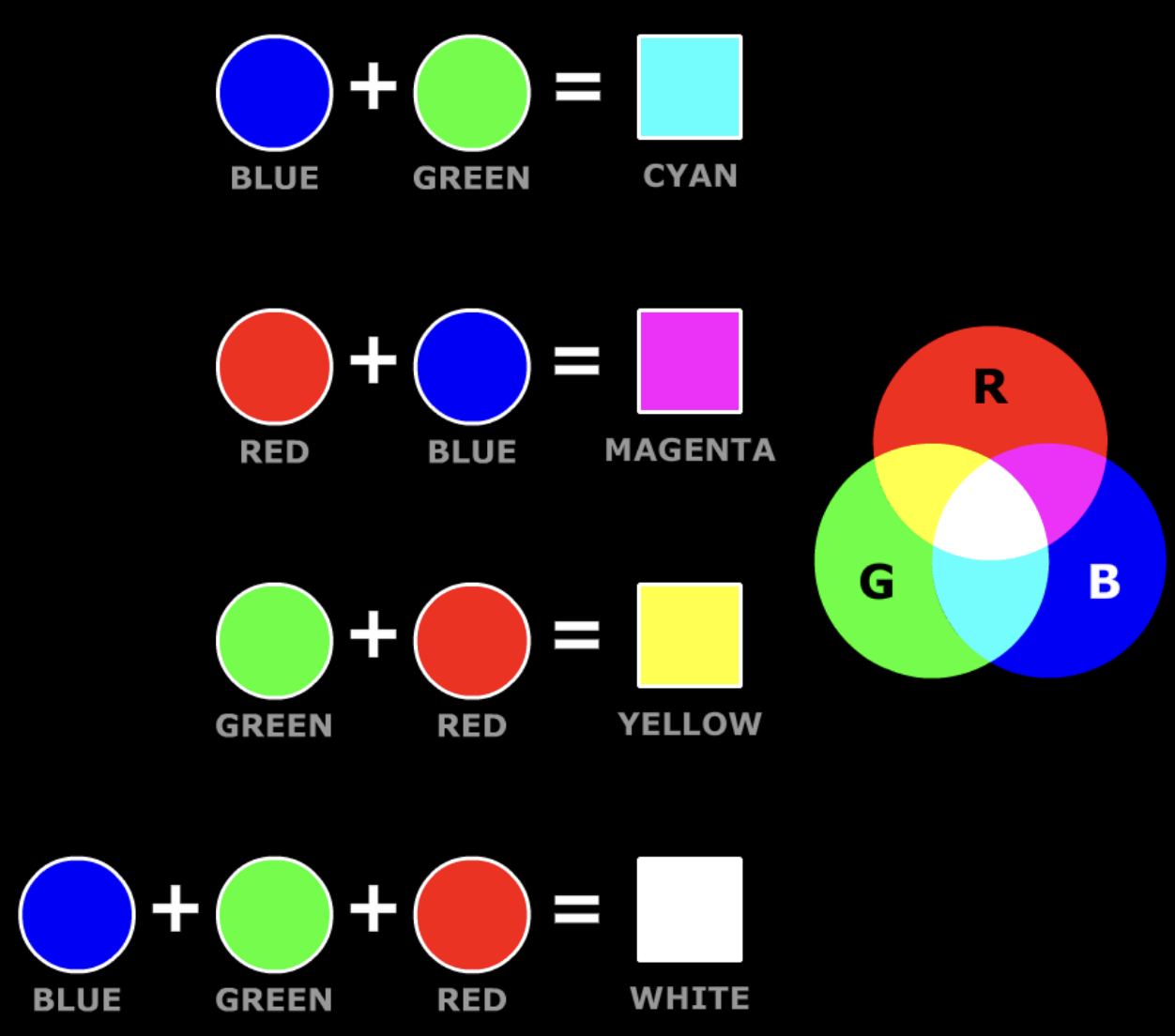
Figure 1. Light weirdness. Source: Wikimedia Commons. Good thing I became a chemist.
But why does red plus green look yellow when there's no yellow light actually present? That's where your eyes and brain come in.
Most of us have three types of color-sensitive cells, called cones, in the retina. A cone doesn't tell your brain, "Hey, that's red." It simply responds to light over a range of wavelengths. The color you see is constructed by your brain from the relative signals coming from the different types of cones.
That's why just three colors of light can be mixed in different proportions to produce the enormous range of colors we see. It's also why your computer monitor can fool you into seeing millions of colors using nothing more than tiny red, green, and blue lights.
But what happens when one of those three systems is missing?
That's where Jimmy M won the "loser lottery".
The Eyes (Don't) Have It
The retina is a thin layer of nerve tissue lining the back of the eye. It converts incoming light into electrical signals that are sent to the brain through the optic nerve. It contains two main types of light-detecting cells: rods and cones. Rods are extremely sensitive to light and allow us to see in dim conditions, but they don't provide color information.
Most people have three types of cones, called S, M, and L. Each responds to a range of wavelengths, but S cones are most sensitive to shorter wavelengths (about 420 nm), M cones to medium wavelengths (about 530 nm), and L cones to longer wavelengths (about 560 nm). Roughly speaking, these correspond to blue, green, and red.
Figure 2 shows this clearly.
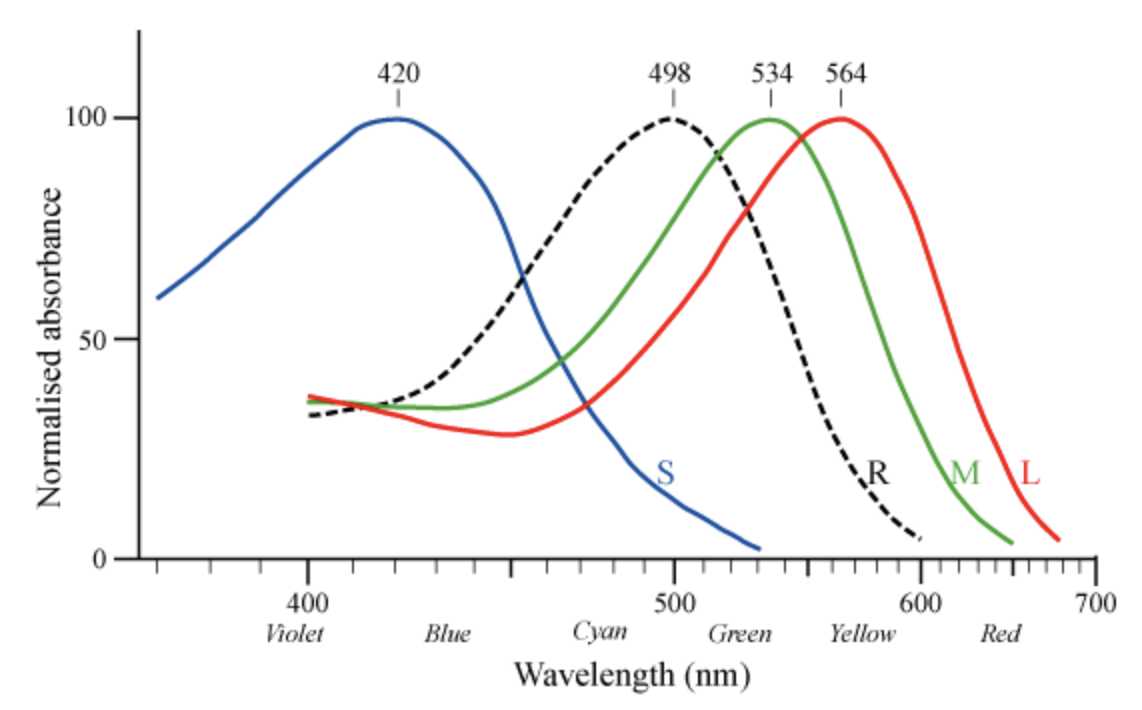
Figure 2. Sensitivity of rods (R) and the three types of cones (S, M, and L) to different wavelengths of light. Yes, it's more complicated than red, green, and blue. Source: Wikimedia Commons.
So What's Going On With Jimmy?
Jimmy M's comment says that while most people use three color systems, he has only two. That sounds like dichromacy, a relatively severe form of color blindness in which one of the three types of cone photoreceptors is absent or doesn't function.
Which one? Who knows. If the L-cone system doesn't function, it's called protanopia; if the M-cone system doesn't function, it's deuteranopia; and if the S-cone system doesn't function, it's the much rarer tritanopia. In all three cases, the brain has only two cone systems instead of three from which to construct the colors we see.
It's All in the (Blue) Genes
Of course, genetics are involved. The genes responsible for the L and M cone pigments are located on the X chromosome, which is why red-green color blindness is much more common in men than women. The two genes are located next to each other, and their unusual arrangement also makes them particularly susceptible to genetic rearrangements. The S-cone gene is located on chromosome 7, and inherited defects involving it are much rarer.
An Imaginary Color?
What about Jimmy M's strangest statement: “My brain fabricates the missing color. It is an imaginary color.”
It's true, sort of.
Brains can't magically replace the information from a cone system that isn't working properly. But here's the weird part: the colors we see aren't simply wavelengths of light. They're our brain's interpretation of signals from the cones.
Magenta is a great example. There is no wavelength of light corresponding to magenta. Instead, certain combinations of light stimulate our red- and blue-sensitive cone systems, and our brain interprets that combination as magenta. Mighty strange, if you ask me.
If Jimmy is a dichromat, his brain is doing the same thing, except it has only two working cone systems instead of three. He doesn't simply see the same world we do with one color missing. His brain takes what his eyes give it and builds its own version.
Color Blind? Uncle Sam Wants You
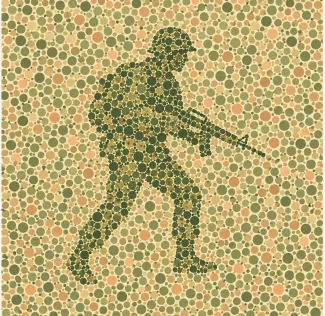
Camouflage partly works by using colors that blend an object into its surroundings. Our three-cone visual system can be very good at falling for the trick. A dichromat views the same scene with only two working cone systems, so the color match may not work the same way. In experiments, dichromats have been able to detect texture differences hidden by color camouflage that fooled people with normal color vision. There's actually a journal paper specifically about this phenomenon.
In other words, Jimmy has less color information than most of us. But under the right circumstances, that can make him harder to fool with color. [2]
So when the Army told the poor guy that his color blindness could help him spot camouflage, apparently the Army saw something Jimmy couldn't: a job opportunity. Sometimes seeing less really does let you see more. Too bad you're in a swamp with people shooting at you.
Fortunately, he made it back from Nam, and 57 years later he's a dedicated ACSH reader. Lucky for both of us.
NOTES
[1] The first U.S. draft lottery for the Vietnam War was held on December 1, 1969. Birth dates were drawn at random and assigned numbers from 1 to 366, with the lowest numbers called first. Drawing #1 was September 14, JM's birthday. He won perhaps the worst lottery in American history.
[2] Jimmy M is even "stranger" than you think. He just sent me the following:

Josh Bloom
Dr. Jonathan (Josh) Bloom, ACSH's Director of Chemical and Pharmaceutical Sciences, earned his Ph.D. at the University of Virginia and completed postdoctoral training at the University of Pennsylvania. During his 20-plus years in drug discovery at Wyeth, his research group discovered the antibiotic Tygacil®, approved in 2005. He holds 25 issued patents and has authored 35 academic papers. Since joining ACSH in 2010, he has written more than 2,000 articles and dozens of op-eds for major newspapers, including The Wall Street Journal and Chicago Tribune.