For influencers, GLP-1 microdosing promises significant weight loss with fewer side effects, lower costs, and sometimes benefits that extend well beyond obesity. Emerging research suggests there may be something to taking less, but the science is not nearly as expansive as the promises.
The Algorithm Medical Group, which includes influencers on TikTok, Instagram, Reddit, and X, has backed microdosing GLP-1s. Let’s take a moment to separate science from fiction. The challenge is separating a potentially useful dosing strategy from another medical trend in search of evidence.
Stay curious. Stay informed. Free, independent writing delivered weekly
— no ads, no sponsored fluff.
Join Now
Donate
Microdosing one of the growing list of GLP-1s has emerged as an off-label strategy designed to:
- Improve tolerability
- Reduce cost
- Serve as a maintenance dose
For the tl;dr crowd, there is a scientific rationale for all three strategies, although the clinical evidence is uneven and much remains to be established. There is an additional important caveat. What influencers mean by microdosing is unclear; there is no consistent definition. Variables that fall under the term “microdosing” include smaller doses or longer intervals between doses. In the clinical literature, microdosing usually means taking 25–50% of the labeled starting dose.
Why GLP-1s Work—and Why They Come at a Price
The underlying pathogenesis of obesity is complex, and GLP-1s target only part of that complexity. A misalignment of hormones and neural impulses, initiated or enhanced by lifestyle choices of diet and exercise, results in obesity. Although effective management requires a multidisciplinary approach, including nonpharmacologic and surgical interventions, the GLP-1s seem to be the Holy Grail. The multiplicity of their actions has resulted in significant weight loss for many individuals.
However, they come with physiologic and economic costs.
The Uncomfortable Side of Weight Loss
The primary adverse physiologic effects stem from a mode of GLP-1 action: slowing gut motility, which enhances the satiety signal so you stop eating sooner. Commonly reported symptoms include nausea, vomiting, diarrhea, and constipation. As reported in the STEP 1-3 trials, these adverse symptoms occurred in about 72% of treated patients versus 47% in the control group. Moreover, most symptoms were mild to moderate, increased with dose, were transient (lasting no more than a week), and led to discontinuation in 4% of participants. [1]
Less Medication, Less Weight Loss? Not Necessarily
Weight loss is largely independent of these adverse effects, whereas GI symptoms increase with higher doses, supporting lower doses. Pharmacologic modeling of GLP-1s found that reducing dose frequency does not reduce weight loss in a 1-to-1 manner. For example, switching from one dose per week to one dose every 2 weeks maintains roughly 75% of the weight loss. If dosing frequency is matched by increasing dosage, approximately 100% of the weight loss is maintained.
A scientific report in Nature studied 56 patients treated with a low dose of semaglutide, up-titrated to achieve a weight loss of roughly 4 to 10 pounds per month. All of the patients received submaximal doses along with the usual lifestyle suggestions, including a reduced-calorie diet and exercise.
At three months, 14.3% achieved more than 10% weight loss relative to their pre-treatment weight; 50% achieved 5–10% weight loss relative to their pre-treatment weight, and the remaining 35.7% lost less than 5% of their pre-treatment weight. No patient discontinued therapy because of side effects. These findings suggest that meaningful weight loss can occur without reaching the maximum recommended dose. Whether microdose regimens consistently achieve results comparable to standard dosing remains undetermined.
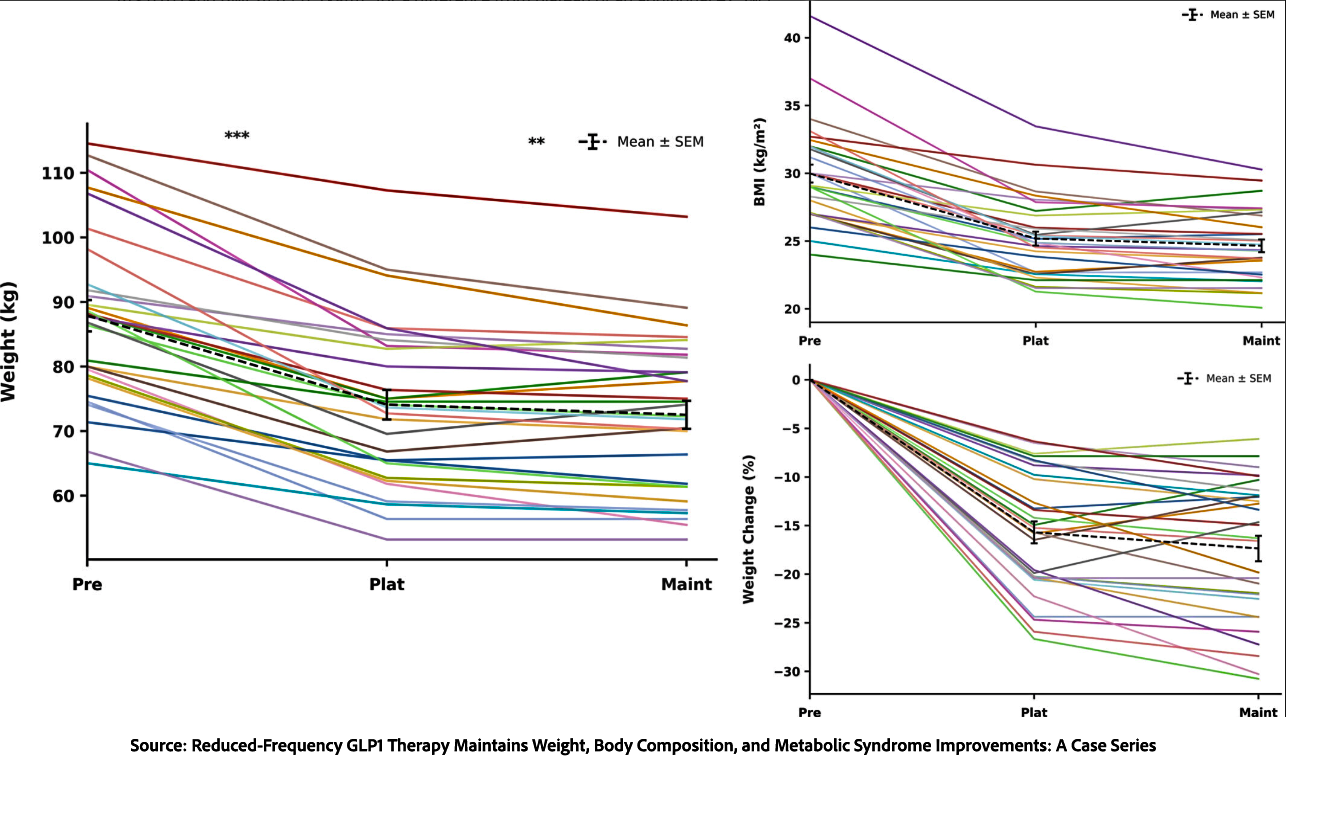
Finally, a proof-of-concept study examined the impact of reduced-frequency dosing on weight-loss maintenance after patients reached a weight plateau. The retrospective case series initially identified 38 patients considering reduced-frequency dosing. Four never made the transition, while another four returned to weekly injections after regaining weight. Among the remaining 30 patients, weight loss was maintained over an average of approximately nine months, suggesting that reduced-frequency maintenance may work for selected patients.
What Smaller Doses Have Yet to Prove
So, is microdosing a viable alternative? I would say yes, with a few concerns:
- If you're using it strictly for weight loss, the evidence suggests microdosing is almost as effective; however, the growing evidence of clinical benefit in cardiovascular disease, diabetes, and renal insufficiency has not been demonstrated at microdoses. The relevant question is not simply whether lower doses still work, but which benefits survive dose reduction, and which may depend on exposures not yet studied.
- Lower doses do not eliminate the established safety concerns. The formal contraindications for semaglutide include a personal or family history of medullary thyroid cancer, MEN2, and serious hypersensitivity to the drug. [2] Other concerns, including pancreatitis, gallbladder disease, and worsening diabetic retinopathy, require appropriate clinical evaluation and monitoring.
- Dose pens are not designed for fractional dosing, and compounded products may vary in potency and purity.
Where the Science Ends and Social Media Begins
On the Internet, the benefits are expanding faster than the evidence. No microdose studies support a role for GLP-1s in longevity, reducing inflammation, the growing desire to control hormonal regulation, or mental well-being. As my colleague Katie Suleta has discussed on many occasions, the line between patient experience and commercial promotion is blurring.
Small Doses, Big Assumptions
GLP-1 medications have earned their remarkable reputation through clinical trials demonstrating substantial weight loss and, for certain drugs and populations, reductions in cardiovascular and other health risks. Microdosing has not. There is a plausible case for using lower doses or extending dosing intervals, particularly when side effects or costs threaten continued treatment.
Social media has taken a reasonable clinical question—how little medication is needed to achieve a desired outcome—and transformed it into a much broader promise of better health, longevity, and well-being. Perhaps some of those claims will eventually prove true. For now, the science supports further investigation, not universal enthusiasm. In short, while the dose may be small, the burden of proof is not.
[1] Constipation seems to be far less transient.
[2] MEN2, or Multiple Endocrine Neoplasia type 2, is a rare autosomal dominant genetic mutation.