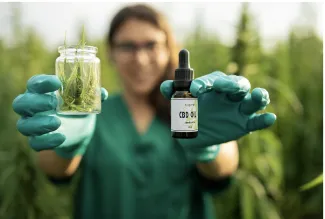
At last month's White House ceremony, President Trump signed an executive order requiring the Drug Enforcement Administration to reschedule cannabis from a Schedule I controlled substance to a Schedule III controlled substance. During the event, Centers for Medicare and Medicaid Services (CMS) Administrator Mehmet Oz announced plans for a new pilot program under which Medicare would pay for certain hemp-derived cannabidiol (CBD) products.
I have written here about why I believe that rescheduling cannabis is a small step in the right direction, but it unfortunately keeps prohibition in place. The CMS initiative introduces its own set of problems.
The CMS announcement runs counter to Congress’s recent effort to “close the hemp loophole,” and the two policies undermine each other. CMS is signaling that CBD has legitimate therapeutic value and should be easier for patients—particularly seniors—to access, while Congress is simultaneously tightening federal restrictions, shrinking the legal CBD market, and increasing compliance costs for manufacturers. One branch of the federal government is trying to normalize and integrate CBD into mainstream health care; another is narrowing supply, complicating legality, and potentially raising prices. Instead of coherent reform, we’re experiencing policy whiplash—expanding coverage on paper while limiting availability in practice.
When Congress set a limit of no more than 0.4 milligrams of THC for hemp-derived products in its recent spending bill, it might have seemed like a minor, safety-focused change. In truth, it could make CBD production economically unfeasible. Hemp naturally contains some THC, and when producers extract CBD at effective levels, they also concentrate THC. To comply, they would need to discard product, perform costly additional processing, or dilute CBD to the point of insignificance. All these actions increase prices, squeeze out smaller producers, and threaten to eliminate a legitimate CBD market under the pretense of “consumer protection.”
Currently, people purchase CBD products over the counter at market prices that generally reflect open competition: Low-end products typically cost about $15–$30; mid-range CBD oils, gummies, and capsules usually range from $30 to $80; and premium products can cost $80 to $200 or more, with most tinctures averaging roughly $0.05–$0.25 per milligram of CBD. If third-party payers begin covering CBD, the pricing structure could worsen. When insurers enter a mostly cash market, manufacturers often respond by raising list prices, knowing insurance will cover much of the cost. As Michael Cannon and I mentioned in our white paper, “Drug Reformation,” that’s precisely what happened after the Affordable Care Act mandated coverage of oral contraceptives, whose prices then increased faster than many other already-insured drugs. If the same occurs with CBD, Medicare beneficiaries may be protected, but people paying out of pocket could face significant price hikes, making CBD less affordable for those without coverage.
It’s not as if seniors lack access to CBD now, nor are these products unaffordable. People can already buy them over the counter at competitive prices. That’s why CMS’s move, however well-intentioned, is unnecessary and could be harmful. Once Medicare gets involved, “coverage” rarely stays straightforward—it brings prescriptions, clinician gatekeeping, documentation requirements, and layers of regulation. This risks medicalizing CBD, limiting who can produce it, and turning a functioning consumer market into a government-controlled one. Instead of helping patients, CMS might just complicate things and make a product that’s already accessible more regulated, less consumer-friendly, and more difficult to access.
If nothing else, the obvious conflict between CMS’s effort to cover CBD and Congress’s recent attempt to “close the hemp loophole” should lead lawmakers to reconsider their new restrictions. Instead of increasing contradictory federal controls, Congress ought to consider repealing its flawed THC cap and enabling a competitive CBD market to continue serving consumers.
All this explains why today’s White House announcement on cannabis rescheduling was underwhelming and why Dr. Oz’s Medicare–CBD proposal was troubling. Instead of clarifying the legal landscape or easing access, Washington appears ready to add bureaucracy to an existing consumer market, risking higher prices, fewer choices, and increased federal control. Seniors already have access to CBD; they don’t need CMS to “help” by medicalizing it. Worse, this initiative could harm the millions of non-seniors who benefit from CBD and other hemp-derived products by raising prices, reducing supply, and making what is now widely accessible more difficult—and more costly—for others to obtain.
# Reprinted with permission. Dr. Singer's original article can be found on the Cato Institute website

Jeffrey Singer
Jeffrey A. Singer is a senior fellow at the Reason Foundation, where he focuses on health care policy and drug policy. He is President Emeritus and founder of Valley Surgical Clinics, Ltd., Arizona's oldest and largest private group surgical practice. From 2017 to 2026, he served as a senior fellow in the Cato Institute's Department of Health Policy Studies and as a Visiting Fellow at the Goldwater Institute. Singer is a member of the Board of Scientific Advisors of the American Council on Science and Health and serves on the expert panel for Doctors for Drug Policy Reform. From 1994 to 2016, he was a regular contributor to Arizona Medicine, the journal of the Arizona Medical Association. He served on the Advisory Board Council of the Center for Political Thought and Leadership at Arizona State University from 2014 to 2018. His writings have appeared in peer-reviewed medical and scientific journals, as well as in publications such as the Wall Street Journal, Washington Post, USA Today, The Hill, and National Review. He has been a guest on national and local television and radio. Singer received his BA from Brooklyn College (City University of New York) and his MD from New York Medical College. He is a Fellow of the American College of Surgeons.