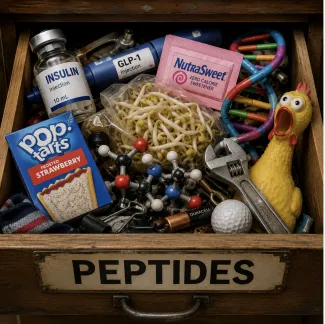
Lately, TikTok, Instagram, and just about every other fact-challenged corner of the internet have become obsessed with peptides. If you believe the hype, they build muscle, burn fat, erase wrinkles, speed healing, improve sleep, and teach your cat to play the trombone.
So naturally, I'm often asked:
"What do you think about peptides?"
My answer is always the same.
"Which one?"
Because that question is like asking a nutritionist, "What do you think about food?"
The only sane reply is, "Which food?"
The word food describes Pop-Tarts, chitlins, and bean sprouts. Likewise, the term peptide describes thousands of different molecules, most of which have little or nothing in common besides being made of amino acids. With drugs, changing even one atom can alter their properties. Peptides are no different. Changing even a single amino acid in a peptide with dozens of them can completely change what they do.
So before deciding whether peptides are the greatest medical breakthrough since penicillin or the latest overpriced wellness fad, let's answer a much simpler question:
What the hell is a peptide?
As little chemistry as humanly possible
There are probably peptides that will put you in a coma. Hopefully, the next paragraph won't. Figure 1 is a "picture" of what an amino acid looks like:
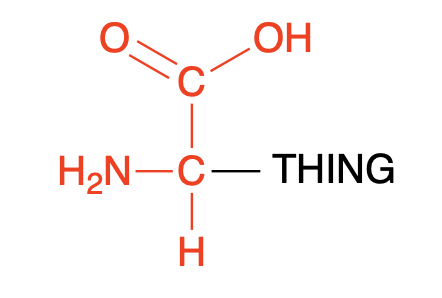
Figure 1. Generic structure of the amino acids that make up peptides and proteins. "THING" represents the side chain (R group), the only part of an amino acid that varies among the 20 amino acids used to build peptides and proteins. Everything shown in red is common to all amino acids.
Size matters
The smallest peptide consists of two amino acids. Perhaps the most familiar peptide in everyday life is aspartame (Nutra Sweet), which consists of the amino acids aspartic acid and phenylalanine (Figure 2). [1]
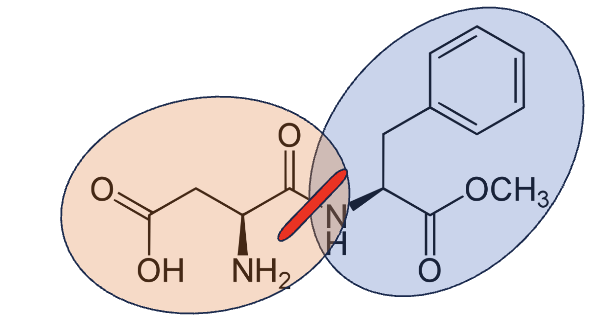
Figure 2. Aspartame is a dipeptide consisting of aspartic acid (orange) and phenylalanine (blue) connected by an amide bond (red).
The size of the largest peptide is not a single number. There isn't a strict upper limit, but as peptides approach roughly 100 amino acids, they're increasingly likely to be called proteins instead. Explaining the differences between the two is beyond the scope of this article. Figure 3 gives a graphical representation of small, medium, and large peptides. Although most are linear, some are branched and cyclic.

Figure 3. Graphical representation of small, medium, and large peptides.
The entire peptide-health premise rests on a misconception. The word peptide describes a molecule's structure, not its function. Knowing that something is a peptide tells you almost nothing about what it does, whether it works, or whether you should put it anywhere near your body.
Here's where the internet really goes off the rails. Spend five minutes on social media, and you'll find people claiming they've discovered injectable [2] peptides that regulators don't want you to have and drug companies don't want to sell. Conveniently, they also know where you can buy them. The problem is that they're treating all peptides as though they belong in the same bucket. They don't.
The easiest way to see why this makes no sense is to compare a few of naturally occurring peptides (Table 1). They all belong to the same structural class, yet they perform completely different jobs in the body—sometimes opposite ones. For example, insulin (51 amino acids (AA)) lowers blood sugar while glucagon (29 AA) raises it. GLP-1 (30 AA) suppresses appetite while ghrelin (30 AA) stimulates it. And gastrin (17 AA) stimulates gastric acid secretion while somatostatin inhibits it.
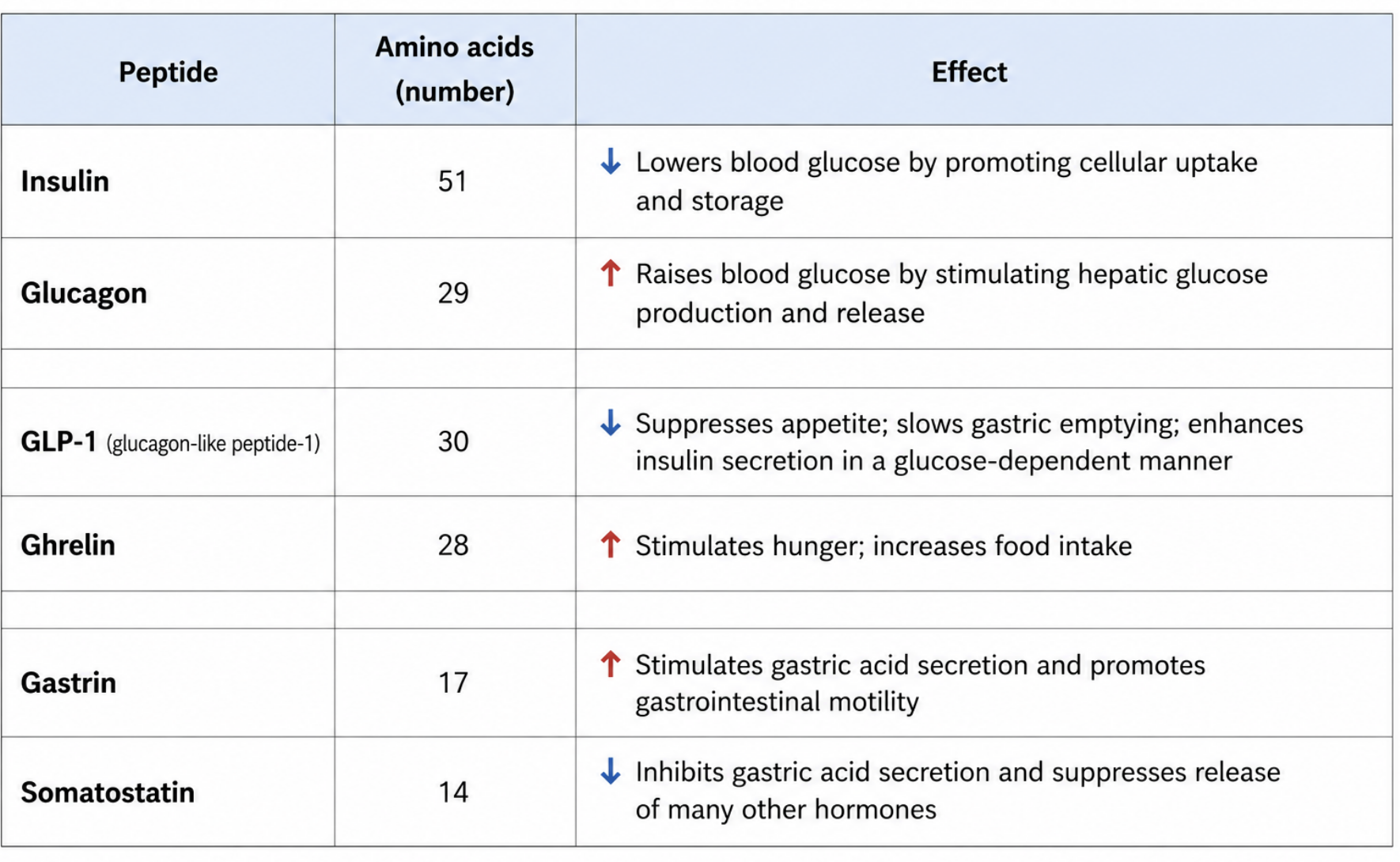
Table 1. Activity of three sets of common peptides.
If someone marketed "hormones" as though they all did the same thing, you'd laugh. The word peptide is just as broad. It tells you how a molecule is built, not what it does or whether it's safe.
Bottom line
Peptides aren't a treatment or a miracle. They're simply chains of amino acids.
Knowing that something is a peptide tells you almost nothing about what it does.
The only intelligent question isn't "What do you think about peptides?"
It's "Which peptide?"
NOTES:
[1] If you want to be picky, aspartame is the methyl ester of a dipeptide called aspartylphenylalanine.
[2] I wrote injectable because most peptides make lousy oral drugs. They're usually broken down in the digestive tract, poorly absorbed, or both. Of course, there are exceptions.

Josh Bloom
Dr. Jonathan (Josh) Bloom, ACSH's Director of Chemical and Pharmaceutical Sciences, earned his Ph.D. at the University of Virginia and completed postdoctoral training at the University of Pennsylvania. During his 20-plus years in drug discovery at Wyeth, his research group discovered the antibiotic Tygacil®, approved in 2005. He holds 25 issued patents and has authored 35 academic papers. Since joining ACSH in 2010, he has written more than 2,000 articles and dozens of op-eds for major newspapers, including The Wall Street Journal and Chicago Tribune.