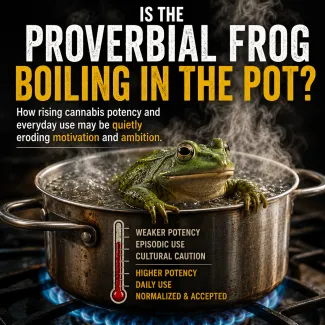
As the use of high-potency marijuana expands with America's liberalized drug laws, researchers are again asking whether frequent cannabis use dulls drive. The science isn't settled, but acute studies show less effort for reward while intoxicated, and a large 2024 analysis linked adolescent and young-adult use to worse school and work outcomes. Here’s what the evidence actually shows.
While studying to become a psychologist years ago, I worked as a psych tech on an inpatient psychiatric unit. I became friends with four other psych techs, and we would sometimes get together after work for ping pong, chess, and pot. As the only one not smoking, I saw that my peers' motivation to play dwindled with each joint, allowing me to win more games as the evening progressed. Eventually, they lost interest in competing altogether and preferred to sit around and mellow out. I always went home feeling good about my wins, even though my sobriety contributed as much to the outcome as my skill.
That evening was not a morality play. It was a small, visible version of a question the country needs to revisit: when cannabis is stronger and used daily by millions, what happens to drive? The old label was “amotivational syndrome.” The evidence today is more nuanced than the rhetoric on either side, but it is not empty—and it is concentrated where frequency, potency, and adolescence overlap.
The Long-Running Debate Over Cannabis and Motivation
During my graduate studies, my personal observations were reinforced by early marijuana researchers. I learned that it was the late 1960s when the term amotivational syndrome was first introduced by two separate groups of researchers who were independently studying regular marijuana users. While not a diagnosis in the DSM-5 or DSM-5-TR, amotivational syndrome does appear in the DSM-5-TR's discussion of the functional consequences of Cannabis Use Disorder. These original definers of the term claimed that marijuana use appeared to be associated with a cluster of behaviors including:
- Diminished drive or ambition
- Apathy and passivity
- Reduced interest in work, school, or achievement
- Difficulty sustaining long-term goals
While a 2024 review of the research on cannabis and motivation concluded that recent non-acute studies do not support a general amotivational syndrome, the authors also concluded that weekly cannabis users are less willing to expend effort for reward while they are intoxicated, thus raising the possibility that frequent use could contribute to a persistent "amotivational state.”
The authors also stated that there was some evidence from both the acute and non-acute marijuana use literature that marijuana exposure is associated with blunted reward anticipation responses in the ventral striatum.
 Today’s Cannabis Is Far More Potent—and More Widely Used
Stay curious. Stay informed. Free, independent writing delivered weekly
— no ads, no sponsored fluff.
Join Now
Donate
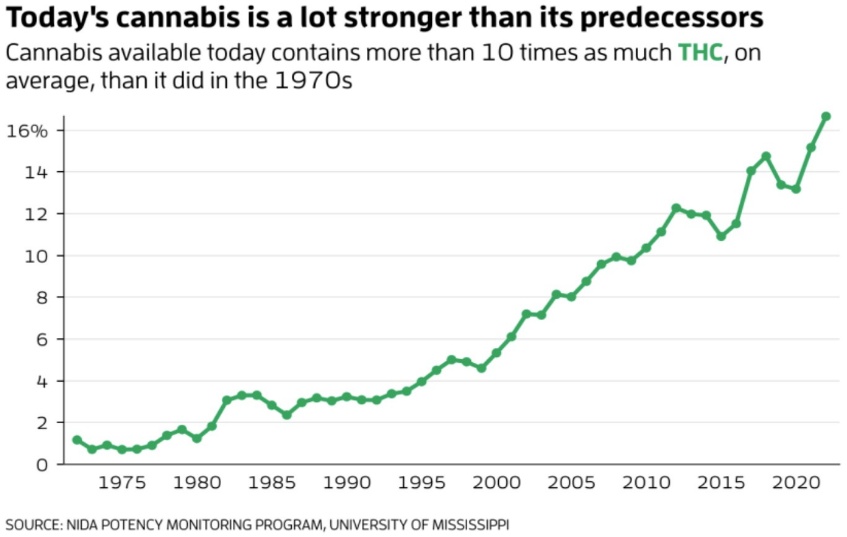
Although the percentages vary, there is universal agreement that today’s marijuana is much more potent than that used in the 1960s. The Potency Monitoring Program, a project led by the National Institute on Drug Abuse and carried out at the University of Mississippi, shows a clear trend: over the last 50 years, the average amount of tetrahydrocannabinol (THC) in marijuana – the plant’s main psychoactive component – has increased dramatically. This has been achieved through selective breeding and a shift from a mixture of leaves and stems to sinsemilla, produced from unpollinated female plants.
Marijuana use is becoming more widespread. As of August 2026, twenty-four states and the District of Columbia have legalized small amounts of adult recreational marijuana use. Recent data from the Substance Abuse and Mental Health Services Administration (SAMHSA) indicate that marijuana use has been increasing. In 2024, 64.2 million people used marijuana at least once during the preceding year. Between 2021 and 2024, marijuana use increased by 21%, increasing prevalence by 3.3 points in adults aged 26 and older. Another interesting statistic compares the frequency of marijuana use with alcohol use. In the United States, daily or near‐daily (DND) alcohol use remains more prevalent than DND cannabis use among late midlife adults, but the opposite is true for young adults.
The University of Michigan's Monitoring the Future study has been following marijuana use among young adults over time. In 2023, among people ages 19–30, which includes most of the older Gen Z population and some younger Millennials:
- 42.4% used marijuana during the preceding year
- 28.7% used it during the preceding 30 days
- 10.4% reported marijuana use on 20 or more occasions during the preceding 30 days—roughly daily/almost-daily use. Each level (yearly/monthly/weekly/daily) significantly further increases the risk of DSM-5 cannabis use disorder (CUD). Almost daily users are the group that raises the greatest concerns since that level of use is associated with 17 times the risk of CUD compared to non-users
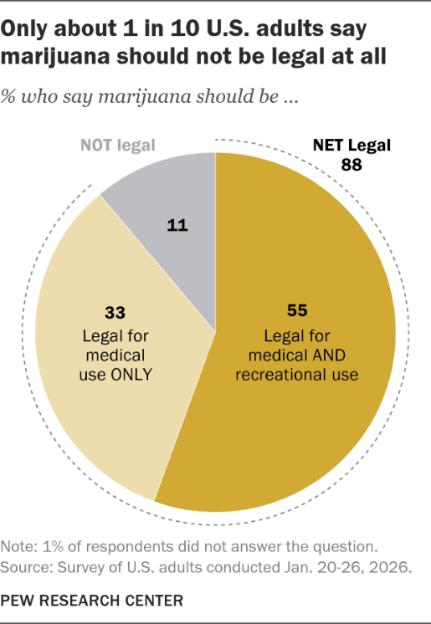 According to Pew Research, public opinion on the legalization of adult marijuana use for medical or recreational use has remained fairly stable at 55% since 2019, when it increased by 10%. Only 11% currently favor total prohibition. That figure was 15% ten years ago.
What Cannabis Use May Mean for Education and Achievement
A 2024 meta-analysis of 63 studies involving 438,329 people examined marijuana use during adolescence and young adulthood and subsequent educational and employment outcomes. It found moderate-certainty associations with lower academic achievement, greater school absenteeism, higher dropout rates, lower probability of completing high school, and lower probability of obtaining a postsecondary degree.
Although the data on unemployment associations were of low certainty, the authors acknowledged a possible increase in unemployment related to the educational findings. With associational studies, correlation does not prove causation, but it also does not rule it out. For obvious reasons, no randomized clinical trial could ever be conducted; we don't give people drugs if we think they're harmful. All this leads me to wonder how much less motivated we are becoming less motivated as a nation.
Are We Underestimating the Cost of Lost Motivation?
When my fellow psych techs put down their paddles fifty years ago, the frog was in barely tepid water. The marijuana was weak, use was episodic, and the cultural consensus still recognized a trade-off between chronic intoxication and drive. Today, the water is simmering. Potency has surged tenfold, daily consumption has surpassed daily drinking, and public perception has largely dismissed the drug as harmless recreation.
The tragedy for the frog is that it grows too comfortable to notice its own gradual incapacitation. Amotivational syndrome does not present as an acute emergency. It manifests as the high school diploma that was never earned, the promotion never sought, the graduate program never applied to, and the subtle, collective fading of ambition. As we dismantle the legal prohibitions of the past, we risk ignoring the biological reality of the present: that drive, focus, and the willingness to strive are fragile cultural assets. If we define societal harm solely by fatal overdoses and emergency room visits, cannabis will always look benign. But if we measure harm by the slow erosion of human potential, we may already be feeling the heat.