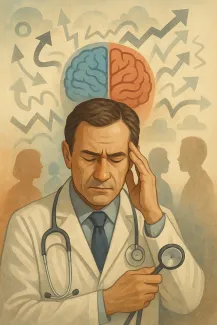
Although the original author of this phrase is unclear, it was first popularized in a book by Thomas Kida (2006). In preparing lectures for physicians on reducing medical errors, many of which are thinking errors, I’ve become well acquainted with the 20-30 types of thinking errors as differentiated by Nobel Prize-winning psychologist and New York Times best-selling author, Daniel Kahneman. My awareness of the prevalence of human thinking errors has increased my skepticism of my thoughts as well as scientific findings.
In my professional role as the behavioral science faculty member of a family medicine residency, I observed a subgroup of residents who preferred specialty rotations to their required family medicine continuity clinic time. They did not enjoy their time with patients. This was a bad omen for their eventual satisfaction as full-time family physicians. I wondered if thinking errors might be responsible.
The Difficult Patient
Some residents complained there were too many complex, “difficult patients” in their 15-minute clinic timeslots. In my review of the research on difficult patients, I discovered these patients are sometimes referred to as black holes, problem patients, or “heartsinks,” a reference to the feeling experienced when the patient’s name is seen on a clinician’s schedule. Surprisingly, the range of patients perceived as “difficult” by primary care physicians is broad, ranging from 11% to 48%. I questioned what factors might account for the unexpected variation.
I discovered an ambitious study of 500 ambulatory patients at Walter Reed Army Hospital that examined various patient and physician factors in explaining the wide range of patients perceived by their physicians as difficult. Patient variables included the presence of a depressive or anxiety disorder, multiple physical symptoms, and symptom severity, all outside the physician’s control.
Physician subjects completed the Physician Belief Scale (PBS), a validated 32-item scale that assesses the physician’s beliefs as to the importance of psychosocial issues in medical care. [1]
The higher the physician’s score on the PBS, the greater their belief that addressing psychosocial issues is unimportant in the delivery of care. While physicians cannot control patient variables, they can exert some control over their own beliefs on this matter.
After each patient visit, physicians completed a questionnaire assessing their perceived difficulty during the patient encounter. Physicians with a PBS score >70, believing that psychosocial issues were unimportant, judged 23% of their patient encounters as difficult. Physicians whose PBS scores were <71, who recognized the importance of psychosocial concerns, categorized only 8% of patients as difficult, a 15% reduction in the number of patients perceived as difficult.
The take-away?
Physicians who value providing whole person care from the bio-psycho-social perspective will have a significantly lower percentage of patients that they will perceive as difficult, which translates into greater enjoyment in their delivery of care. [2]
To be fair, significant barriers exist for physicians who wish to integrate psychosocial factors into their approach to patient care. Despite recommendations to integrate psychosocial science in medical school curricula, it is nearly impossible to accurately document how much behavioral and social science is currently being taught in United States medical schools. The time devoted to psychosocial factors remains small relative to biomedical content. Once residents begin clinical rotations, the model they observe is primarily bio-medically focused.
A final barrier is the constant pressure to see more patients by shortening allotted exam timeslots. One positive, cost-effective change addressing the psychosocial needs of patients involves integrating behavioral health professionals in primary care settings. The physician’s primary role becomes recognizing psychosocial concerns that arise and offering the patient a real-time referral to the co-located specialist. The Veterans Administration has adopted this model, as have several western states.
In summary, one key thinking error in the minds of physicians and those responsible for their training that needs to be abandoned is the belief that one can ignore the psychosocial components of health and illness and still provide optimal patient care. Since the research literature reveals between 30-60% of primary care patients present with problems that involve significant psychosocial components, ignoring this reality compromises the quality and effectiveness of the health care delivered and reduces the physician’s overall career satisfaction.
If we want medicine that heals whole people and reinvigorates those who practice it, we must confront the mental shortcuts that blind us to the psychosocial aspect of health. We must rethink our assumptions and advocate for training and clinic models that give psychology a seat beside biology in every consultation.
[1] Examples of questions include: The biological model of disease is the most appropriate model for health care. I am intruding when I ask psychosocial questions, and the stresses we all experience do not significantly influence the course of disease.
[2] Satisfying the rule of replication, this study’s findings were replicated in a subsequent study.
Timothy Spruill, Ph.D
Dr. Spruill completed his doctorate in Counselor Education & Counseling Psychology and accepted a graduate faculty position at Andrews University serving for 7 years as an associate professor of counseling psychology. In 1998, he joined the Osteopathic Family Medicine residency faculty at AdventHealth in Orlando in the Department of Psychiatry. He has served as a consultant to the Emergency Department.