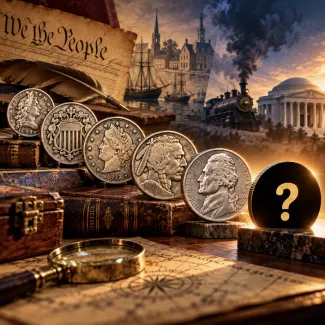
Before long (and not a moment too soon), pennies will be nothing more than an annoying memory, a pet peeve I've written about before. The Common Cents Act recently passed the Senate and awaits the president's signature. [1]
But Congress may actually do something else useful (although I wouldn't bet on it): change the composition of the nickel, or perhaps eliminate it entirely. Why? Because the nickel is the least economically sensible of all U.S. coins. It costs about 13 cents to manufacture a five-cent coin.
Even Congress should be able to figure out that math.
This gives me the opportunity to show my numismatic side. It was a passion in my younger days, but definitely not a great way to score babes. After 1964, coin collecting became far less interesting. With the discontinuation of regular silver coinage, [2] older coins got scooped up for their metal value in short order, so I gave it up. [3]
This didn't help me score babes either.
Nickelomics
Yet, while the government loses 8 cents every time it mints a nickel, certain older nickels are worth many thousands of dollars. A few are worth millions. Apparently, the trick is to make them badly, make very few of them, or make them two centuries ago.
Translation: A very small number of coins have significant mint errors, and some are extraordinarily valuable. Others were minted in very small numbers, often due to economic conditions at the time. And while "the older the better" is sometimes true, a coin's rarity, condition, and collector demand matter the most. Artistic design also plays a role. Some are beautiful; some suck. [4]
The nickel: Poor in value, rich in history
The following may or may not make sense at first. The first nickel was minted in 1866, but the first five-cent coin arrived 74 years earlier. It was made of 90% silver and called a "half disme," later shortened to "half dime" (Fig. 1).
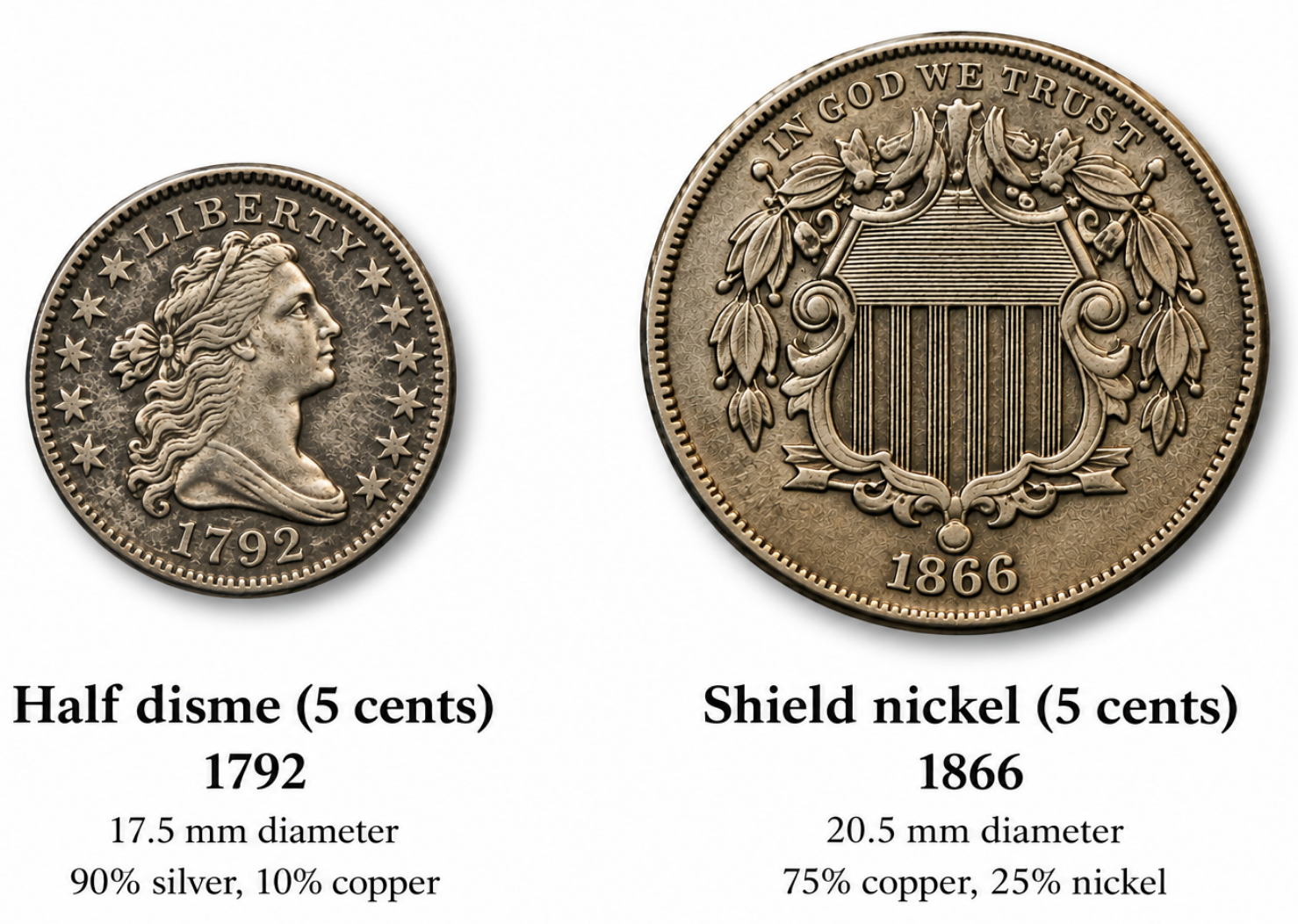
Figure 1. Same denomination, vastly different values. A 1792 half disme sold for $432,000 in 2025, while an 1866 Shield nickel, despite its interesting design, can be had for a few hundred bucks.
The history behind these coins is mind-blowing. The half disme pictured may be the first "official" coin minted in the U.S., while the Shield nickel was first produced just a year after the Civil War ended.
Moving on: The common and the very uncommon Liberty Head nickel
The Shield nickel lasted only 17 years (short by coin standards). Its design was unpopular, and the Mint was looking to modernize its coinage.
Next up was the Liberty Head nickel (Fig. 2), and she has many stories to tell. The coin was minted from 1883 through 1912, but there's much more to the story.
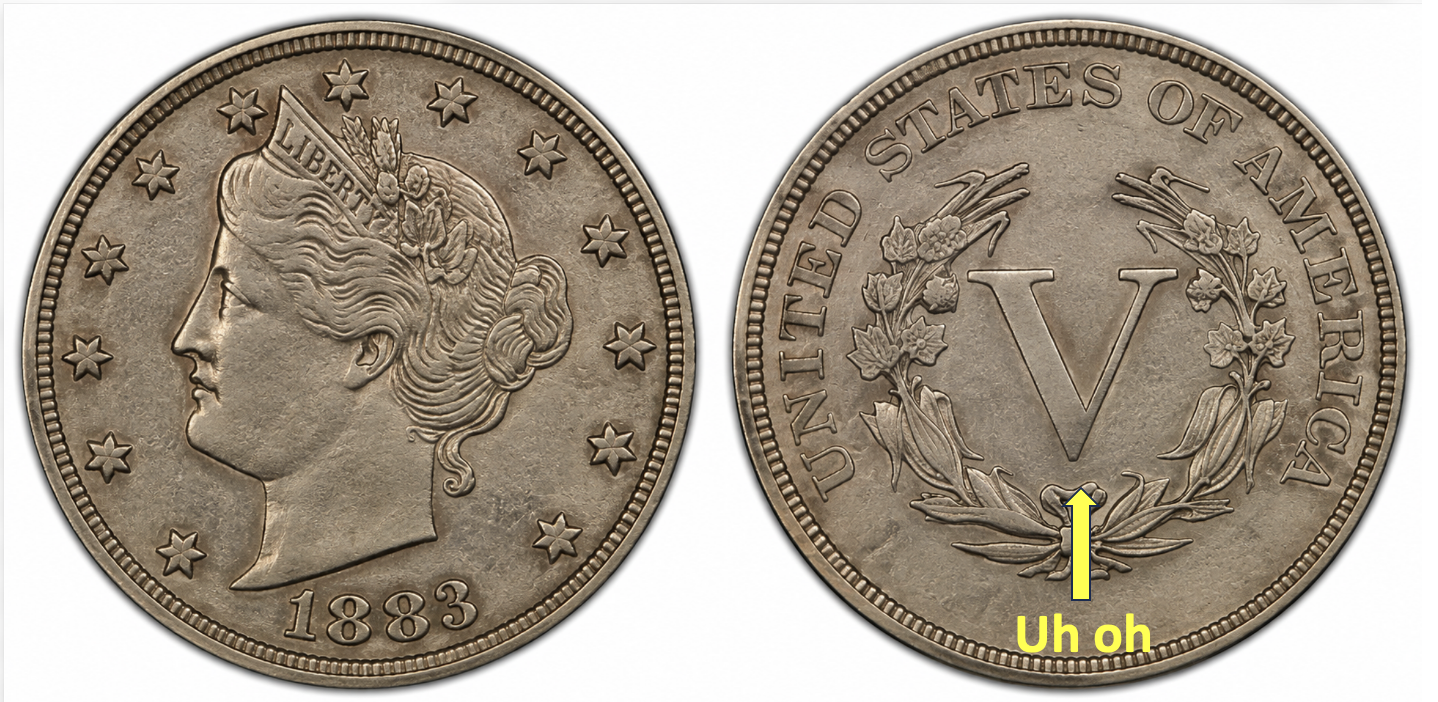
Figure 2. The Liberty Head nickel was designed by Charles E. Barber, chief engraver of the U.S. Mint. Unfortunately, his design had a rather expensive flaw.
Note that the V indicates five, but the damn thing didn't specify five what. So, it didn't take much thought for a few people (perhaps ancestors of Bitcoin billionaires) to figure out that if they gold-plated the coin, they could pass it off as a $5 gold piece, which was also in circulation at the time! I think you can see why this worked (Fig. 3). The mint quickly figured this out and added CENTS to the back in that same year.
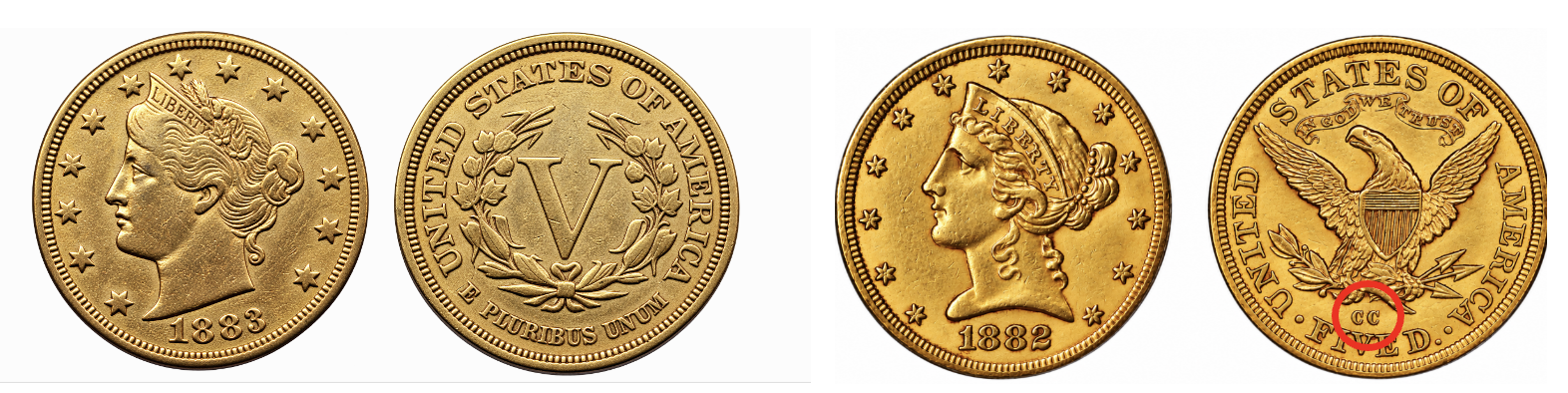
Figure 3. On the left is a gold-plated 1883 Liberty Head nickel (also called a Racketeer nickel). On the right is a five-dollar gold piece (also called a half eagle). They were almost exactly the same size. Duh. (Anyone wanna guess what the CC (red circle) means?)
This story is hard to top, but before the Liberty Head nickel went to the great smelter in the sky, it had one more trick up its five-cent sleeve: one of the greatest mysteries in American coin collecting. In 1913, the gorgeous Buffalo nickel grazed its way into American pockets, but somehow five Liberty Head nickels with that same date also came into existence. Who made them, and why? More than a century later, no one knows whether they were the result of an innocent mistake or some good old-fashioned skulduggery.
OMG. One of those five coins sold for $4.56 million in 2018 (Fig. 4).
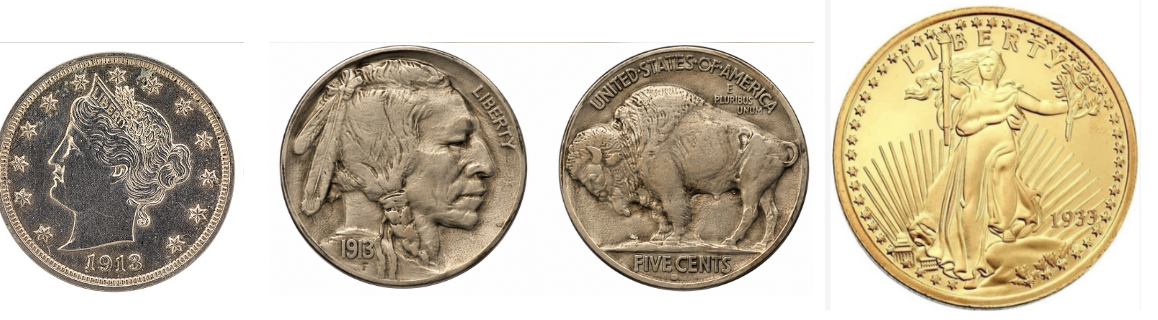
Figure 4. (Left) One of five 1913 Liberty Head nickels. Don't expect to find this in your change. (Center) A 1913 Buffalo nickel in really good condition can fetch a few thousand dollars. (It was the first regular-issue American coin to feature an animal other than a bird.) (Right) $4.5 million may seem like a lot, but this rare nickel is far from the most valuable. That distinction belongs to a 1933 Saint-Gaudens $20 gold double eagle, which kicked its 5-cent ass, selling at auction for a ridiculous $18.9 million in 2021.
Enter Thomas Jefferson. Bye-bye buffaloes
Unlike most other U.S. coins, the nickel has retained exactly the same composition for 160 years: 75% copper and 25% nickel.
With one exception.
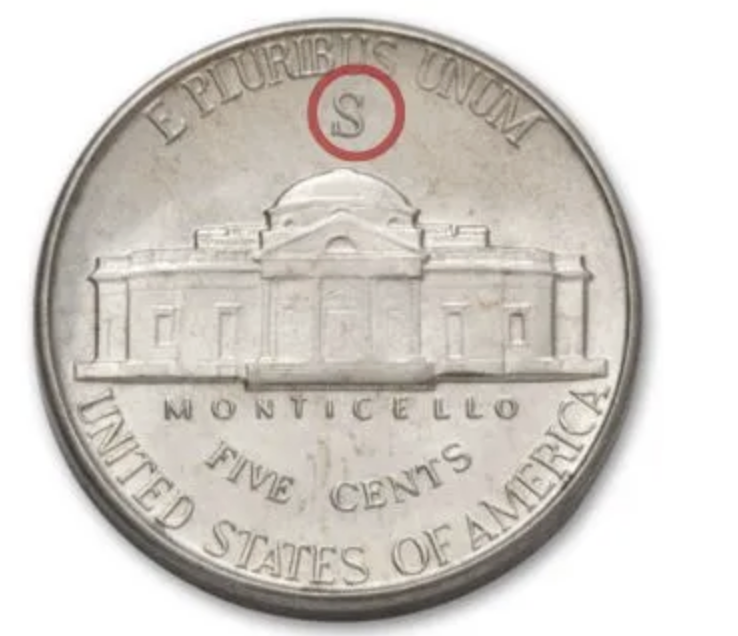
Figure 5. Silver-containing war nickels are easily recognized by the large P, D, or S mint marks above Monticello, showing where they were minted. P= Philadelphia, D = Denver, and S = San Francisco.
Bottom line
As has happened with other U.S. coins, the cost of producing the nickel has exceeded its face value, and some think it's an annoyance and a waste of money. Several European countries have effectively phased out their smallest coins. Could the United States do the same, leaving the dime as our smallest coin? Not a terrible idea.
Will Congress do the same? I wouldn't bet my last nickel on it.
NOTES:
[1] The last penny intended for circulation was minted in 2025. The signing of the Common Cents Act is essentially a formality.
[2] 1964 was the last year that dimes, quarters, and half dollars contained 90% silver. Silver was eliminated from dimes and quarters in 1965, but half dollars retained 40% silver through 1970.
[3] Nice move, schmuck. A 1964 quarter is now worth about $10; a roll is worth more than $400. Somehow, stuffing them into pinball machines seemed like a good idea. Rather than saving the many rolls I had, I pissed them away, the first of many financial miscalculations I would make.
[4] What genius came up with this stupid idea? Americans hated this coin.
[5] If this sort of thing interests you, I've written about what is arguably the coolest coin of all – the silver three-cent piece. You can read about it here.

Josh Bloom
Dr. Jonathan (Josh) Bloom, ACSH's Director of Chemical and Pharmaceutical Sciences, earned his Ph.D. at the University of Virginia and completed postdoctoral training at the University of Pennsylvania. During his 20-plus years in drug discovery at Wyeth, his research group discovered the antibiotic Tygacil®, approved in 2005. He holds 25 issued patents and has authored 35 academic papers. Since joining ACSH in 2010, he has written more than 2,000 articles and dozens of op-eds for major newspapers, including The Wall Street Journal and Chicago Tribune.