One could easily be overwhelmed by the barrage of health claims that make the news these days. Cannabis is responsible for more than its share. Smoked, eaten, or otherwise consumed, marijuana is touted as a remedy for just about everything, including insomnia. Plenty of people swear that THC helps them sleep. But does it?
A new study in JAMA Network Open suggests that the answer may be more complicated than you think. Before you lose any sleep, let's examine the study. Just don't expect a definitive answer either way.
To sleep or not? That is the question.
The researchers used data from the Coronary Artery Risk Development in Young Adults (CARDIA) study, which began in 1985 and followed participants for 35 years to investigate the development of cardiovascular disease and its risk factors, from young adulthood through middle age — a category I can no longer claim to belong to, no matter how badly I stretch the definition.
During the 35-year follow-up, participants were periodically questioned about their marijuana use. For this analysis, the researchers examined data from 1,266 participants, 891 of whom had their sleep objectively measured. Sounds impressive, and in some ways it is. But not so fast. Although the researchers collected information about marijuana consumption over 35 years, they measured sleep objectively (using a watch-like wrist thingy) for only seven days. This may sound like grounds for immediate dismissal, but it's not. The findings have limitations, but they're hardly landfill-ready.
Smoke or fire?
The study has some legitimate strengths: a large number of participants, decades of cannabis-use data, and actual measurement of sleep rather than relying on self-reporting. But it also has weaknesses, including incomplete information about what kind of cannabis participants used, how much THC they consumed, or how they consumed it. And because this was an observational study, it couldn't establish whether marijuana caused the differences in sleep. Let's take a look.
The results: A mixed bag of weed
Table 1 summarizes the differences in sleep measurements between recent marijuana users and never-users.
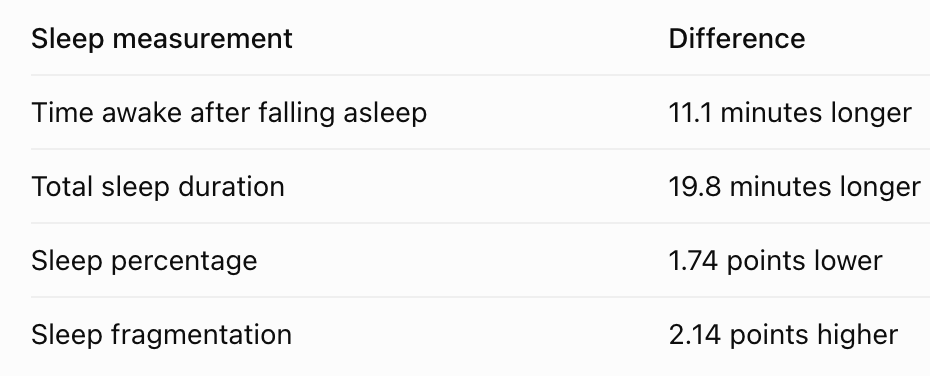
Table 1. Differences in objectively measured sleep between recent cannabis users (past 30 days) and never-users, adjusted for potential confounding factors. All differences were statistically significant. Source: JAMA Network Open, October 9, 2026. DOI: 10.1001/jamanetworkopen.2026.38303
Even though all four differences were statistically significant, this doesn't mean that they were clinically significant. An extra 11 minutes awake at night or 20 additional minutes of sleep is hardly worth getting hysterical about. And longer sleep doesn't necessarily mean better sleep.
The lower sleep percentage (the proportion of time in bed actually spent asleep) and increased fragmentation suggest that cannabis users slept somewhat less efficiently, even though they slept a little longer overall. Pretty modest headlines, but there still might be something real going on.
And what might that be?
Something else popped up when lifetime marijuana use was considered, and this might be more interesting. For every additional cannabis-year (365 cumulative days of use), the adjusted odds of prolonged nighttime wakefulness increased by 21%, the odds of poor sleep efficiency by 10%, and the odds of highly fragmented sleep by 4%. [1]
Some weirdness
Although the researchers found statistically significant differences in objectively measured sleep, they found no statistically significant association between marijuana use and how participants rated their own sleep quality. In other words, the wrist devices detected differences that weren't reflected in what people reported about their sleep. Does this mean marijuana users were sleeping poorly without realizing it? Not necessarily. The differences may have been too small to notice, or the measurements may have captured changes that didn't meaningfully affect how rested people felt. The study can't tell us which explanation is correct.
Bottom line
What can we conclude from all this? A few things, although none provides a definitive answer.
- Recent cannabis users slept somewhat differently. They slept a little longer but also experienced more nighttime wakefulness and fragmentation.
- Lifetime use may matter. Greater cumulative cannabis use was associated with several measures of disrupted sleep.
- Cause and effect, if any, remain unclear. This was an observational study of recreational marijuana use, not a clinical trial testing cannabis as a treatment for insomnia.
So, is marijuana a sleep aid or a sleep disruptor?
Let me sleep on it.
NOTE:
[1] These percentages represent increases in odds, not increases in the duration or severity of sleep problems. For example, 21% higher odds of prolonged wakefulness does not mean 21% more time spent awake.

Josh Bloom
Dr. Jonathan (Josh) Bloom, ACSH's Director of Chemical and Pharmaceutical Sciences, earned his Ph.D. at the University of Virginia and completed postdoctoral training at the University of Pennsylvania. During his 20-plus years in drug discovery at Wyeth, his research group discovered the antibiotic Tygacil®, approved in 2005. He holds 25 issued patents and has authored 35 academic papers. Since joining ACSH in 2010, he has written more than 2,000 articles and dozens of op-eds for major newspapers, including The Wall Street Journal and Chicago Tribune.