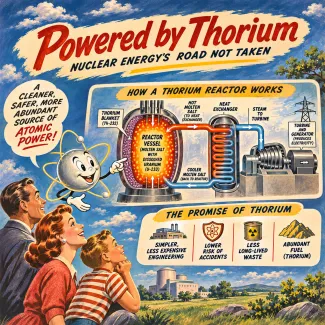
Geek that I am, one day I was idly looking at the chart of the nuclides, a “periodic table” of atomic isotopes, when I noticed that a lighter form of uranium, U-233, is just as capable of undergoing nuclear fission as U-235, the isotope normally enriched for use in nuclear reactors. It turns out that U-233 is virtually nonexistent in nature, but thorium, found naturally almost entirely as Th-232, is much more abundant than uranium and, more importantly, can be converted into U-233, providing an alternate source of nuclear fuel.
I called my professor friend and asked why we weren't doing this, since producing U-233 from thorium seemed much easier and cheaper than running our massive uranium enrichment plants. He guessed that, back in the 1950s, when scientists first explored using thorium to produce U-233, the Navy was designing nuclear reactors for submarines and had already settled on highly enriched uranium. Rickover, who headed the Navy's nuclear reactor program, didn't want to waste resources exploring a different approach that wouldn't be used aboard a Navy ship. According to this hypothesis, he discouraged further work, and thorium reactors were largely sidelined for decades. Having served in Rickover's Navy for several years, that makes as much sense to me as anything else I've heard.
Four Promises, One Overlooked Fuel
Proponents of the thorium cycle point to several advantages:
- Simpler, less expensive, and more foolproof engineering with lower likelihood of accidents
- Proliferation resistant
- Won’t run out of fuel
- Less nuclear waste
Let’s see if any of these hold water.
A Different Fuel, a Different Reactor
Splitting an atom, especially large atoms like uranium or plutonium, releases tens of millions of times as much energy as splitting a chemical bond in, say, a hydrocarbon. It takes a neutron hitting the atom to cause it to split (fission), and each atom that fissions releases two or three neutrons. To keep a reactor operating, one of those neutrons needs to cause another fission. Just as it takes more than a twig’s worth of wood to keep a fire going, it takes a certain amount of uranium to sustain a fission reaction.
All those fissions produce a lot of energy in the form of heat, which heats the fuel, in the case of a conventional reactor, uranium. To keep the fuel from reaching its melting point, it needs to be cooled; in a conventional nuclear reactor, that means circulating water through the core and then through a steam generator, where the hot water boils to make steam, that spins turbines to produce electricity. This is like a car engine, in which a mixture of water and antifreeze circulates to cool the engine, heating up the water, where the radiator removes (exchanges) enough of the added heat to keep the water cooling the engine (coolant) from boiling. You can find a more detailed look at building a reactor here.
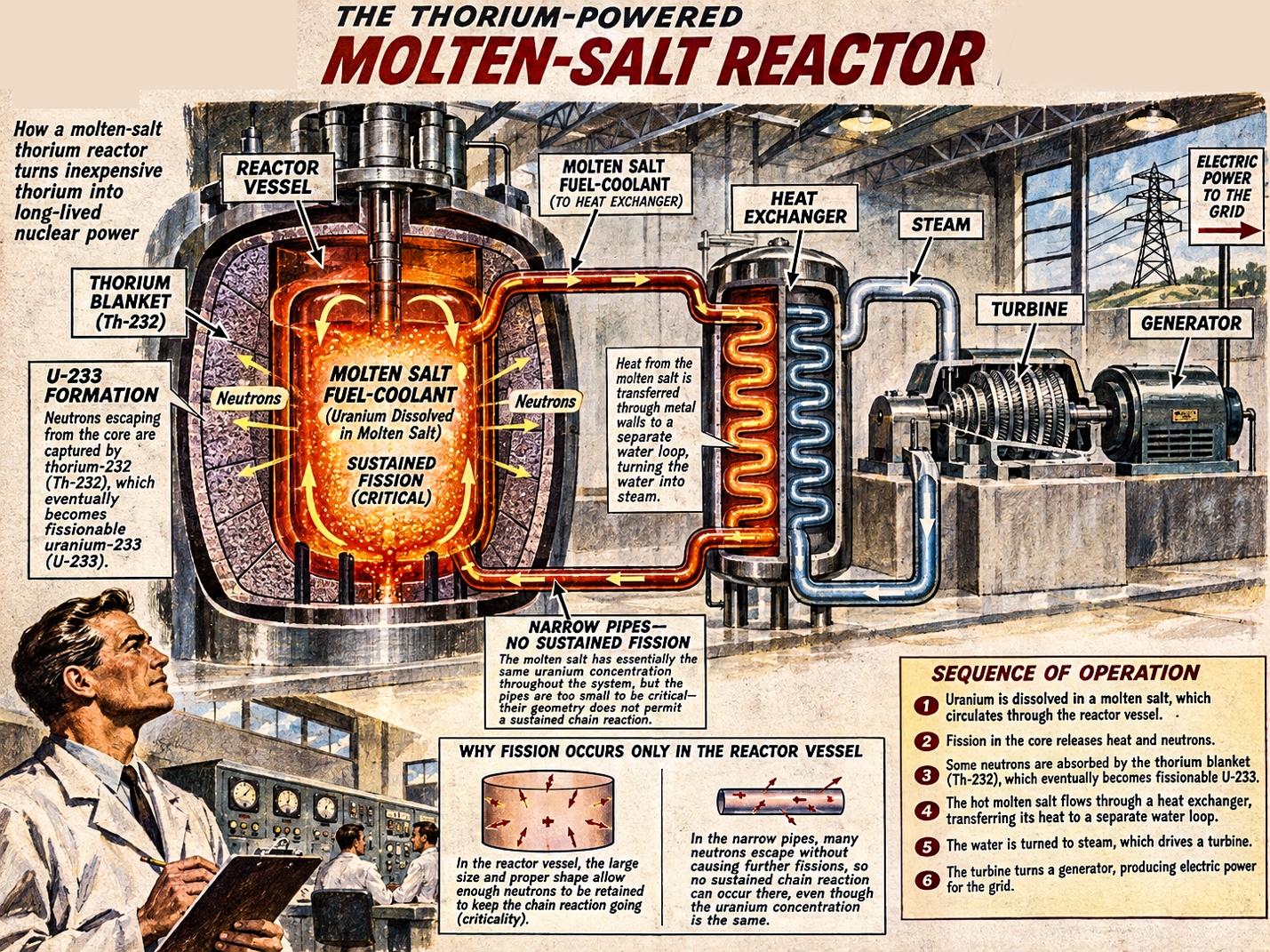
These basic components – fuel, coolant, heat exchanger – are fundamental to all nuclear power plants, including thorium reactors. However, thorium reactors have two substantial differences. First, thorium surrounds the reactor core, allowing some neutrons escaping from the core to be absorbed by Th-232 atoms, which eventually become fissionable U-233 atoms. The other is that the uranium fuel is dissolved directly into the coolant—the molten salt that carries heat away from the reactor.
The clever part is that the circulating molten salt has essentially the same uranium concentration throughout the reactor system, yet sustained fission occurs only inside the reactor vessel. That vessel is large enough and has the necessary geometry for the uranium to reach criticality and sustain a nuclear chain reaction. When the salt exits the reactor vessel, it flows through relatively narrow pipes, where the geometry no longer allows a sustained chain reaction. From there, it passes through a heat exchanger, transferring its heat to a separate system that produces steam to turn turbines and generate electricity.
Taking the Pressure Off Nuclear Power
Unlike water-cooled reactors, which operate at very high pressures to keep the water coolant liquid at the high temperatures needed for good thermal efficiency, salt remains molten at atmospheric pressure. It is much easier and much less expensive to design a plant to operate safely at atmospheric pressure than at 2000 psi, the pressure at nearly a mile underwater. In addition, the fission products dissolve in the molten salt, which can be purified to remove radioactivity as it’s produced, rather than letting it accumulate in the fuel rods.
Proliferation-resistant
Uranium-233 can be used to create a nuclear weapon as readily as U-235 or plutonium-239. The US, USSR, and India have tested weapons containing U-233, so producing it from thorium raises concerns about weapons proliferation. But producing U-233 also produces small amounts of U-232, which, as it decays, emits powerful gamma radiation, making the U-233 harder to handle. This does not make a weapon impossible to build, but it makes weapons containing U-233 harder to store and transport than those using U-235 or plutonium-239.
A Nuclear Fuel Supply Measured in Millennia?
While there’s a lot of uranium in the world, there’s much more thorium. Depending on our eagerness to build new reactors – including breeder reactors – we have anywhere from one to several centuries of uranium on Earth. There is four times as much thorium on Earth as uranium. Additionally, all naturally occurring thorium is Th-232, which means that every atom of thorium can produce U-233, compared with less than 1% of uranium atoms. In other words, if humanity builds enough reactors to replace fossil fuels, we’ve got maybe a century’s worth of uranium; using thorium-fueled reactors could give us power for many millennia.
Less Waste, but Not Waste-Free
Fissioning U-233 produces nearly the same fission products as U-235. The key difference is the ability to remove those fission products as they form, rather than letting them accumulate in the fuel. At present, spent fuel from nuclear power plants across the country is stored in cooling pools and dry casks, many of which are clustered outdoors at reactor sites, awaiting eventual transport for final disposal—if the United States ever opens a long-term spent fuel repository.
This storage is necessary because spent fuel contains not just fission products, but also unfissioned uranium and substantial amounts of heavier elements such as neptunium, plutonium, and americium. In a molten-salt reactor designed for chemical processing, many of these materials can be separated from the still-usable uranium fuel, allowing that fuel to continue circulating rather than being discarded with the waste.
There is another advantage. Once the initial U-235 fuel is replaced by U-233 produced from thorium, the reactor can be designed to operate with little or no U-238. As a result, it produces relatively little transuranic waste. Th-232 and U-233 are lighter nuclei and must absorb more neutrons before becoming heavier elements such as Pu-239 or Am-241. This can substantially reduce the amount of long-lived radioactive waste requiring disposal while also limiting plutonium production and its associated proliferation risks.
A Second Chance for Thorium?
The molten salt reactor design works with uranium too, and a few small modular reactors on the drawing boards use this design. The technology is just as safe using U-235 as it is with U-233, and the points about less waste and being simpler, cheaper, and safer remain valid. But it falls a little short on proliferation resistance, especially if U-238 is dissolved into the molten salt (which would almost certainly be the case to avoid running a reactor on highly enriched uranium).
Listening to the claims of the pro-thorium crowd, it’s easy to come away wondering whether they're overly enthusiastic about a technology that was examined and discarded 60-70 years ago. I’m not sure the thorium cycle is the answer to all our energy problems; that said, I also think the decision to abandon it in the US was a mistake, and that bringing it back for another try would make sense.