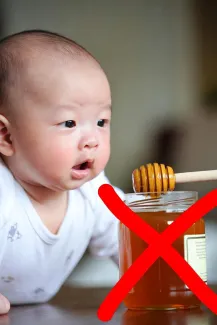
Honey has developed quite a loyal fan base, and for good reason. It is well-loved for its rich sweetness and distinct flavor profiles, not to mention its science-backed health benefits. From soothing coughs and aiding in chronic wound care to supporting cardiometabolic health with regular use, honey is a powerhouse. Because of all these wonderful benefits, it can be surprising to learn that infants under the age of one should never consume it. It seems natural to assume that something so good for adults would be good for babies, but unfortunately, this is not the case. Though rare, introducing honey to infants under one year old can lead to a serious condition called infant botulism.
Honey is made from nectar that bees harvest from plants local to their hives. While collecting nectar and pollen, bees can pick up dirt, plant debris, and bacteria—including spores of the Clostridium botulinum bacterium. These hardy, dormant spores occur naturally worldwide in soil, untreated water, dust, and air. A bee can easily pick them up during foraging, and they sometimes end up in the finished honey.
These spores are ubiquitous and commonly contact our food sources. Healthy adult digestive systems handle them without issue. Infants, however, have immature gut microbiomes and immune defenses that can allow the spores to germinate. When this happens in an infant’s warm, low-oxygen intestinal environment, the bacteria produce botulinum neurotoxin. This toxin blocks the release of acetylcholine, disrupting nerve-to-muscle communication and causing flaccid paralysis—the hallmark of the disease.
Contaminated powdered infant formula (such as the ByHeart recall in 2025) can also introduce spores through manufacturing or environmental contamination [1]. Honey is unique because it requires no added preservatives; its naturally low water activity and acidity generally prevent bacterial growth, though pre-existing spores can survive.
Recognizing the Signs: What to look for
- Constipation (often the first symptom)
- Difficulty sucking or feeding
- Droopy eyelids (ptosis)
- Weakened cry
- Muscle weakness / poor head control (“floppy” infant)
- Difficulty breathing, which can progress to respiratory paralysis
All symptoms stem from the inability of muscles to contract properly.
Diagnosis is confirmed via stool sample testing, but treatment with the antitoxin (intravenous botulism immunoglobulin, or BIG-IV / BabyBIG) often begins on strong clinical suspicion alone. The earlier the antitoxin is given, the better the outcome and the shorter the recovery. Severe cases can require weeks of intensive care, including mechanical ventilation and tube feeding. Thanks to modern ICU support and BabyBIG, the survival rate now exceeds 98–100%, with most infants recovering fully and few long-term consequences.
Conclusion
Before the antitoxin’s development, mortality reached approximately 90%, with survivors often enduring prolonged ventilator dependence and feeding support. Infant botulism is now highly survivable, but prevention remains the safest strategy. Simply keeping honey (and products containing it) out of an infant’s diet until after their first birthday eliminates this avoidable risk.
Notes
Nara Organics recall, announced June 13, 2026, involved all lots of its Whole Milk Organic Powdered Infant Formula. No formula has tested positive for C. botulinum to date, but the recall was precautionary.
[1] A large outbreak with dozens of cases (reports vary between approximately 28 confirmed to higher totals depending on final tallies of unconfirmed cases.

Desiree English
Desiree English is a high school science teacher with eight years of classroom experience. She holds a B.S. in Kinesiology and brings a unique blend of academic expertise and real-life “in-the-trenches” parenting to family and children’s content.