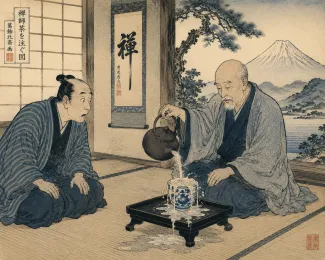
A famous Zen story captures one of the hardest problems in communicating science, especially in an age shaped by divisive social media commentary.
A university professor once traveled to visit a respected Zen master to learn about Zen. When they sat down for a visit, the master began quietly preparing and serving tea.
The professor, eager to show off his intelligence, talked continuously about his philosophies and knowledge. The master listened patiently, filled the professor's cup to the brim—and then kept pouring.
The professor watched the liquid spill over the table until he could no longer contain himself. "It’s full! What are you doing?"
The Zen master stopped pouring and smiled at him. "Like this cup, you are full of your own opinions and speculations. How can I show you Zen unless you first empty your cup?"
Much of our engagement on social media, increasingly the home for communicating and sharing scientific and health-related information, begins with our cups full to the brim. Whether the cup is filled by expertise, belief, datasets, or affinity groups may make a great deal of difference in the content, but it makes little difference in the act of communicating - little can enter a cup that is already overflowing.
This is a problem on all sides of the discussion. Experts talk over and around skeptics, while skeptics put up walls of “knowing” and lived experience. In both instances, we talk not so much to one another as past one another. The great failing of public health has not been in the message but in the messaging. To be equitable in my critique, many of the message recipients’ cups of tea were already full; public health’s failing was its inability to rework the messaging to meet people where they were.
That challenge is not unique to public health; it appears in every conversation where knowledge must become understanding
As I have said before, I understand persuasion because no one comes to a surgeon asking to be operated on. Informed consent requires transferring both information and understanding; it requires making room in both the clinician’s cup of communication and the patient’s cup of understanding.
There is a ritual to serving tea, primarily to infuse the experience with its pace and grace. Digital communication, because it rewards speed over pace and likes and virality over grace, makes serving tea more difficult. We do not need new regulations or liability rulings to begin serving tea differently. Another Zen parable guides us in how to stop letting the tea pour over the table.
 A Zen master loved his evening walk with his dog, who, equally appreciative, would bound ahead, explore, and then return to his master, wagging his tail. One evening, the teacher invited one of his students, troubled by the contradictions he encountered in Buddhist thought, to join him.
The teacher called to his dog, “Fetch me the moon,” while pointing to the now full moon. “Where is my dog looking?” asked the teacher. “He’s looking at your finger,” was the reply.
“Exactly. Don’t be like my dog and confuse the pointing finger with the thing being pointed at.”
People often argue over the finger, tone, tribe, authority, wording, and identity, while never looking at the moon together.
To share scientific knowledge, we need to do more than sharpen the facts or polish the phrasing. We must recover something of the tea ceremony: its patience, attention, and willingness to slow down before pouring more. Only then can we stop arguing over the finger, return our eyes to the moon, and perhaps begin serving the tea of science with the pace and grace the moment requires

Chuck Dinerstein, MD, MBA
Director of Medicine
Charles Dinerstein, MD, MBA, is the Medical Director of the American Council on Science and Health. A vascular surgeon with more than 25 years of clinical experience, he brings a physician's understanding of medical decision-making, an appreciation for scientific uncertainty, and a broader perspective on healthcare economics and policy to his writing.