Having played the piano for 65 of my 73 wretched years, I was curious, after reading Dr. Lynn Webster's companion piece about taking up the drums at 75, whether Mozart, Chopin, and Rachmaninoff had done my brain any favors. (Rachmaninoff was a nasty SOB who wrote some of the most beautiful music ever, but apparently expected it to be played by people with 3 hands. [1]
Memory has never been one of my strengths.
Additionally, memory has never been one of my strengths.
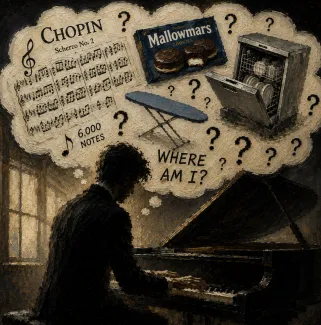
And age isn't helping. Whereas I might have looked in the kitchen for a box of Mallowmars 20 years ago, I'm now more likely to wander into a random area of the house, forget why I'm there, and then resume my search behind the ironing board.
Yet, Chopin's Scherzo No. 2 contains roughly 6,000 notes... and I can play it (more or less accurately) from memory, only moments after abandoning my search for whatever the hell I was looking for in the first place.
So, I located my computer (dishwasher) and poked around to see if there was any literature on whether piano memory has any bearing on Mallowmar memory.
The answer is a pretty strong yes. Let's look at a few studies. Before I forget.
In a pioneering 2007 randomized trial, healthy older adults who received six months of individualized piano lessons showed significant improvements in executive function and working memory compared with controls.
Fifteen years later, Bugos and colleagues confirmed and extended those findings in a larger randomized controlled trial of 155 adults aged 60 to 80. After 16 weeks of piano training, participants demonstrated better working memory and processing speed than untreated controls and outperformed computerized brain training on a test of verbal fluency. While neither study was designed to determine whether piano playing prevents dementia, both suggest that learning and practicing the instrument can strengthen cognitive abilities that typically decline with age.
Whether those improvements translate into a lower risk of dementia is a much harder question. To answer it requires following thousands of people for years rather than months.
The Monash Study
Perhaps the strongest evidence comes from a large prospective study led by Monash University. Researchers followed nearly 11,000 cognitively healthy adults over age 70 and found that regular instrument playing (not just piano) was associated with a 35% lower risk of developing dementia. The study used Cox proportional hazards analysis [3], the standard statistical method for evaluating time-to-event outcomes such as dementia, and the association reached conventional statistical significance (hazard ratio 0.65; 95% confidence interval 0.42-0.99; P = 0.047). The study's large size and prospective design make the findings compelling, although the statistical significance was borderline. Like any observational study, it cannot prove that playing a musical instrument prevents dementia. Even so, it wasn't an outlier. Most studies have reported similar findings, although not all have.
Whether those improvements translate into a lower risk of dementia is a much harder question. To answer it requires following thousands of people for years rather than months.
A Different Key: The Keys to Staying Sharp Study
Before you run out and buy a Steinway, there's one more study worth mentioning. (Or steal one, something that I tried with the help of my ACSH colleagues: See A Science Lesson for NYC Shoplifters).
Not every study has been positive. The aptly named Keys to Staying Sharp trial reached a different conclusion. Older adults were randomly assigned to piano lessons, music appreciation classes (listening to and discussing music rather than playing it), or no intervention. After a year, the piano group did not perform significantly better than the music appreciation group on measures of cognition or everyday functioning. In other words, learning to play the piano wasn't clearly superior to simply engaging with music.
Does this negate the Bugos studies or the Monash findings? No. It simply means the evidence isn't unanimous. That's hardly surprising when you're studying something as complicated as the aging brain. One possible explanation is that music itself, whether played or listened to attentively, benefits cognition. Another is that the studies differed in design, duration, outcome measures, or statistical power. Whatever the explanation, the mixed results are a useful reminder that the evidence is encouraging, not conclusive.
Bottom Clef
Will 65 years of wrestling with Chopin keep me from peeing in the closet in 10 years? I have no idea. But if the answer is yes, practicing arpeggios beats a nursing home any day.
Sadly, there is considerably less evidence that pickleball—another passion of mine—enhances memory, at least as reported by T-shirt manufacturers.

NOTES:
[1] Rachmaninoff's reach about a 13th (an octave plus a fifth). This makes him non-human. It's no wonder that his works are devilishly hard to play. (My best is a 9 – an octave plus a note. It's not fair).
[2] Pet peeve: At the risk of sounding like the snob I am, we are not piano players, as in those mustachioed guys banging out tinny tunes in an 1860s saloon while spitting in the vicinity of the spittoon. We are pianists. Pronounced like the male organ. ← (Ha! Stupid pun.)
[3] A Cox proportional hazards model is the standard statistical method for estimating how different factors affect the risk of an event, such as developing dementia, over time.

Josh Bloom
Dr. Jonathan (Josh) Bloom, ACSH's Director of Chemical and Pharmaceutical Sciences, earned his Ph.D. at the University of Virginia and completed postdoctoral training at the University of Pennsylvania. During his 20-plus years in drug discovery at Wyeth, his research group discovered the antibiotic Tygacil®, approved in 2005. He holds 25 issued patents and has authored 35 academic papers. Since joining ACSH in 2010, he has written more than 2,000 articles and dozens of op-eds for major newspapers, including The Wall Street Journal and Chicago Tribune.