Does Football Cause Brain Disease?
While the link between repetitive head impacts (RHI) and long-term neurodegenerative diseases (NDD), including Alzheimer's disease (AD)/dementia, amyotrophic lateral sclerosis (ALS), chronic traumatic encephalopathy (CTE), and Parkinson's disease (PD), seems settled in the public eye, it remains a hotbed of intense scientific debate. Critics argue that much of the existing research pointing to a high risk of brain disease is flawed because:
- Neuropathological studies relying on brains donated by families may have created a selection bias that potentially inflated the risk of a rare disease.
- Retrospective interviews, asking family members to recall a player’s behavior, “contaminating” a clear sense of cause and effect.
- Media coverage, driven by fear-inducing headlines, gets in front, forgive the metaphor, of the data’s skis.
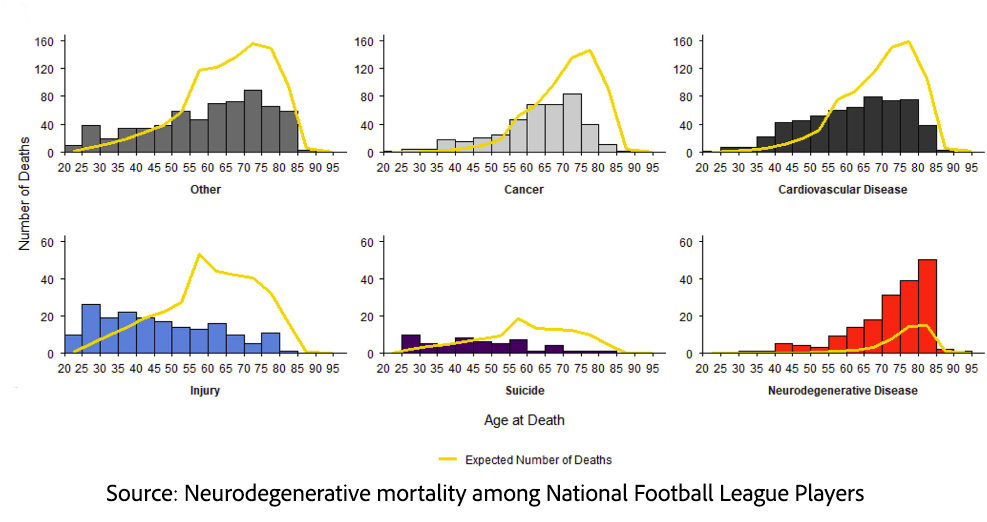
A new study reported in The Lancet uses data from the Sports Reference, LLC database, which contains information on all NFL players since the league's founding in 1920. The study dataset included nearly 20,000 players who played in at least one NFL game since 1960, 10% of whom have died, with their deaths cross-referenced with the National Data Index. Of the 1876 known causes of death, neurodegenerative diseases accounted for 178, primarily all-cause dementia.
Beyond the Headlines
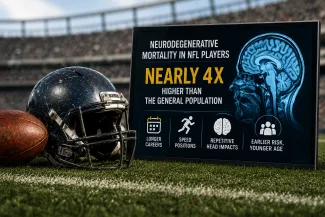
“Neurodegenerative mortality was nearly four times higher than the general population”
Elite NFL athletes generally enjoy a lower overall risk of death compared to the general population; a phenomenon termed the “STARS” effect (Selection through Athletic Resilience Survivor). This reflects resistance to major diseases due to genetics, peak physical fitness, excellent medical care, and a generally healthy lifestyle. However, when it comes to neurodegenerative disease, this athletic resilience disappears, and their risk of dying from brain disease is clearly elevated.
Not Every Player Shares the Same Risk
However, the risk is not uniform, varying with an individual’s biological and NFL career.
The data reveal that this risk is not uniform; rather, it is driven by specific biological and occupational factors. There is a dose-response relationship.
- Players with careers lasting 5 or more seasons have significantly higher rates of mortality from both dementia and Parkinson's.
- "Speed" position players [1] face twice the dementia rate of non-speed players. While taking fewer total hits, they experience higher-magnitude impacts, resulting in the highest rates of traumatic brain injuries per game.
Repetitive head trauma appears to accelerate the onset of these neurologic disorders, with players under 60 facing a 15-fold increase in ALS mortality and an 8-fold increase in dementia mortality. As a result of the length of their careers and their likelihood of playing speed positions, non-white players comprise the majority of ALS and dementia deaths under age 60, significantly younger than their White counterparts.
What the Study Still Can't Tell Us
As with all studies, the analysis was constrained by the data. In this instance, there was a lack of individual-level detail on head impacts and lifestyle factors off the field and out of season. Additionally, death certificates rarely look beyond the primary cause of death, which may result in under-reporting the true incidence of brain disease.
Football Isn't Alone
My friend, Mauro Proenca, recently wrote about a new concussion protocol for Futbol. Soccer, too, shows both the STARS effect and a heightened risk of neurologic disease. A study of a smaller subset of soccer players compared with matched controls showed a similar dose-response to repetitive head injury. Longer careers and positions on the pitch, particularly defenders, had a roughly 3-fold elevation in risk. Goalkeepers who rarely “head” the ball had no greater risk than the general population.
Science Meets the Courtroom
While the NFL is not legally immunized by the government, it has achieved a massive degree of practical and legal insulation.
- In 2015, a federal court approved a massive class-action settlement between the NFL and thousands of retired players. In exchange for uncapped monetary awards, nearly the entire class of retired players legally released the NFL from any future head-trauma lawsuits. By settling, the NFL, like other corporate “selves,” avoided a trial where internal documents regarding what and when they knew about repetitive head impacts would have been made public.
- Because NFL players are unionized under a Collective Bargaining Agreement, federal law dictates that disputes over workplace safety and medical care must be handled through an internal arbitration process rather than state tort courts.
- For any current or future player, the NFL relies heavily on the implied assumption of risk doctrine. Paradoxically, this study, as well as the media spotlight, strengthens the NFL’s legal argument – players cannot easily prove negligence.
Where Prevention Can Make the Biggest Difference
For these professional athletes and the wannabe collegiates, all of this is an acknowledged occupational risk. However, the breeding ground for future football and soccer stars lies in our neighborhoods and among our children. The CDC reports that roughly 45% of emergency department visits for sports- or recreation-related traumatic brain injury among children ages 17 and under are related to contact sports, including football, basketball, and soccer.
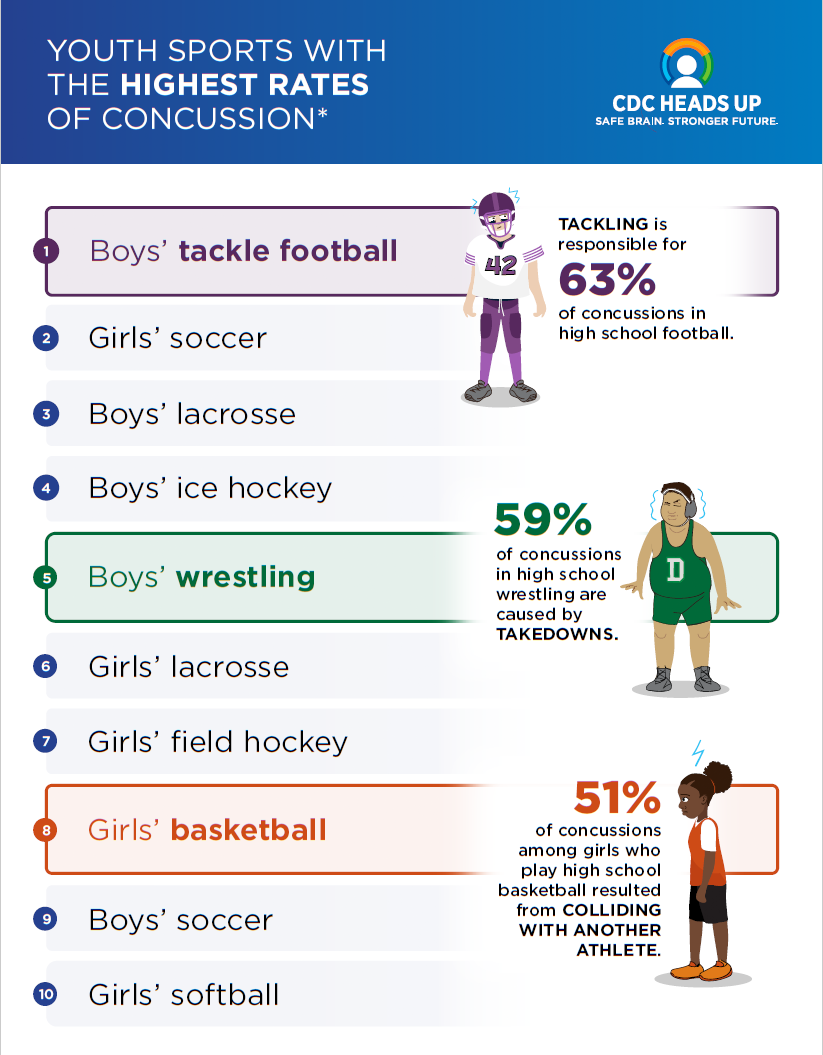 As the graphic shows, unsurprisingly, boys’ tackle football results in the highest concussion rates for youth sports, primarily driven by body-to-body contact. But closely behind is girls’ soccer, where the primary risk is being struck directly in the head by a kicked soccer ball. In fact, girls’ soccer experiences 1.5 times the number of concussions as boys.
Like their collegiate and professional counterparts, youth sports have their own dose-response, with longer years at play more likely to result in a concussion. And youths bring their own biological differences, too. Adolescent girls have less-developed neck muscles, lower neck girth, and smaller head mass relative to ball size than their male peers, reducing the ability to dissipate the forces of impact – the result, a lower biological threshold to brain injury. There is also a cultural component where boys more often yield to peer pressure to “tough it out,” while girls are more likely to report symptoms to parents and staff.
The question is how society chooses to respond. Professional athletes knowingly accept extraordinary occupational risks; children do not. As evidence increasingly points to a dose-response relationship from youth sports through the professional ranks, the focus should be on reducing unnecessary exposure through smarter coaching, better equipment, rule changes, and rigorous concussion management. We may never eliminate the risks of collision sports, but we can certainly be more honest about them.
[1] Defined as defensive backs, running backs, linebackers, wide receivers, tight ends, kickers, and quarterbacks.
Source: Neurodegenerative mortality among National Football League Players The Lancet DOI: 10.1016/j.eclinm.2026.104051

Chuck Dinerstein, MD, MBA
Director of Medicine
Charles Dinerstein, MD, MBA, is the Medical Director of the American Council on Science and Health. A vascular surgeon with more than 25 years of clinical experience, he brings a physician's understanding of medical decision-making, an appreciation for scientific uncertainty, and a broader perspective on healthcare economics and policy to his writing.