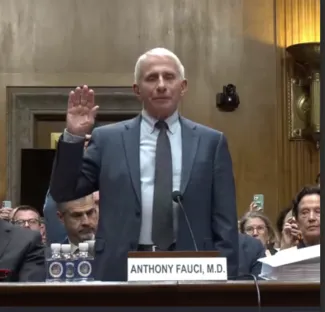
On July 29, Americans did not witness a serious examination of how the COVID-19 pandemic began. They witnessed the culmination of a story years in the making.
Dr. Anthony Fauci appeared under subpoena before the Senate Homeland Security and Governmental Affairs Committee and invoked the Fifth Amendment more than 100 times. Senator Rand Paul, the committee chairman, said the committee would consider holding him in contempt, while Fauci accused Paul’s long campaign of laying a perjury trap.
The spectacle offered something for both partisan camps: For people already convinced Fauci committed a crime, his silence will be treated as a confession. For those who view Paul’s investigation as political persecution, the hearing confirms that evidence no longer matters.
That is how a toxic narrative works. It erases uncertainty as intolerable and replaces it with a villain.
A toxic narrative often begins with facts that are real but incomplete: federal money passed through EcoHealth Alliance to support coronavirus research at the Wuhan Institute of Virology; public-health guidance changed; officials sometimes spoke with more confidence than the evidence justified; and China withheld key records.
These are legitimate reasons for investigation. They are not, by themselves, proof that Fauci created the virus, concealed its origin, or lied to Congress.
The World Health Organization’s advisory group concluded that available evidence favors zoonotic spillover, yet crucial information remains missing and a laboratory origin must remain under consideration. But that nuanced reality does not fit on a campaign placard or in a viral video. Political storytelling demands certainty. One side declares the laboratory theory disproven; the other treats Fauci’s culpability as established fact.
Neither claim is warranted.
Paul’s narrative offers a clear protagonist, villain, and crime. But the evidentiary steps matter: Risky research is not proof of producing SARS-CoV-2. Deficient National Institutes of Health (NIH) oversight is not proof Fauci knew the virus escaped from a lab. Private scientific debate is not proof of conspiracy. And disagreement over technical definitions—like “gain of function”—is not evidence of perjury.
The phrase “gain of function” itself became a narrative weapon. Paul referred to its broad scientific sense—research altering an organism’s properties—while Fauci relied on a narrow federal regulatory category for enhanced pathogens with pandemic potential. While experts debated whether the Wuhan research fit the broader definition, the NIH maintained it fell outside the regulatory threshold.
Fauci’s answer may have been technically defensible, but it was rhetorically disastrous. His categorical denial sounded absolute, so when later records revealed altered viral properties, many felt deceived. Fauci and public-health officials bear responsibility—not for unproven, sweeping crimes—but for communicating uncertainty as authority. Institutional defensiveness made legitimate questions sound disreputable to even discuss and created fertile ground for a counter-narrative.
That dynamic intensified because the Fifth Amendment carries both legal and narrative weight. Legally, invoking it protected Fauci from potential false-statement charges given Paul’s repeated demands for prosecution. Narratively, silence looks like concealment—converting a constitutional safeguard into visual shorthand for guilt.
A genuine inquiry permits evidence to shape its conclusion; a prosecutorial spectacle begins with the conclusion and uses the witness to dramatize it.
Congress has an obligation to investigate public funding, international research oversight, reporting compliance, biosafety standards, records preservation, and executive transparency. Fauci’s long public service does not place him beyond scrutiny, and questioning him is not an attack on science. Science is a method for testing claims and exposing uncertainty, not loyalty to an official.
However, oversight loses legitimacy when it is organized around a predetermined villain. Paul’s habit of treating unresolved scientific questions as proof of intentional criminal conduct distorts the search for truth.
The cost of this feud reaches beyond two physicians who plainly distrust each other. It teaches the public that changing one’s mind is dishonesty, that uncertainty indicates conspiracy, and that the exercise of a constitutional right is an admission of guilt. Most dangerously, it leaves the country unprepared for the next pandemic because decisions are reduced to partisan identity.
We need accountability without mythology. That means releasing records while respecting security parameters, establishing clearer definitions for high-risk pathogen research, strengthening grant and international subcontractor oversight, requiring timely reporting of unexpected experimental results, and examining how uncertainty was communicated without pretending uncertainty is misconduct.
The tragedy of the Fauci-Paul feud is that it replaces necessary accountability with partisan storytelling. Fauci’s service does not preclude scrutiny, Paul’s suspicions do not constitute proof, and an unresolved origin is not an invitation to invent certainty. Our institutions must prove they can learn from a catastrophe rather than pick teams. Until then, congressional hearings will generate heat, headlines, and toxic narratives—but no answers to prevent the next pandemic.

Lynn Webster, MD
Lynn R. Webster, MD, is a physician, researcher, and author specializing in pain and addiction medicine. He is a Senior Fellow at the Center for U.S. Policy and co-author of Deconstructing Toxic Narratives: Data, Disparities, and a New Path Forward in the Opioid Crisis.