Science is meant to be self-correcting, but is this true in practice? In psychology, several influential theories on human behavior and morality were later found to be based on fraudulent studies, including the Stanford Prison Experiment and the Kitty Genovese assault. Microbiology is rife with fraudulent images. Psychiatrists continue to endorse the long-debunked “chemical imbalance” theory of depression in research articles and to patients when prescribing selective serotonin reuptake inhibitors (SSRIs). In public health and medicine, many agencies are more concerned with restricting rather than endorsing what is perhaps the most highly-effective and highly impactful solution (e-cigarettes) to the primary cause of preventable premature death (smoking).
What is going on in science? Are these all isolated cases? Unfortunately, reflecting on my decade in academic research, my answer is “no.” Not every scientific research area is flawed, of course, but so many instances point to a common thread. One paper points to the structure of modern academia:
“We are losing sight of the academic mission: to think, to enquire, to design and perform new research, to innovate, to teach and communicate our findings for the purpose of societal improvement… a key contributor has been the corporatization of academic institutions. In principle, there is nothing wrong with making universities strong businesses. However, a key problem has been that instead of facilitating academic work, these systems have created obstacles to performing the core mission.”
The academy’s ostensible purpose is to advance knowledge, trusting in science to continually self-correct. In practice, however, the academy has grown into a bureaucracy that primarily serves itself, sidelining the very mission it was created for; a textbook case of Pournelle’s iron law of bureaucracy. Instead, science has become susceptible to groupthink determined by funding agencies, which has compromised scientific integrity, hindered improvements in public health and medicine, and lost the trust of ordinary people.
Vicious Cycle of Hypercompetition
The problem starts with the production of far too many PhDs. Large research laboratories often rely on research trainees as inexpensive labor to sustain high research output. This is beneficial for the head of the research group (“principal investigator” or PI), but – as system dynamics modelers showed when studying the biomedical workforce as a population in a finite environment – does not serve students, or the system, well.
Over the course of their career, each PI could produce nearly 20 PhD students. But since there is little to no growth in the number of academic faculty positions, only one of those students can take the faculty member’s place. For most PhD students, their dream job is to become a tenured professor. Academia are not typically knowledgeable about – and even frown upon – non-academic jobs (if there even are relevant jobs).
Let’s take the average “reproduction number” of 6.3 biomedical PhDs for every PI. What happens to one of these students after earning their PhD? A few decades ago, it wasn’t uncommon to go directly into a tenure-track faculty position, since it was assumed that their PhD program trained them for independence. Now, since many PhD students are competing for the same tenure-track slots, the universities will choose the most highly qualified ones.
This usually means extending their training period in the form of a postdoctoral fellowship. These “postdocs” are temporary positions involving slightly more responsibility, but still in service of someone else’s research program.
However, it has become the norm to do one or more postdocs. Not only does this weaken PhD program standards (since PhDs are no longer expected to be independent yet), but it shifts the goalposts for entry into an independent position: how can a PhD with two postdocs under their belt compete with five other similar candidates?
The Ecosystem of Academic Research Funding
From another perspective, how is the university going to choose between approximately six highly qualified candidates? The answer is: grant funding. The university administration will pick the candidate who can benefit the university administration the most.
Look at any job posting for a tenure-track faculty position. After describing the bare-minimum qualifications, the posting will then list qualities that they value over and above everything else. Usually, the first and most important quality is grant funding, e.g.:
- “Candidates must demonstrate a record of research excellence and productivity with the potential to sustain extramural funding”
- “Preference will be given to candidates with (1) demonstrated potential to obtain extramural funding”
To some extent, this is justified, rational self-interest by the university, since if a research funder is willing to pay the researchers’ salaries and research costs, this frees up room in the university’s budget. But the problem is, grant funding has become expected by universities, whose “bullshit jobs” – positions that serve to prop up the bureaucracy itself rather than advancing knowledge – have grown far faster than faculty positions.
So it’s not just about researchers “carrying their own weight” with research grants. When I was in academia, an administrator said the quiet part out loud to me: the only grants that “count” towards my performance evaluation and eventual tenure application are the ones that come with large “indirects” to the university – i.e. a payment to the university that’s over and above what the grant is for, ostensibly to cover overhead costs.
The indirect rate is no small sum, averaging in the ballpark of 40%-50% of the total grant amount, depending on the university. Universities have become increasingly reliant on these indirect costs to support other functions at the university – including administrators’ high salaries and a dedicated workforce to sustain the grant-seeking bureaucracy itself: a self-imposed need for support with applying for and administering grants.
In the past, professors were often in “hard money” positions, meaning the university guaranteed their salaries. That has shifted, first with the administrations pressuring faculty more strongly to seek grant funding. I was told by an administrator that “the university will be fine as long as you [collectively] keep getting 10% more [federal grant] funding every year.”
More recently, getting a federal grant has become a hard requirement for promotion and tenure, and even for entry-level positions. But all the while, the percentage of submitted grants that actually get funded have been declining, into the single digits.
Survival Depends on Aligning with Research Funders
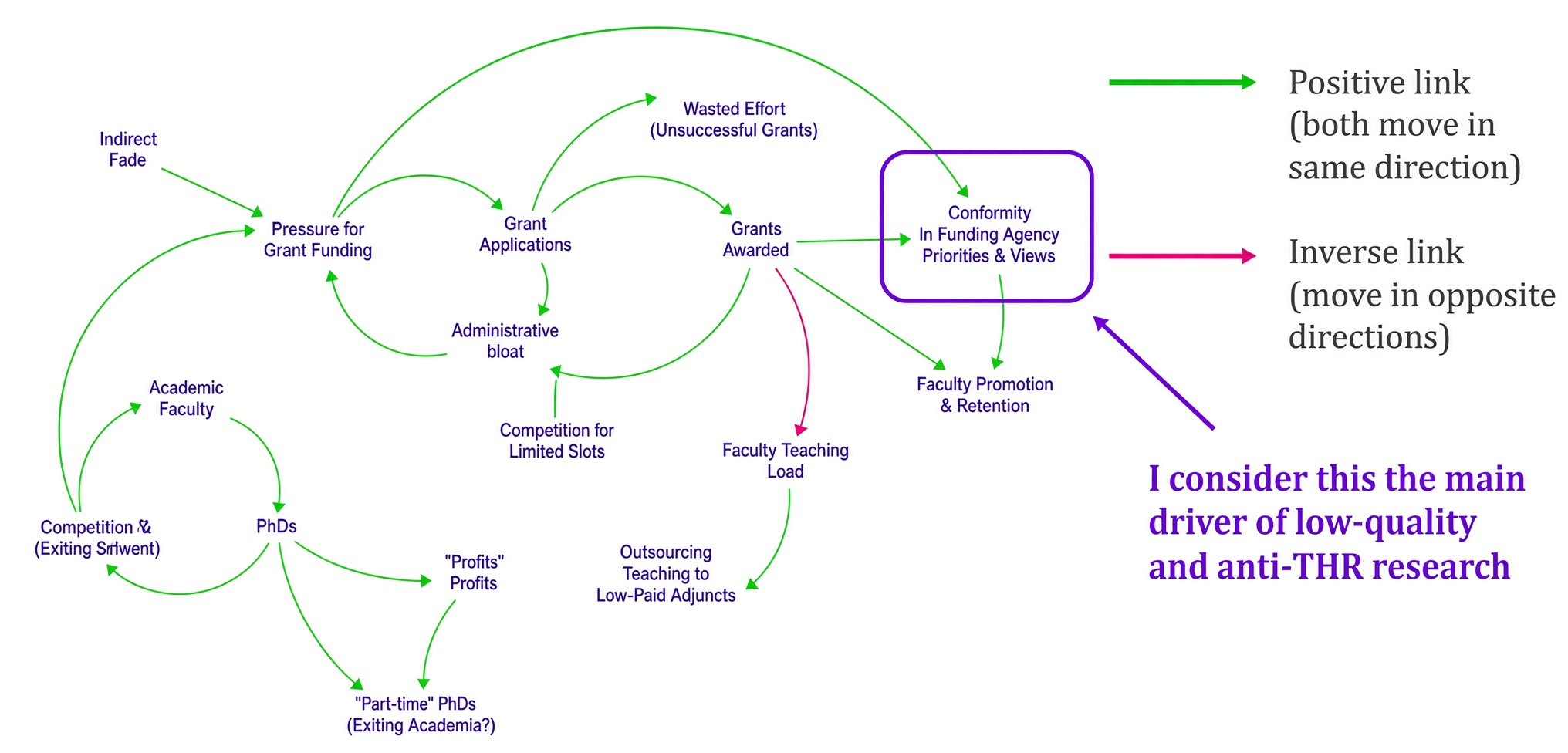
The only researchers who can “survive” in the ecosystem of academia are the ones that are successful at getting grants that “count.” Aligning with federal funders’ priorities and viewpoints, therefore, is essential to survival in academia. This is where the science becomes compromised, since the funders determine which questions are worthy of scientific inquiry.
Bringing all of the above together, there are several positive feedback loops, or “vicious cycles,” including the overproduction of PhDs and the grant-seeking activities creating their own administrative workforce that requires even more grant funding to sustain. The figure below is my conceptualization of this system and how it has resulted in a bias against research on tobacco harm reduction (THR), the field I work in.
Think about the chances of getting a nutritional study on the ketogenic diet funded in the era when there was institutional capture by Ancel Keys’s anti-fat views based on his flawed 7-country study. Or about the chances of getting funded to study potential infectious causes of Alzheimer's Disease when the poorly-supported amyloid hypothesis dominates. Not only would such studies not get funded, but – since the grant-pursuing process requires publishing supporting evidence before, during, and after grants which must align with the funding agency’s views – such views are treated with hostility and ostracization.
In my case, in tobacco control research, after initially buying into the predominant thinking that e-cigarettes are just as harmful as cigarettes, especially to youth, I unexpectedly changed my mind with my own research. I soon went against the mainstream tobacco control stance at the time to embrace THR. Prior to my own surprising results, I had never heard any other perspective on e-cigarettes in the academic spheres, which I understand now is partly due to many scientific journals having policies against publishing research funded by industry.
What I thought should have spurred an interesting scientific question was instead ignored by my colleagues, despite me being able to publish prolifically in high-impact journals while in academia. My stance was also an easy reason to decline my very neutrally framed grant applications, which is “fatal” in the academic ecosystem. Perhaps in a way, I was another casualty of the academic research ecosystem. But from my perspective, I decided I could do more good for public health consulting to the noncombustible nicotine industry than I ever could in academia.
Leaving the university for the private sector permitted what the academy should have afforded me: freedom to follow the science wherever it led and the right to pursue research without conforming to political considerations and academic groupthink.

Arielle Selya
Arielle Selya, PhD, is a behavioral scientist whose work focuses on nicotine use, tobacco harm reduction, and the analysis of population-level trends. She earned her doctorate in neuroscience from Rutgers University and has published 85 peer-reviewed papers.