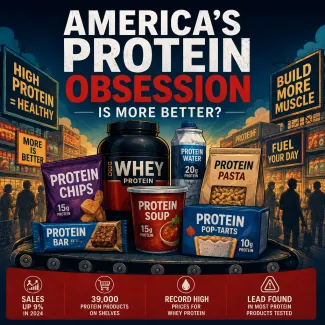
Every day, a new protein product promises a place in our daily routine. A decade ago, the norm was whey powder and bars that tasted more like spackle than food. The category has since improved in flavor and texture, but it has also leaned into marketing built on a simple, misleading equation: more protein means healthier. Companies now add protein to pasta, chips, soup, even water.
The numbers back up the trend. In 2024, U.S. protein supplement sales grew more than 9%, and protein became the nutrient consumers most often say they try to prioritize, cited by about 70% of respondents in market surveys. Many people who follow a "high protein" diet also equate "healthy food" with "good source of protein." American supermarkets now stock nearly 39,000 products marketed on their protein content, and demand has pushed the price of 80% whey protein concentrate to record highs. Even Pop-Tarts joined in; the "Protein" version has 10 grams of protein per serving, alongside 31 grams of sugar and about 380 calories—more protein, yes, but wrapped in the same sugar bomb.
This veneer of healthiness hides two separate problems. One concerns product quality; the other asks whether chasing more protein makes sense in the first place.
Protein’s Health Halo
Start with quality. Consumer Reports tested 23 dairy-based, plant-based, and beef-based protein products and found elevated levels of lead in more than two-thirds of them. Plant-based products averaged nine times as much lead as dairy-based ones. Three products also exceeded CR’s level of concern for cadmium and inorganic arsenic.
However, there is an important caveat. The investigation was not peer-reviewed, so methodological flaws cannot be ruled out. Industry groups also argue that the Prop 65 threshold is stricter than the FDA’s, inflating the share of products classified as noncompliant. Still, the findings are not inconsistent with peer-reviewed research, which has previously found undeclared stimulants, prohormones, and anabolic agents in sports supplement categories that include protein products.
But contamination distracts from the bigger question. Even if every protein product were perfectly pure, why are we so fixated on eating more of it? Protein is essential for muscle formation and maintenance, as well as the production of enzymes and antibodies, so “more is better” feels intuitive. Yet a 2026 review published in Cell Press Blue suggests the opposite might be true. Reducing protein intake, rather than increasing it, could offer a more promising path to longevity. Before getting there, it is worth asking: how did we become so convinced we needed more in the first place?
Why Do We Choose High-Protein Foods?
A 2024 Italian study tracking retail data found a 21.6% jump in sales of products labeled "High Protein" in the first three quarters of 2022 versus the same period in 2021, spanning yogurt, bars, cereal, cheese, pasta, and drinks; fresh protein desserts grew fastest, up 48.4%.
The pattern isn't limited to Italy. In the International Food Information Council's 2025 survey, 70% of Americans said they were trying to eat more protein, up from 59% in 2022. For the fifth year running, protein topped the list of nutrients people said they were trying to consume; "high protein" was the most common diet pattern, and for the first time, "good source of protein" became the top criterion people used to define a healthy food.
Interest outpaces knowledge, though. In the same survey, 35% of Americans said they had increased their protein intake over the past year, even though 53% didn't know and 26% were unsure of the recommended daily intake. 29% relied on friends and family for protein advice, compared with 25% who turned to healthcare professionals.
A study in Nutrients evaluated 36 protein-enriched processed foods, including yogurt, bars, cereal, bread, and pasta. Protein content ranged from 10% to 88%, and almost all products also carried claims such as “no added sugar” or “low carb.” Of the 139 people surveyed who used these products, 36.7% said they chose them because they considered them healthy, while only 10.8% did so based on professional advice. Yet 80.6% believed that excessive protein consumption could pose health risks.
The numbers reveal a curious gap between how important people say protein is and how they decide how much to eat. Protein has gone from being a nutrient to a health seal. Brands can charge a premium for “High Protein” labels while sugar, sodium, and saturated fat remain high or even increase.
So, do we actually need more? U.S. data don't suggest a deficiency. Based on a national sample of Americans’ diets, men aged 20 to 59 consumed an average of 97.3 grams of protein a day, and women averaged 70.2 grams, both already above the standard 0.8 g/kg baseline.
How Much Protein Do We Actually Need?
Worldwide guidance converges on roughly 0.8 g per kilogram of body weight per day for healthy adults, though needs rise with age, activity, and specific goals such as preserving muscle during weight loss. For a 60 kg adult, that's about 48 grams a day, easily covered by ordinary food without resorting to "high protein" products.
A workshop at Indiana University's School of Public Health reviewed 11 widely held claims about protein needs; the best-supported were that there is a minimum requirement for health, that higher intake helps preserve lean mass when energy is deficient, and that some sources, especially animal-based ones, offer higher-quality protein. Questions such as optimal intake per meal, timing, and the long-term effects of very high-protein diets remain far less settled than popular discourse suggests. [1]
The bottom line: for most people, ultra-processed "high protein" products aren't necessary to meet requirements, even if they're a convenient option.
Could Less Protein Be More?
A review examined how protein restriction and restriction of specific amino acids affect the biology of aging. In flies and rodents, protein restriction extends lifespan and improves markers such as adiposity, energy expenditure, and glucose handling, sometimes even when the intervention begins later in life. In aged mice, reducing protein or isoleucine intake improved frailty markers and delayed molecular signs of aging.
The evidence is less clear for mitochondria, the body's “energy factories.” Some studies show that protein restriction lowers reactive oxygen species and improves mitochondrial function, while high-protein diets have harmed skeletal muscle mitochondria in other models. The results vary too much by tissue and species to draw a clear conclusion.
Healthy aging is where the tension is sharpest. Some older adults are told to eat more protein to preserve muscle and avoid muscle wasting (sarcopenia). Observational data links higher intake to lower frailty risk. But a study of more than 3,000 British twins over 60 found that those eating above 1.3 g/kg/day had less muscle mass and more muscle wasting (the cross-sectional design prevents establishing causation). Differences in protein source and body composition may explain some of the findings.
The impact of specific amino acids remains under investigation. Methionine, isoleucine, and valine restriction reproduce several benefits of broader protein restriction in flies and mice, but human evidence is limited and mixed.
None of this proves that eating less protein extends human life. This narrative review relies mostly on animal studies, and the human evidence covers metabolic markers and short interventions, not lifespan itself. Claiming "less protein means longer life" goes well beyond what the data support, and deliberately cutting protein would be a bad idea for people with elevated needs, such as children, pregnant women, people recovering from illness, or older adults at risk of muscle loss.
Protein in Perspective
The honest answer is less exciting than the headline promises. Protein deserves its place on the plate, just not on the pedestal we’ve built for it. Protein matters, especially for preserving muscle during aging or weight loss, but it isn't a stand-alone marker of a healthy diet; a healthy diet also depends on the fiber, vitamins, minerals, and other compounds found in fruits, vegetables, legumes, and whole grains. And although protein restriction offers intriguing clues about aging, the evidence is nowhere near strong enough to prescribe eating less in pursuit of a longer life.
The larger lesson is simpler: protein is a nutrient, not a nutritional verdict. A protein-enriched cookie is still a cookie, and adding ten grams of protein doesn’t erase the sugar, sodium, saturated fat, or calories surrounding it. Perhaps the healthiest response to our protein obsession isn’t to eat more or less, but to stop treating “high protein” as another way of saying “healthy.”
[1] The workshop was funded by a variety of “protein producers,” including Danone, the National Pork Board, the American Egg Board, and Glanbia Performance Nutrition, among others, and some authors had industry ties. That doesn't invalidate the conclusions, especially given that the workshop stopped well short of declaring protein a miracle nutrient or urging everyone to eat more of it.

Mauro Proença
Mauro Proença is a nutrition graduate student with a postgraduate degree in Clinical Nutrition from the University of São Paulo (USP), Brazil.