
Sometimes science produces strange results—really strange, in fact. This is one of those times. Late last month, a paper published in the Journal of Alzheimer’s Disease detected a perplexing relationship between obesity and dementia-related mortality. The finding that these factors are associated isn’t that strange in and of itself, since our metabolic health profoundly affects our well-being in many ways. But the direction of the link certainly is: obesity appeared to protect against mortality in dementia patients. Patients who were overweight or obese at the time they developed dementia had lower risk of mortality, compared to those who were normal weight.
Perhaps even more puzzling, the result is not easily dislodged by typical criticisms of epidemiological research. It therefore offers us the opportunity to delve deeper than the headlines and pose a critical question we should always ask when examining health and science news: Do these results hold up to scrutiny?
Many behavioral-health articles that are based on survey data have deep methodological flaws, do not consider alternative explanations of their findings, and have few redeeming qualities. However, this paper is much more careful in considering—and ruling out—alternative explanations and statistical biases. This doesn’t necessarily mean the results are accurate and reliable, but they answer some questions and raise others, which after all is the goal of science.
Summary of the Study
The analysis used data from the Health and Retirement Study, a nationally-representative study that recruited adults aged 51+ starting in 1992 and followed them every two years until death. At each survey wave, comprehensive data were collected, including surveys on health behaviors and health status and validated tests of physical and cognitive functioning.
Analyses were based on adults who did not have dementia at baseline (this is important because it rules out reverse-causality from pre-existing dementia). Mortality in the subsequent years was examined as a function of obesity status (normal weight, overweight, class I obese, and class II & III obese, all based on body mass index (BMI) at the time of developing dementia, after adjusting for other major health conditions, smoking status, self-rated health, and sociodemographic characteristics. Several variations of the analysis consistently showed that those who were overweight or obese at the time they developed dementia had lower mortality (by roughly 20%).
The authors are clear that it’s not known whether this is a causal relationship, but if it is, they speculate it might occur because excess weight might protect against dementia’s effects on malnutrition and difficulty with eating.
Ruling out Alternative Explanations and Biases
The authors anticipate and address several challenges to their findings:
Higher mortality in underweight and unhealthy people. Perhaps the most obvious challenge is that if underweight people are grouped with normal-weight people, they might bias mortality upwards in the pooled group. However, the authors excluded participants who were underweight (BMI <18.5) specifically “to reduce potential confounding from underlying illness.”
Reverse causality from weight loss. A related challenge is, were people who were losing a lot of weight already suffering from a to-be-fatal condition? The authors addressed this with a follow-up analysis that further categorized people based on their weight change, not just their weight status at diagnosis:
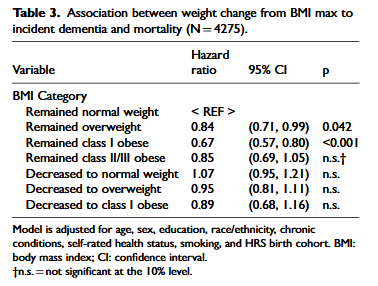
This reveals two things: (1) it confirms that mortality is (comparatively) higher among those who lost weight leading up to the onset of dementia; but (2) this does not explain away the main results, since those who remained overweight or obese still had lower mortality than those who maintained normal weight.
Collider bias. This refers to a statistical phenomenon where failing to include important confounding factors can produce a spurious inverse association. The authors address this through additional analyses that estimate how large a missing variable would have to be to make the association non-significant. It turns out a fairly strong missing association would be needed for the results to be explained away by collider bias, which the authors consider is unlikely because they included a wide range of covariates already.
This is the weakest rebuttal in my judgement since many other health behaviors could affect both obesity and mortality, including physical activity, dietary habits, substance use (beyond the crude measure of ever-smoking), sleep health, etc.
Survivor bias. If people with weight-related health conditions had already died and thus are not in the analysis, that could introduce a statistical bias that makes the surviving overweight and obese people look healthier by comparison. The authors correctly point out that if their results are primarily due to the survival-bias phenomenon, then obesity’s apparent protective effect should increase at older ages, such as was found with obesity and hip fracture. The authors tested how the effects varied by age; the apparent protective effect of being overweight or obese attenuated rather than grew with age, which goes against the characteristic pattern of survival bias. This means survival bias cannot explain away these results: survival bias makes the protective effect look stronger at older ages, but this study found the protective effect was restricted to (comparatively) younger participants.
Confounding by interaction with medical system. While not addressed in the article, another challenge that occurred to me was whether there was a systematic bias based on who was diagnosed with dementia. For example, if overweight and obese people were already receiving medical treatment for weight-related conditions, their dementia may have been caught sooner, whereas for normal-weight people it may have gone unnoticed until a later stage. However, this is a moot point because the dementia outcome did not depend on a doctor’s diagnosis; it was assessed using standardized cognitive tasks as part of the survey.
Remaining Questions and Issues
The many follow-up analyses the authors did show that, whether causal or not, there is a fairly robust relationship between overweight/obesity and lower mortality among dementia patients. The following topics were not addressed by the authors but would be informative for further understanding their results:
Is there a dose-response relationship? A dose-response relationship is one of the Bradford Hill criteria for causality. In this case, there does not appear to be a “clean” dose-response relationship: the overweight, class I obese, and class II & III obese groups had 16%, 27%, and 22% lower hazard rates, respectively. In other words, more weight is not associated with proportionally lower mortality risk. This is usually more indicative of confounding rather than causality, though there could be competing effects (e.g. other health conditions from being severely obese that independently increase mortality).
What about people who gained weight? In the follow-up analysis on changes in weight, only people who stayed in the same weight category or decreased to a lower weight category were analyzed (as the purpose of this analysis was to rule out reverse-causality by weight loss). However, this means that increases in weight category were not analyzed, but this could be another way of evaluating the dose-response question.
The Verdict
The findings that people who are overweight or obese when they develop dementia have a lower mortality risk is robust across different analyses. The researchers did their due diligence in testing several common statistical and methodological issues and showing that none of them explain away their main findings. However, it’s unclear whether this is a causal relationship.
The authors’ interpretation is important, too. They note that the mechanisms are not known and could include causal and non-causal relationships simultaneously. They also explicitly caution against taking any action based on these results, e.g.: “This does not imply that patients with dementia who are normal weight should, therefore, attempt to become overweight or obese, as we cannot definitively conclude that higher weight status is the cause.” Not to mention, even if obesity is protective against mortality in cases of dementia, there are lots of other risks from obesity.
The researchers instead point to implications about prognosis for people with dementia: “But it does serve as a signal, and weight status at incident dementia is potentially useful as one of several prognostic indicators of survival.” This is an appropriate implication that does not exaggerate the evidence: for the authors’ stated purpose, it doesn’t matter whether it’s a “real” or a causal association—a signal is a signal and if obesity is robustly predictive of mortality, it’s reasonable to use it for prognostic purposes.

Arielle Selya
Arielle Selya, PhD, is a behavioral scientist whose work focuses on nicotine use, tobacco harm reduction, and the analysis of population-level trends. She earned her doctorate in neuroscience from Rutgers University and has published 85 peer-reviewed papers.