
As McKinsey's analysis points out, we can readily see that our discretionary spending has dropped 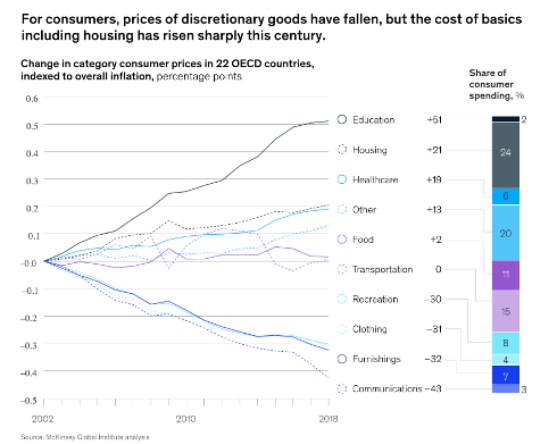 while the cost of necessities has risen – healthcare, housing, and education. In terms of "keeping up," if your measure is status symbols, costs have dropped. It seems like we can all have the newest and best cellphone, shirt, or pants. But if we measure by our ability to achieve more, through education or to be well, as measured by healthcare costs, then more and more of us may be falling behind.
One step, I suppose, to a more equitable society is to flip that script, bringing down the cost of essentials and making a 40-hour workweek sufficient to support oneself and your family.
Source: The cost of basic necessities rose much faster than inflation this century

Chuck Dinerstein, MD, MBA
Director of Medicine
Charles Dinerstein, MD, MBA, is the Medical Director of the American Council on Science and Health. A vascular surgeon with more than 25 years of clinical experience, he brings a physician's understanding of medical decision-making, an appreciation for scientific uncertainty, and a broader perspective on healthcare economics and policy to his writing.